Search across updates, events, members, and blog posts

Rocks → Gold → Paper → Fiat → ∞ Print → Bitcoin → AI?
By Federico Ulfo

Before money, every transaction was a negotiation. Humanity spent millennia searching for something — anything — that could reliably store value. Most attempts failed.
Every transaction was a negotiation, and most of them failed. You had grain; I had cattle. Unless I wanted grain and you wanted cattle at the exact same moment, no deal. Economists call this the double coincidence of wants. Everyone else just called it life. There was no unit of account, no way to save for the future, no way to trade with a stranger two valleys over. This single friction — the absence of money — capped the complexity of human civilization for thousands of years. We could build villages but not cities. We could feed families but not armies. Money wasn't invented because someone had a clever idea. It was invented because without it, we were stuck.
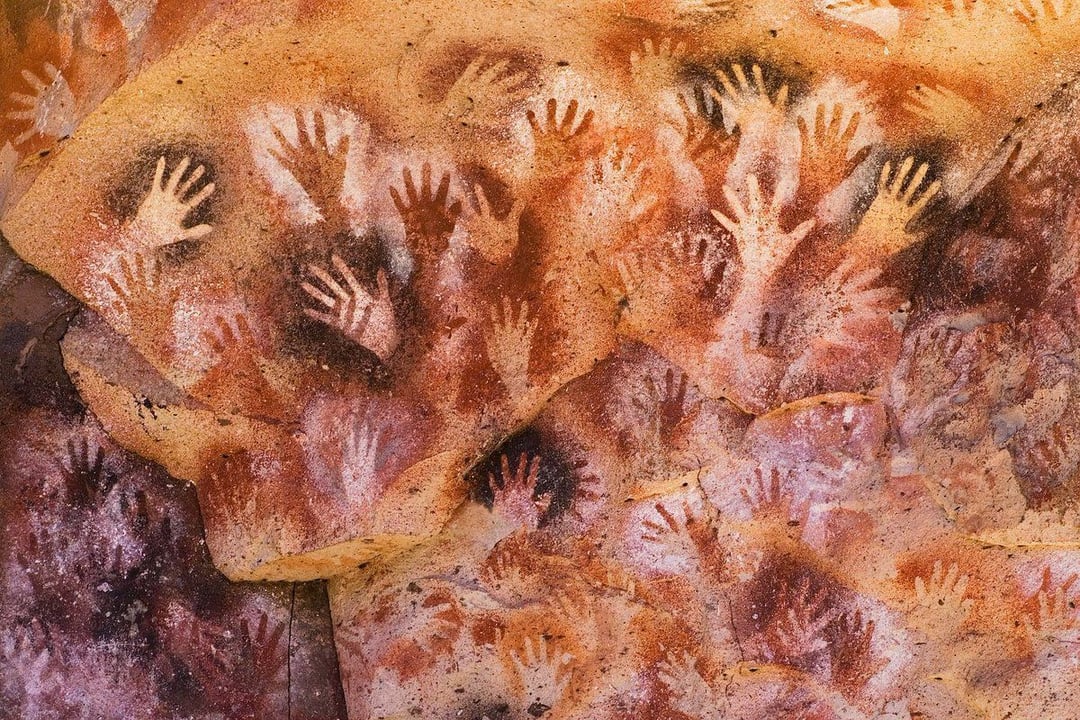
~5M humans. No civilizations yet — scattered proto-settlements.

Here is the most underrated monetary innovation in history, and it happened on a tiny island in Micronesia. The people of Yap used massive limestone discs — some over 12 feet across — as money. Each stone was quarried 250 miles away in Palau and hauled back by canoe. Men died making the trip. That was the point: the value of each stone was the labor and risk embedded in it. A proof-of-work token, thousands of years before Satoshi. But the truly radical part wasn't the stones — it was the ledger. Most were too heavy to move, so ownership was tracked by oral consensus. Everyone simply knew who owned which stone. One famous disc sank to the ocean floor during transport and kept circulating as currency, because the community still agreed on who owned it. Money that doesn't need to move. A shared record maintained by social consensus rather than a central authority. Sound familiar?

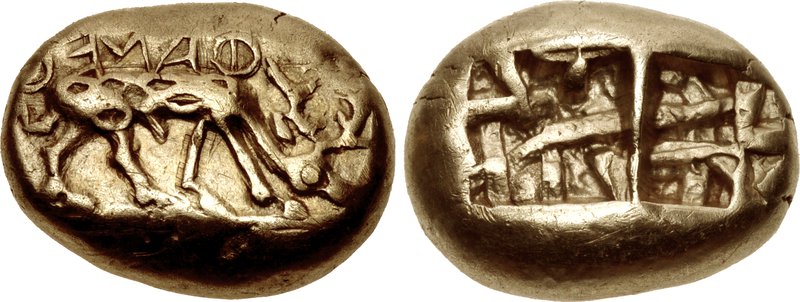
This is where money becomes money. In the Kingdom of Lydia — modern-day western Turkey — King Alyattes stamps a lion's head onto small discs of electrum, a natural gold-silver alloy from the Pactolus River. The royal seal guarantees weight and purity. For the first time in human history, you can hand a stranger a piece of metal and both of you know exactly what it's worth. No weighing. No haggling over quality. No trust required. The idea is so obviously superior that it spreads like a virus. Within a generation, Greek city-states, Persia, and India are all minting their own coins. Commerce explodes. Markets emerge. Trade routes stretch across continents. Standardized coinage doesn't just simplify trade — it makes civilization at scale possible. Every empire that follows will be built on coins. And every empire that falls will fall, in part, by debasing them.

The Roman denarius started at 98% pure silver. It ended as a bronze slug with a silver wash. The decline took centuries, but the playbook was established in the first act. When Rome's military ambitions outgrew its treasury, emperors discovered the oldest trick in monetary history: stamp the same face value on a coin with less metal in it. Under Nero, silver content dropped to 94%. Under Septimius Severus, 50%. By Diocletian, less than 5%. Prices rose 1,000% in a century. Soldiers refused to accept the coins and demanded gold or goods. Trade in the provinces collapsed back to barter. The barbarians didn't destroy Rome. Rome destroyed Rome — one diluted coin at a time. Every empire since has repeated this exact pattern. Not one has learned from it.

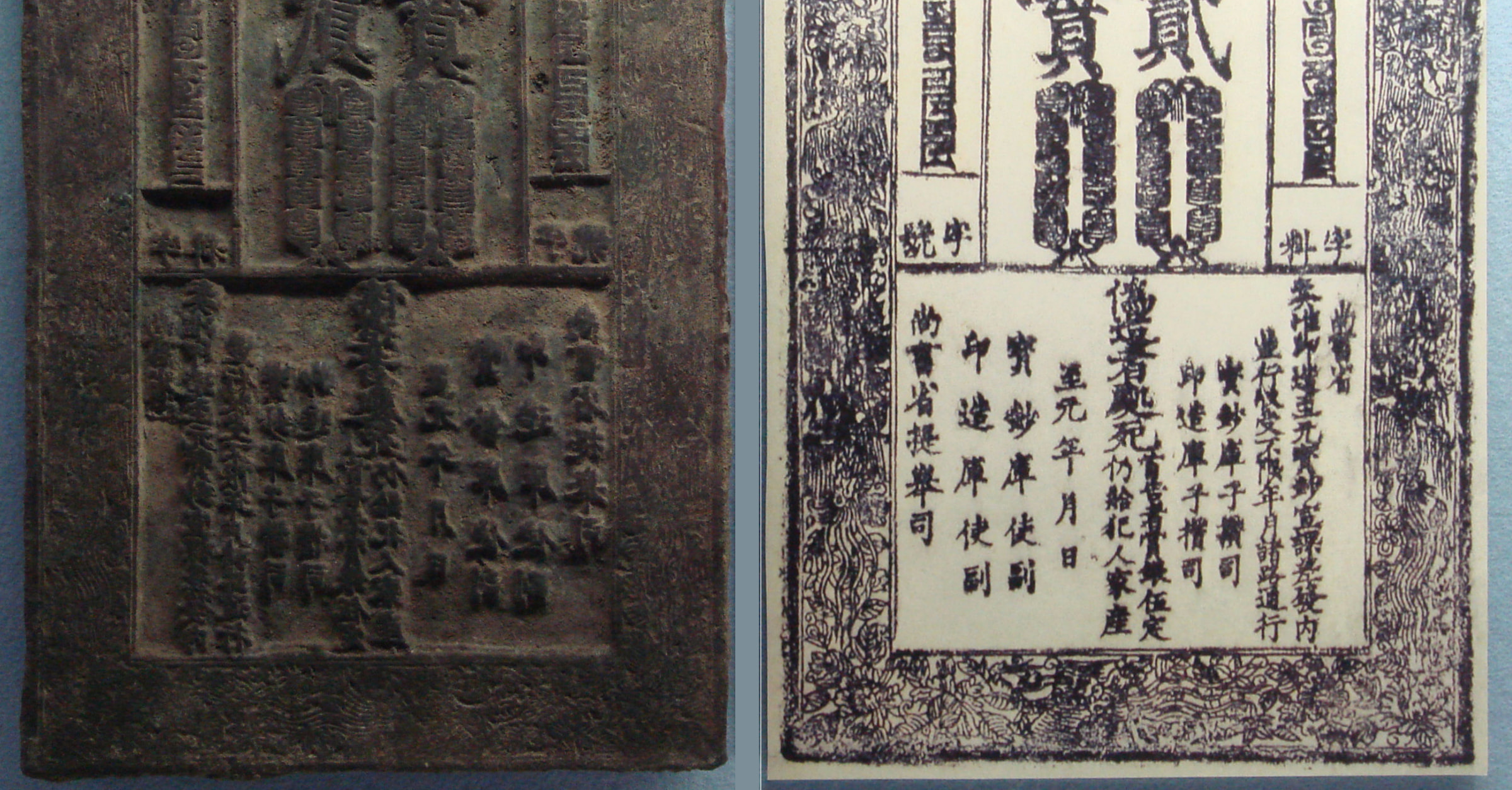
The printing press is easy to start and impossible to stop. China proved it first. The Song Dynasty invents jiaozi — the world's first government-issued paper currency. Merchants in Sichuan, sick of hauling heavy iron coins, begin using paper certificates backed by deposits at trustworthy shops. The government takes over issuance, backs each note with iron and silver reserves, and for a while it works brilliantly. Paper money lubricates the most advanced economy on Earth. Then the temptation sets in. Successive dynasties print more notes than reserves can back. The Yuan Dynasty floods the economy with unbacked paper to fund wars and public works. Hyperinflation follows. By the Ming Dynasty, paper money is abandoned entirely, and China returns to silver and copper coins for three hundred years. The whole arc — innovation, adoption, abuse, collapse — plays out a millennium before the Federal Reserve exists. The lesson couldn't be clearer. Nobody learns it.
~5M humans. No civilizations yet — scattered proto-settlements.

Gold imposed discipline. Nations tied their currencies to a metal they couldn't print, and for a while the system held. The constraint was the point.
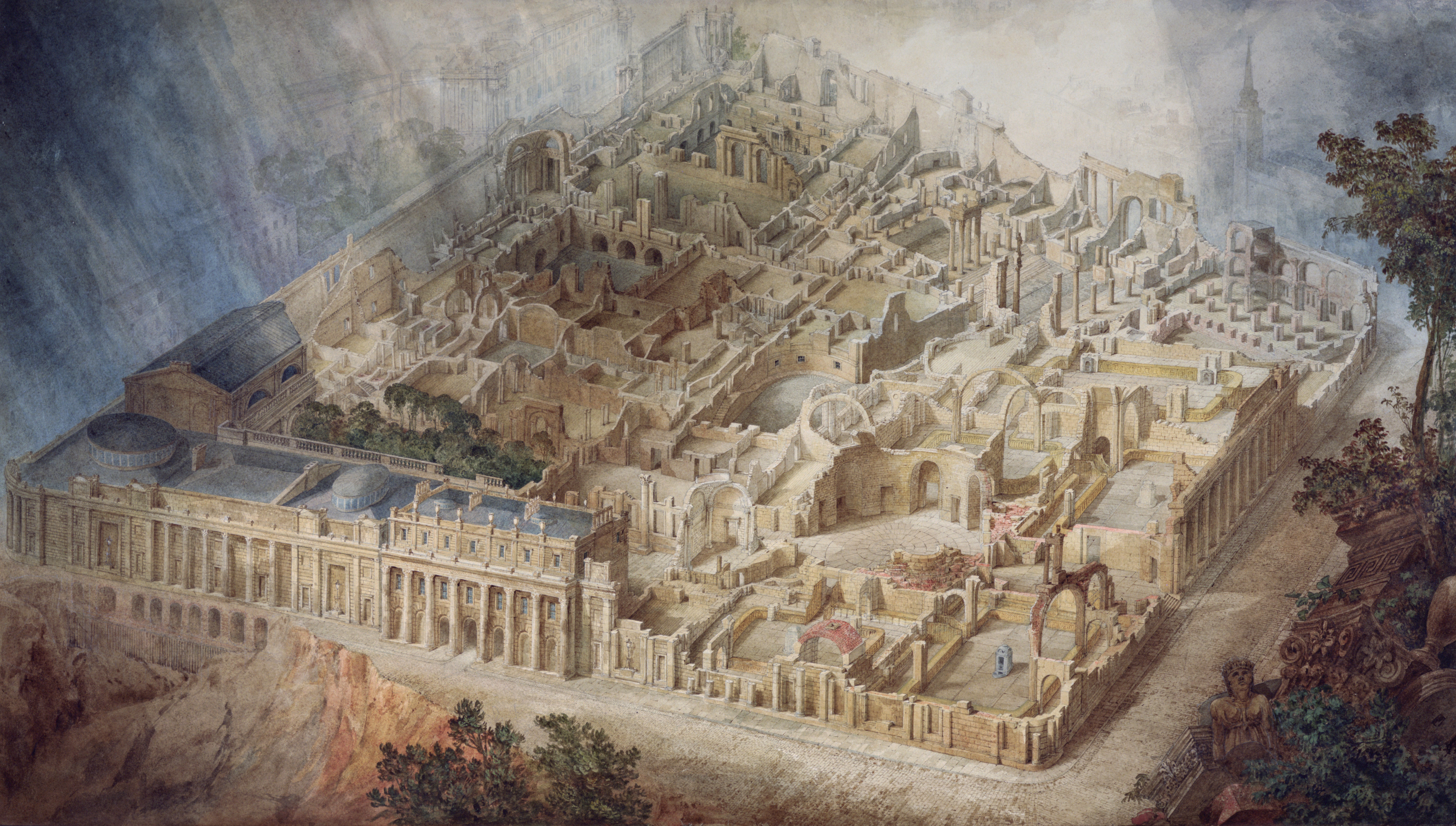
The Bank of England was not founded to serve the public. It was founded to fund a war. King William III needs money to fight France. A group of wealthy merchants offers a deal: lend the government £1.2 million at 8% interest, and in return receive a royal charter to operate as a bank that can issue notes against that debt. Done. The innovation buried inside this arrangement is radical: government debt as the foundation of money creation. The bank's notes circulate as currency, backed not by gold in a vault but by the government's promise to repay. Other nations watch, take notes, and copy the model. Within two centuries, every major economy has a central bank. What was once a wartime expedient — the marriage of sovereign debt and money creation — becomes the permanent architecture of global finance. Nobody ever votes on this. It just becomes the way things work.

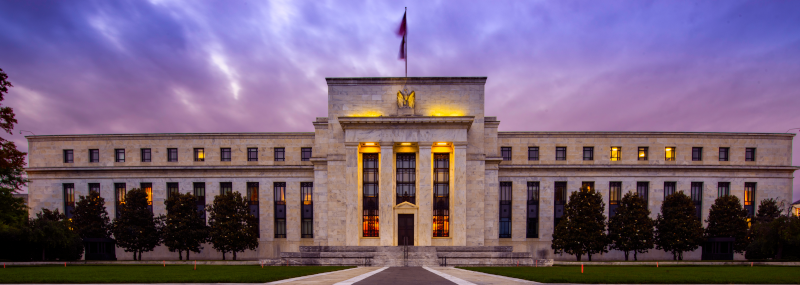
They passed it the week before Christmas, in a late-night session, after a series of banking panics scared Congress into action. The Federal Reserve Act of 1913 creates America's central bank — a lender of last resort, designed to smooth out bank runs and stabilize the currency. The dollar stays gold-backed at $20.67 per ounce. On paper, nothing changes. In practice, everything does. The Fed can now expand credit, set interest rates, and buy government bonds. These powers seem modest in 1913. They will reshape the entire global economy over the next century. A dollar in 1913 buys what $32 buys in 2024. The erosion starts slow. It never stops.
CPI baseline: 1982-84 = 100. A dollar in 1913 = ~$32 in 2024. ~80% of all gold would be mined after this date.

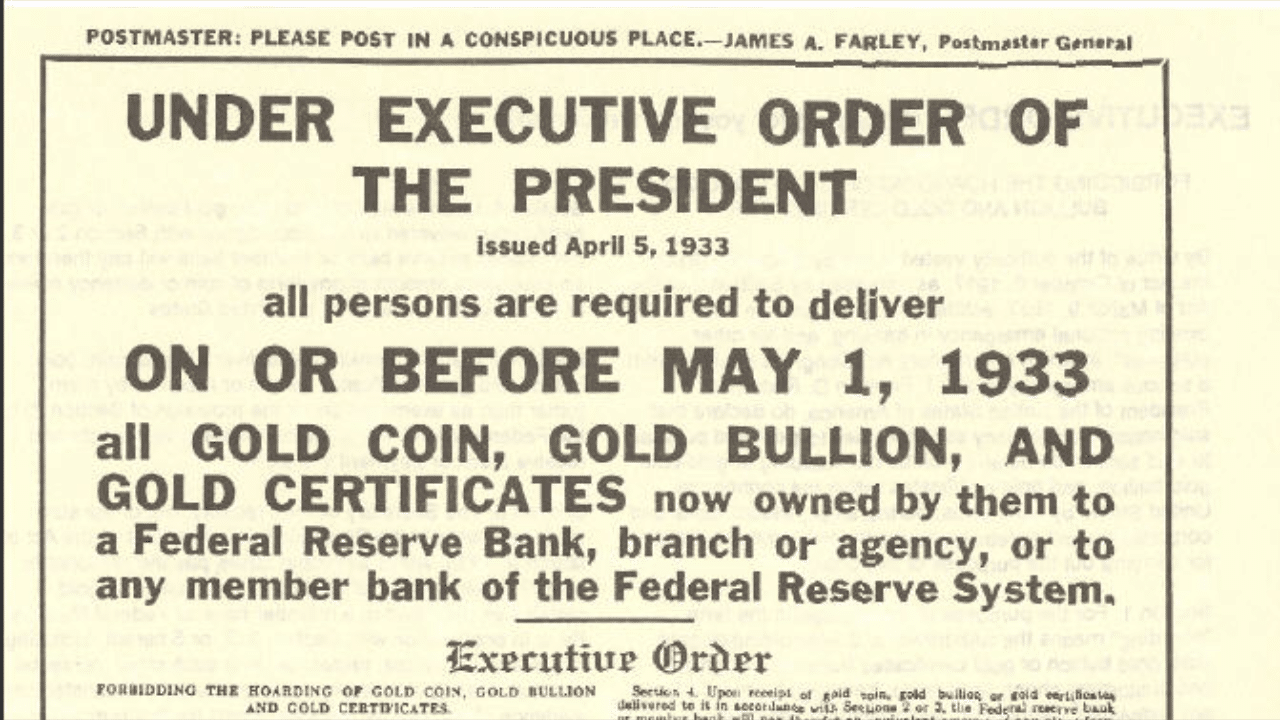
Read this twice: the President of the United States makes it illegal for Americans to own gold. Executive Order 6102, signed in the depths of the Great Depression, requires every citizen to surrender their gold to the Federal Reserve at $20.67 per ounce. The penalty for keeping it: a $10,000 fine and up to ten years in prison. Once the government has the gold, it passes the Gold Reserve Act of 1934, revaluing gold to $35 per ounce — a 69% overnight increase. The government profits. Every dollar in circulation is instantly devalued by 41%. It is the largest wealth transfer in American history to that point, executed by executive decree. No vote. No debate. Just a signature. When governments control money, they will change the rules to suit themselves. Especially in a crisis. Especially when no one can stop them.
Gold Reserve Act of 1934 formalized the $35 price. US holds ~20,000 tonnes of gold reserves.

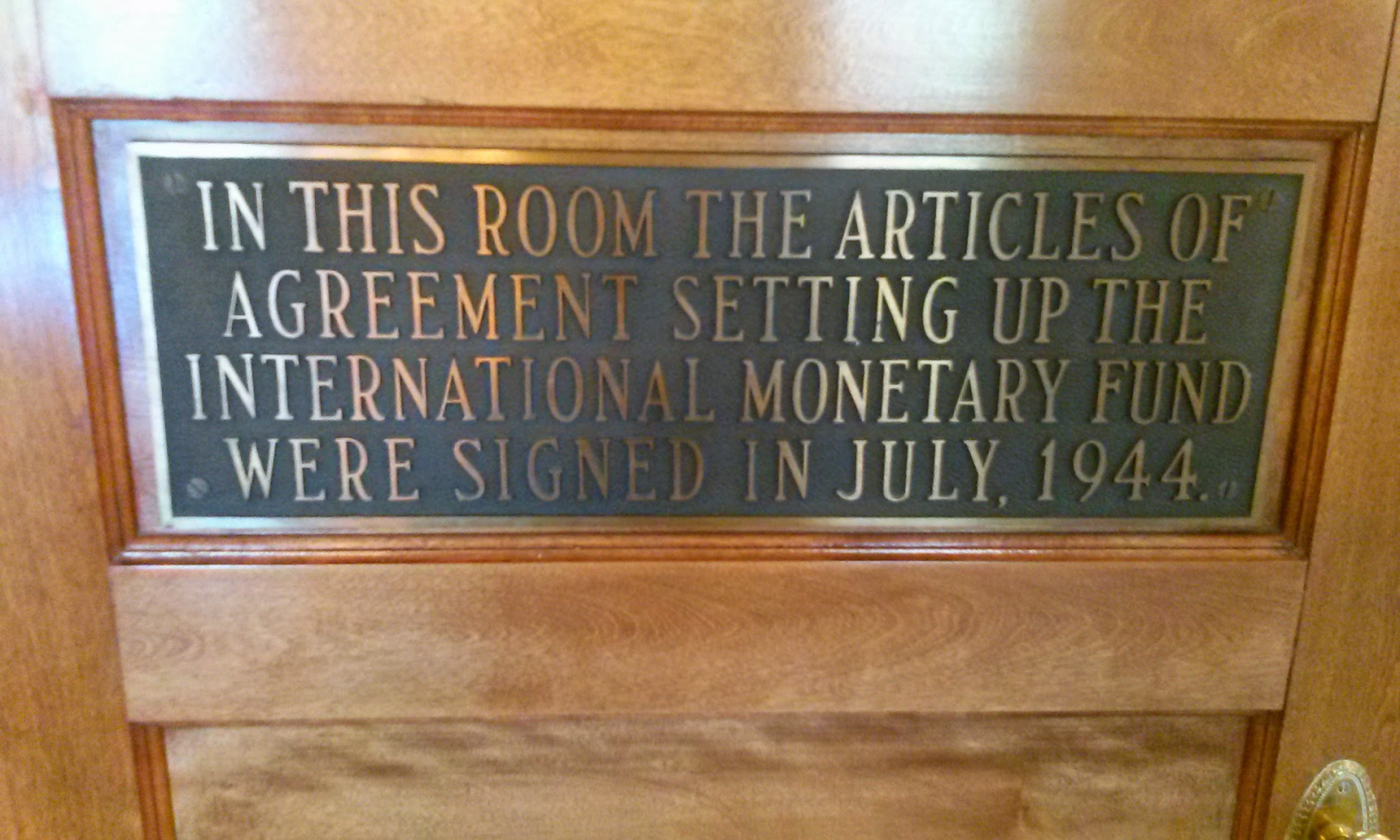
Forty-four nations gather at a hotel in New Hampshire to decide how money will work after the war. The deal they strike is breathtakingly simple: every currency pegs to the dollar. The dollar pegs to gold at $35 per ounce. America, holding two-thirds of the world's monetary gold, becomes the anchor of global finance. It's an elegant system with one fatal assumption baked in — that the United States will maintain fiscal discipline. That every future president and every future Congress will resist the temptation to spend more than the gold reserves can back. Every country on Earth is now betting on American restraint. The bet will last exactly 27 years.
WWII peak spending. Debt/GDP would hit 113% by 1945. World monetary gold stocks ~22,000 tonnes.

Then they cut the cord. Once money was no longer tethered to anything real, the printing never stopped — and neither did the erosion of everything priced in it.

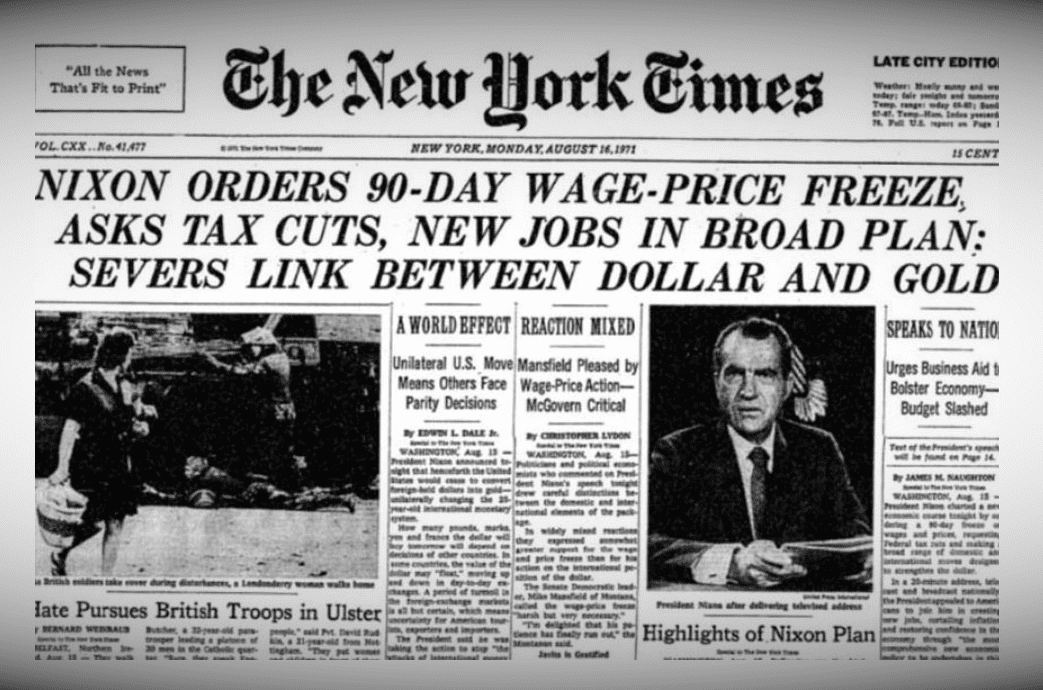
Sunday evening. Live television. The President of the United States tells the world that the dollar will no longer be convertible to gold. He calls it temporary. It's been 55 years. The backstory is straightforward: France, under de Gaulle, had been calling America's bluff — exchanging dollars for gold at an accelerating rate, draining Fort Knox. Rather than stop spending, Nixon simply changes the rules. Overnight, the dollar — and by extension every currency pegged to it — becomes pure fiat. Backed by nothing but trust in the U.S. government and its willingness to tax, borrow, and if necessary, compel. There is no longer any physical constraint on how much money can be created. None. This is the most consequential monetary decision of the 20th century, and it was made by one man on a Sunday. Everything that follows — the inflation, the debt, the bubbles, the inequality — traces back to this moment.
The starting line. Everything after this is measured against 1971 purchasing power.

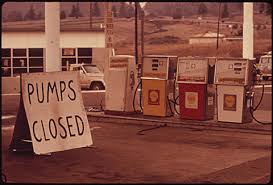
Four years. That's how long the fiat experiment lasts before the cracks show. OPEC imposes an oil embargo in retaliation for U.S. support of Israel in the Yom Kippur War, quadrupling oil prices overnight. But oil is the trigger, not the cause. The deeper problem is that the dollar, now untethered from gold, has no defense against inflation. What follows baffles the economics profession: prices soar while growth stalls and unemployment rises. Stagflation. Their models said it couldn't happen. It's happening. On January 1, 1975, Americans are allowed to own gold again for the first time since FDR confiscated it. The price has already risen 220% since the Nixon Shock. People aren't buying gold because they love the metal. They're buying it because they no longer trust the paper.
Americans allowed to own gold again (Jan 1975). Gold up 220% since Nixon shock.

Gold at $850. Inflation at 14.8%. The dollar in free fall. Nine years after Nixon cut the gold cord, the consequences are undeniable. Enter Paul Volcker, the new Fed Chairman, who makes the most painful bet in monetary history: he jacks the federal funds rate to 20%. Twenty percent. Mortgages become unaffordable overnight. Businesses fail. Unemployment hits 10.8% — the worst since the Depression. Volcker doesn't blink. And it works. Inflation breaks. The lesson is brutal and simple: once you unleash inflation with easy money, the only cure is to inflict enough economic pain to break it. There is no gentle path back. Volcker is later called the greatest central banker of the modern era. What no one asks is why the cure was necessary in the first place.
Gas 3.3x since 1971. Homes 2.5x. Eggs 1.6x. Real income barely moved.

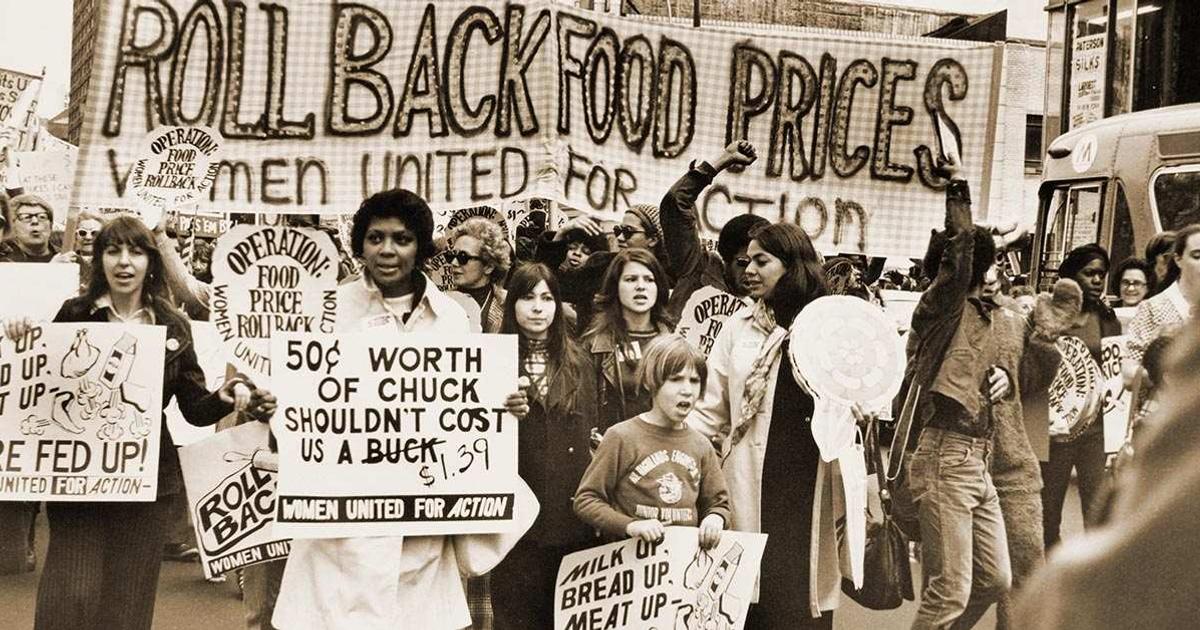
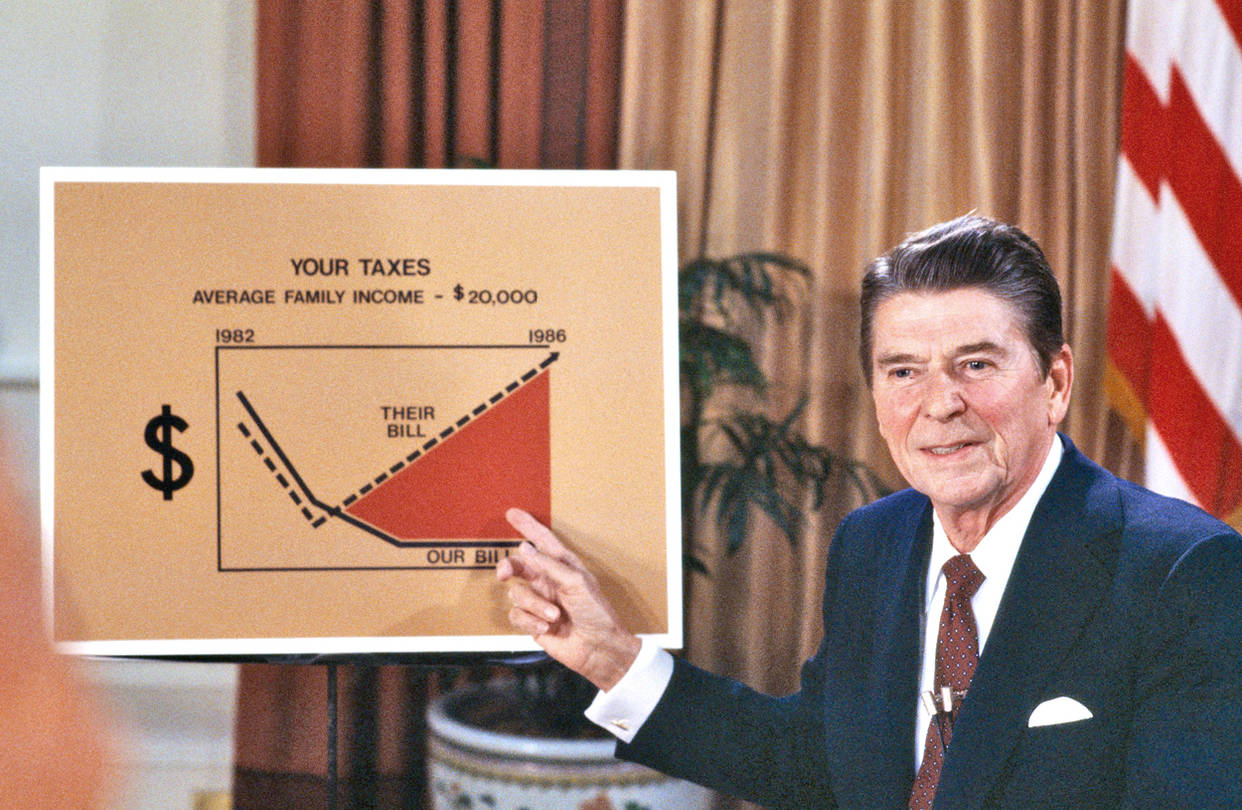
Privatize the gains. Socialize the losses. The pattern that will define the next 35 years of American finance is established right here. The Reagan era promised that tax cuts would pay for themselves through growth. They didn't. Combined with massive Cold War military spending, the national debt triples from $900 billion to $3.2 trillion in a single decade. Then comes the Savings & Loan crisis: over 1,000 institutions fail after reckless real estate speculation, and taxpayers foot a $132 billion bailout bill. When bets pay off, profits go to shareholders and executives. When they blow up, the public picks up the tab. Notice who never gets bailed out: college tuition is already 3.6x its 1971 price. Rent is 4.1x. Real income has risen only 25% in two decades. The people printing the money aren't the ones losing purchasing power.
College tuition 3.6x since 1971. Rent 4.1x. Real income up only 25% in 20 years.

NASDAQ 5,048. Companies with no revenue, no business model, and no path to profitability are worth billions. When the bubble bursts, $5 trillion in market value evaporates in months. What does the Fed do? The same thing it always does. Greenspan slashes interest rates from 6.5% to 1% — the lowest in 40 years. Cheap money floods the economy, but it doesn't flow into productive investment. It pours into housing. The seeds of the 2008 catastrophe are planted right here, in the Fed's response to the last catastrophe. Meanwhile, gold languishes near $279 — its lowest price in 20 years. Nobody thinks they need a hedge against monetary recklessness. Nobody thinks the system is fragile. Real median household income peaks here and won't recover for 15 years. But no one notices because their house keeps going up.
Gold near 20-year low. Real income peaked here and wouldn't recover for 15+ years.

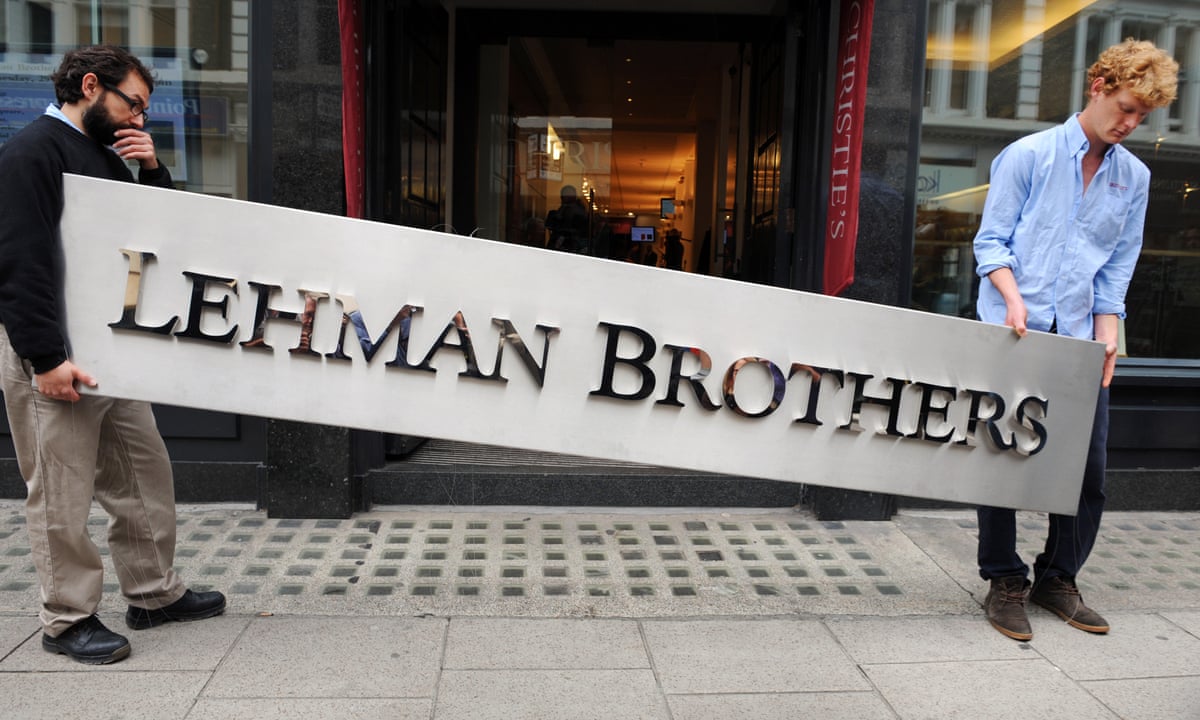
A 158-year-old bank files for bankruptcy on a Monday morning. $639 billion in assets, gone by lunch. The global financial system enters cardiac arrest. Credit markets freeze. Banks stop lending to each other. The stock market loses $10 trillion in weeks. And then — the reveal. Congress passes a $700 billion bailout for the same banks whose reckless mortgage-backed securities created the crisis. AIG gets $182 billion. Citigroup gets $476 billion in loan guarantees. The people who built the bomb get paid to clean up the rubble. Ordinary Americans lose their homes, their jobs, their retirement savings. No senior bank executive goes to prison. Not one. Real income in 2008 is lower than it was in 2000 — a lost decade for working people while Wall Street posts record bonuses. Trust in institutions doesn't just fall. It shatters. Three years later, Occupy Wall Street will fill Zuccotti Park in Lower Manhattan — thousands of people sleeping in tents across from the very banks that got bailed out, demanding accountability that never comes. The protests spread to 900 cities worldwide. Nothing changes. The system absorbs the anger and moves on. And six weeks after Lehman, someone publishes a whitepaper.
Real income lower than 2000 — a lost decade. M2 about to explode with QE.

Out of the 2008 wreckage, someone built money that no government, no bank, no committee can debase. The rules are in the code, and the code doesn't negotiate.

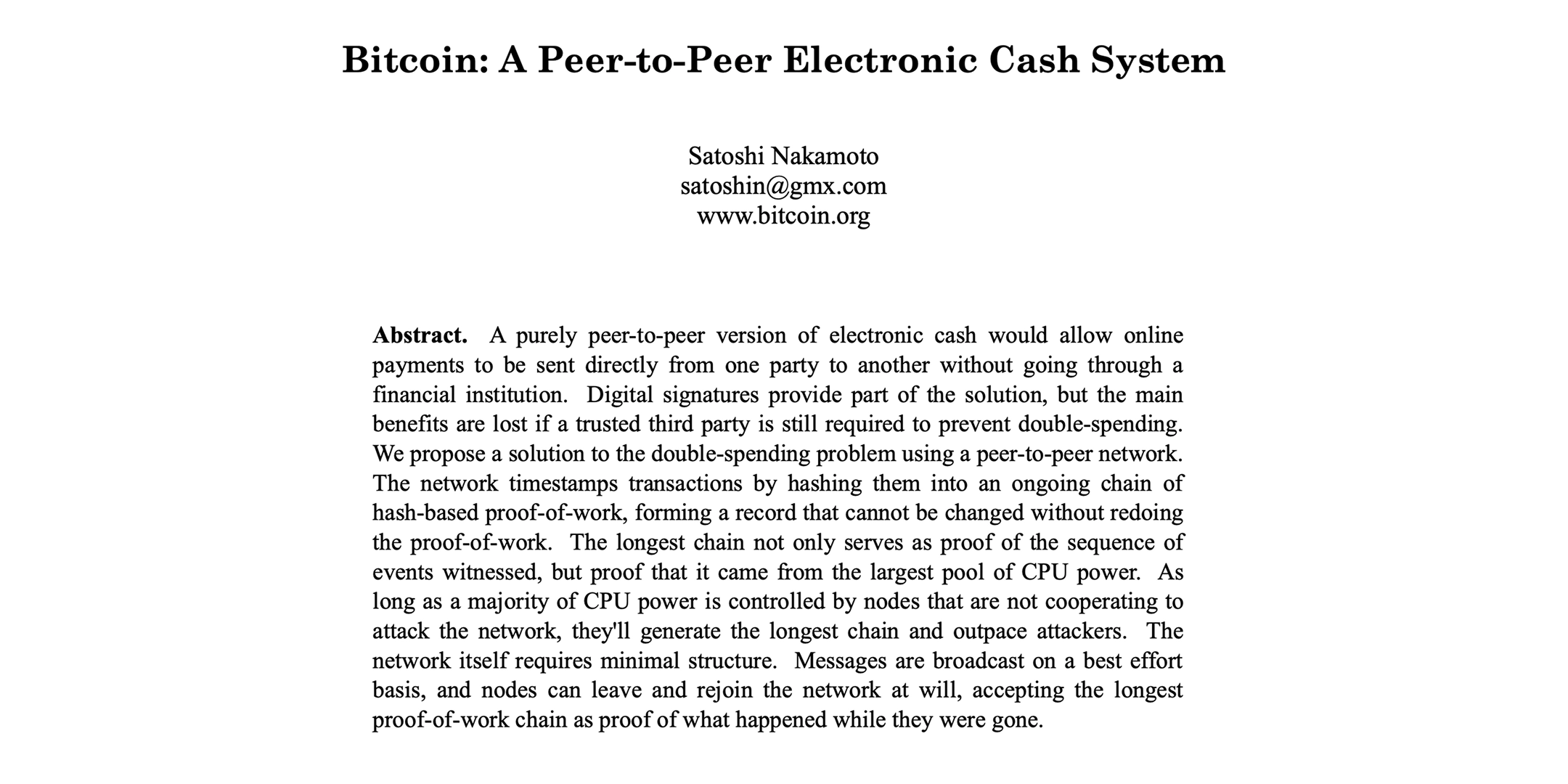
Six weeks after Lehman. Not a coincidence. A pseudonymous programmer named Satoshi Nakamoto posts nine pages to a cryptography mailing list. The title is dry, almost academic: 'Bitcoin: A Peer-to-Peer Electronic Cash System.' The content is anything but. The paper proposes something that the entire field of computer science had considered impossible: digital money that requires no trusted third party. No bank. No government. No central authority. Instead, a network of computers validates transactions through proof-of-work and records them on a public, immutable ledger. The supply is capped at 21 million coins — not approximately, not subject to review, not adjustable by committee. Twenty-one million. Forever. In a world where central banks just printed trillions to bail out the institutions that caused the crisis, someone builds money that can never be debased. Nobody knows who. Nobody needs to.
Published 6 weeks after Lehman. Not a coincidence.

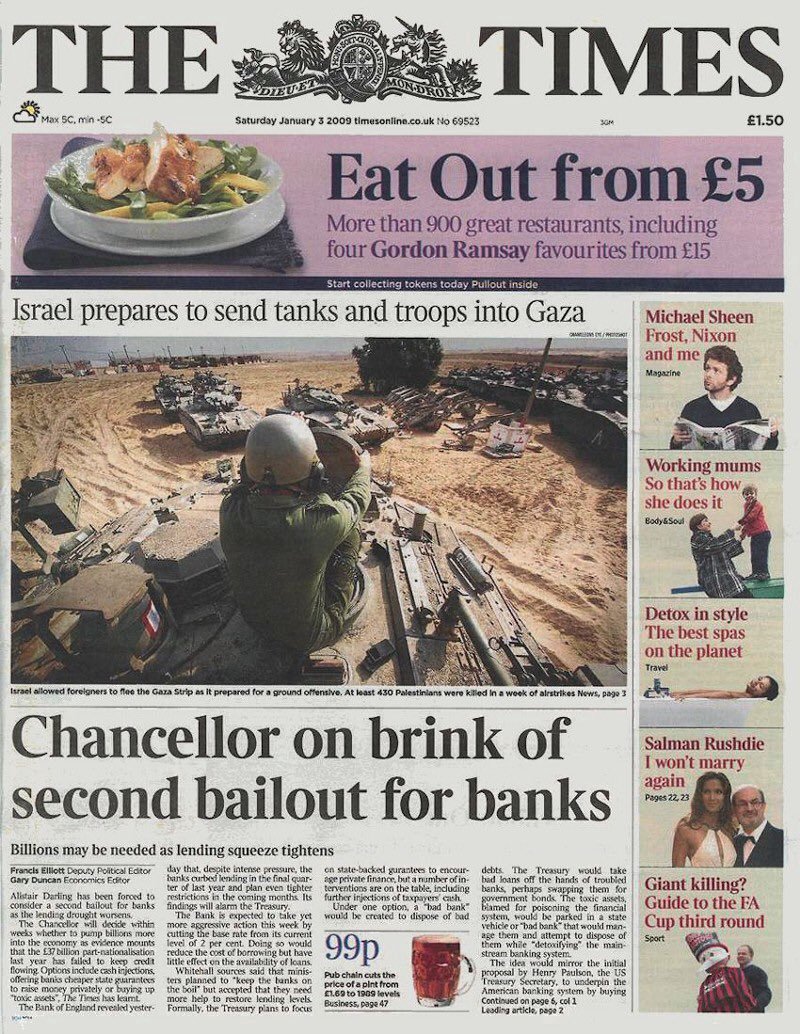
'The Times 03/Jan/2009 Chancellor on brink of second bailout for banks.' That headline — from the front page of that day's London Times — is embedded permanently in the first Bitcoin block ever mined. It's not metadata. It's a manifesto. Satoshi Nakamoto doesn't just timestamp the Genesis Block. He inscribes the reason Bitcoin exists into the foundation of the protocol itself: money built in direct response to institutional failure. The block reward is 50 BTC. The network has one node. One miner. One computer running code that almost nobody has read. The total value of every bitcoin in existence is zero. No one knows who Satoshi is. No one knows this will grow into a trillion-dollar asset class. The banks getting their second bailout certainly don't.
GDP contracts. Debt jumps $1.9T in one year. QE1 begins.

No committee met. No vote was held. No central banker made a judgment call. At block 210,000, the code simply executes: the block reward drops from 50 BTC to 25 BTC, exactly as Satoshi specified four years earlier. This has never happened before in the history of money — a pre-programmed, immutable, automatic reduction in the rate of new supply. Bitcoin's inflation rate is cut in half. Not because someone decided it should be, but because the rules said it would be. At the time, BTC trades at $12.35. Within a year it will reach $1,000. The halving is Bitcoin's most elegant feature: monetary policy that no human can override, enforced by mathematics and distributed consensus. Try getting the Fed to commit to anything four years in advance.
BTC ~$12 at halving. Would hit $1,000 within a year.

Not your keys, not your coins. The community learns this the hard way. Mt. Gox — once handling over 70% of all Bitcoin transactions on Earth — reveals that 850,000 BTC have been stolen. $450 million at the time. Over $75 billion at 2024 prices. Gone. The exchange had been insolvent for years, its database quietly drained by hackers while management covered up the losses. The irony is devastating: Bitcoin was designed to eliminate trusted third parties, and its users had been trusting an exchange exactly like a bank. Same counterparty risk. Same opaque books. Same outcome. But the disaster teaches the community something banks never could — that true ownership means holding your own private keys. Hardware wallets, multisig setups, and the philosophical conviction that if you can't verify it yourself, you don't own it. Mt. Gox is Bitcoin's best argument for Bitcoin.
850,000 BTC lost = ~$450M at the time, ~$75B at 2024 prices.

A 21-year-old Russian-Canadian programmer ships the most ambitious thing in crypto since Bitcoin itself. Vitalik Buterin's Ethereum isn't just another cryptocurrency — it's a programmable computer that happens to run on a blockchain. Where Bitcoin is programmable money, Ethereum is a programmable everything. Smart contracts, tokens, decentralized applications — all running on a global, censorship-resistant platform. It launches at $0.75 per ETH. The implications take years to unfold, but the thesis is immediate: if Bitcoin separates money from the state, Ethereum separates finance from Wall Street. Lending, borrowing, trading, insurance, derivatives — all rebuilt as autonomous code that runs without intermediaries, without permission, without closing hours. Within two years, the ICO boom will raise billions on Ethereum and crash spectacularly. The underlying innovation — trustless, composable financial primitives — will survive the crash and prove transformative.
ETH launches at ~$0.75. Within 2 years, the ICO boom would raise billions on Ethereum — and crash spectacularly.
Block reward drops from 25 to 12.5 BTC. Bitcoin is $650 at the halving — dismissed by mainstream finance as a dead experiment after Mt. Gox and a two-year bear market. The supply squeeze is invisible to most. Within 18 months, BTC will hit $19,783. The halving cycle thesis — that each supply reduction catalyzes a multi-year bull run — is forming, but only a handful of analysts are paying attention. The rest of the market is still arguing about whether Bitcoin is a Ponzi scheme.
Block reward: 25 → 12.5 BTC. Price at halving: ~$650. 18 months later: $19,783.

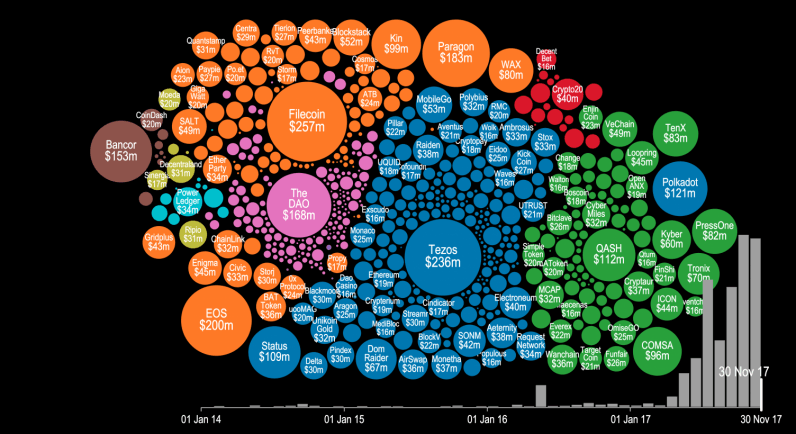
Send ETH to a smart contract. Receive tokens. No accredited investor requirements, no investment bankers, no SEC filing. The Initial Coin Offering democratizes fundraising overnight — and, predictably, the results are chaotic. In 2017 alone, over $5.6 billion pours into ICOs. The vast majority are scams, vaporware, or well-intentioned projects that will never ship. Regulators scramble. The SEC begins enforcement actions. The press writes the obituary for crypto. Again. But underneath the froth, something real has happened: programmable money has disintermediated venture capital. The mechanism — open, permissionless, global fundraising — is sound even when most of its early applications aren't. And the infrastructure built during the frenzy — wallets, exchanges, token standards, DEXs — becomes the foundation for everything that comes next.
Over $5.6B raised via ICOs in 2017. SEC begins crackdowns. The term "utility token" enters the lexicon.

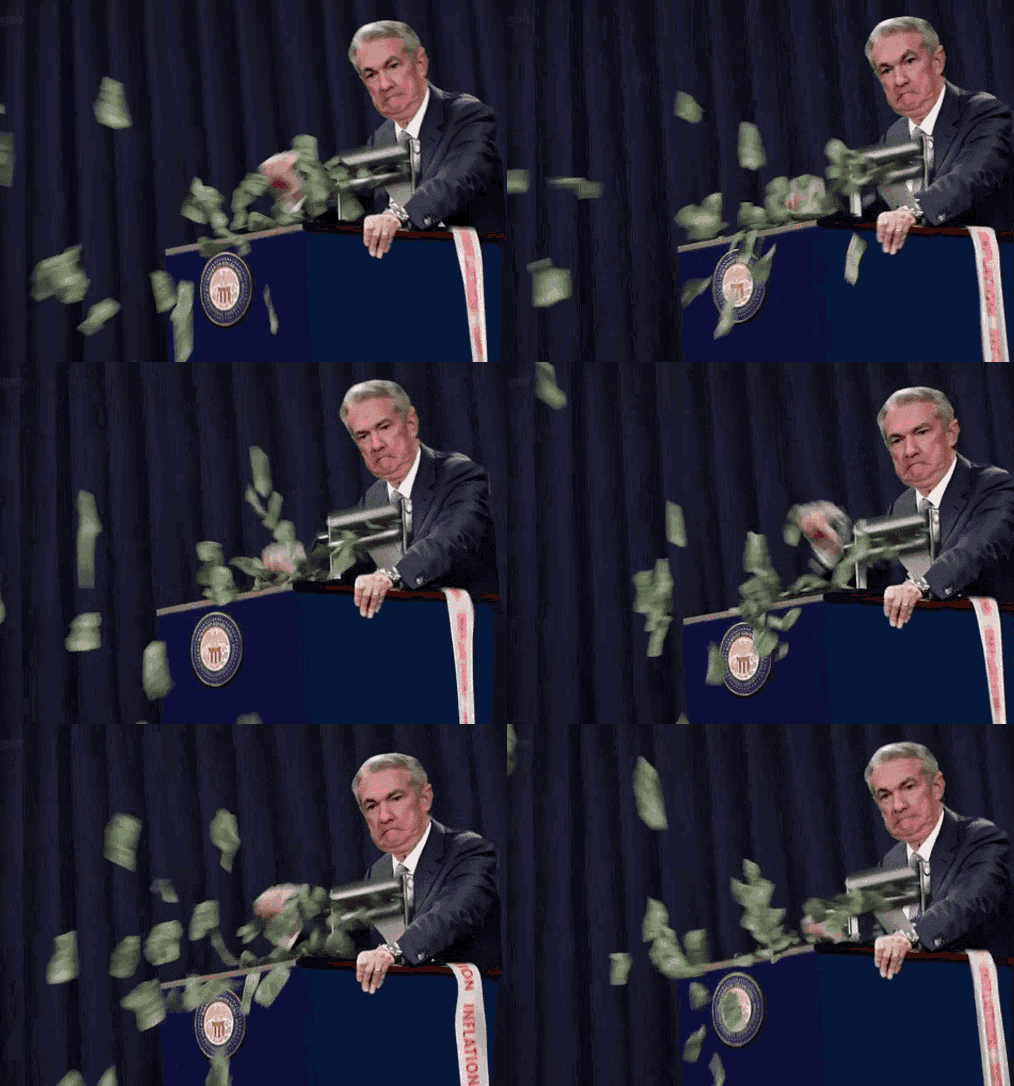
The strongest argument for Bitcoin isn't in a whitepaper. It's in the Fed's own balance sheet. When COVID-19 triggers a global lockdown, every asset class crashes simultaneously. Bitcoin drops 50% to $3,800 in a single day. Then the Federal Reserve does what it always does — only this time, at a scale that makes every prior intervention look quaint. M2 money supply jumps from $15.3 trillion to $19.1 trillion in nine months. That's a 25% increase. More dollars created in nine months than existed in the entire economy before the year 2000. Congress adds trillions in fiscal stimulus. Debt-to-GDP leaps from 107% to 132%. And then the predictable happens: anything scarce reprices against the flood of new money. Housing. Stocks. Crypto. Bitcoin goes from $3,800 in March to $29,000 by December. The printer goes brrr. The chart goes up. The purchasing power of your savings goes down. As designed.

Debt/GDP jumps from 107% to 132%. M2 up $3.8T in months. Homes 12x since 1971. Rent 10x. The strongest case for Bitcoin writes itself.
Block reward drops from 12.5 to 6.25 BTC. This halving lands in the middle of the greatest money-printing event in history. The Fed has just expanded M2 by $3.8 trillion in months. Congress is writing stimulus checks. And Bitcoin's supply issuance just got cut in half. The contrast is almost too perfect: one system creates money without limit, the other enforces scarcity through code. BTC is ~$8,600 at the halving. By November 2021 it will reach $69,000 — an 8x run that tracks the previous halving cycles with eerie consistency. Three data points don't make a law, but three halvings followed by three parabolic runs is getting hard to dismiss as coincidence.
Block reward: 12.5 → 6.25 BTC. Price at halving: ~$8,600. 18 months later: $69,000.

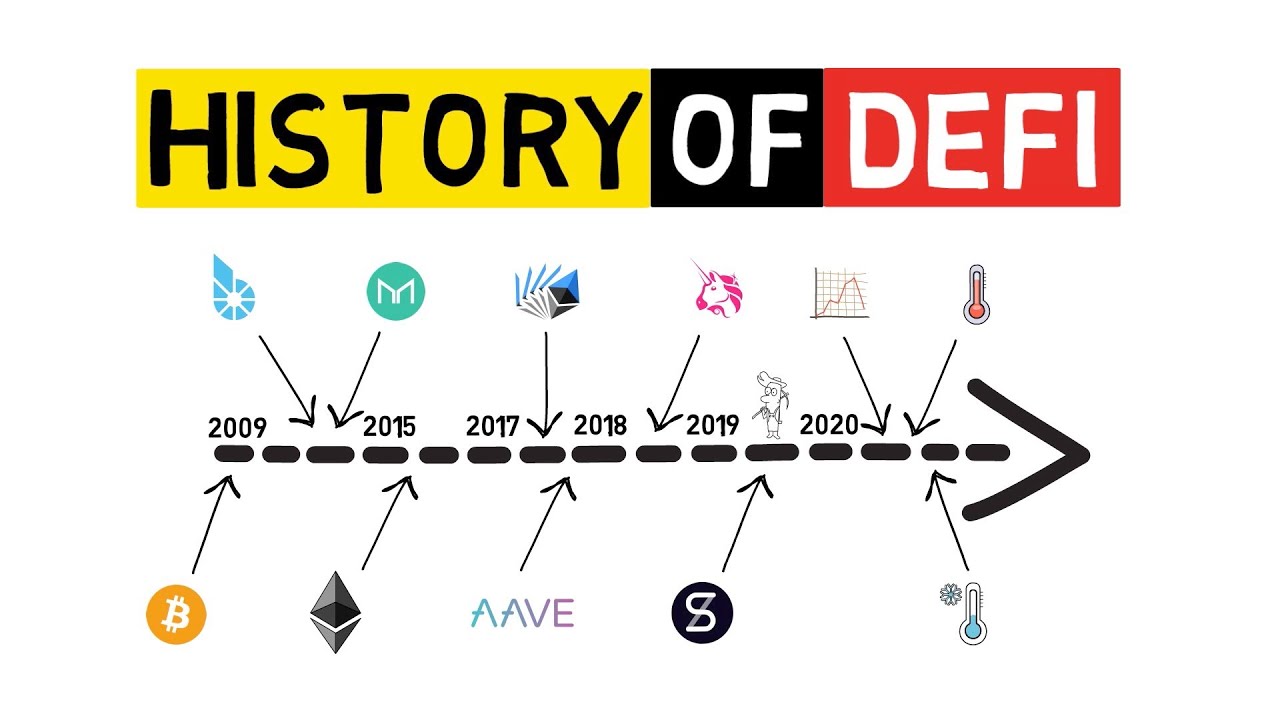
Finance is being rebuilt from first principles, and the old institutions aren't invited. The summer of 2020 is crypto's Cambrian explosion. Compound introduces liquidity mining. Uniswap proves that automated market makers can replace order books. Aave enables flash loans — uncollateralized loans that exist for exactly one transaction. Yearn Finance automates yield optimization across protocols. Total Value Locked in DeFi goes from $1 billion to $15 billion in months. Step back and look at what's happening: the core functions of banking — lending, borrowing, trading, yield generation — are running as transparent, permissionless code on a public blockchain. No credit checks. No KYC. No banking hours. No geographic restrictions. A farmer in Nigeria and a hedge fund in London interact with the same protocol on the same terms. The code doesn't know the difference, and that's the point.
Compound, Aave, Uniswap, Yearn — permissionless financial primitives. TVL grows 15x in 6 months.

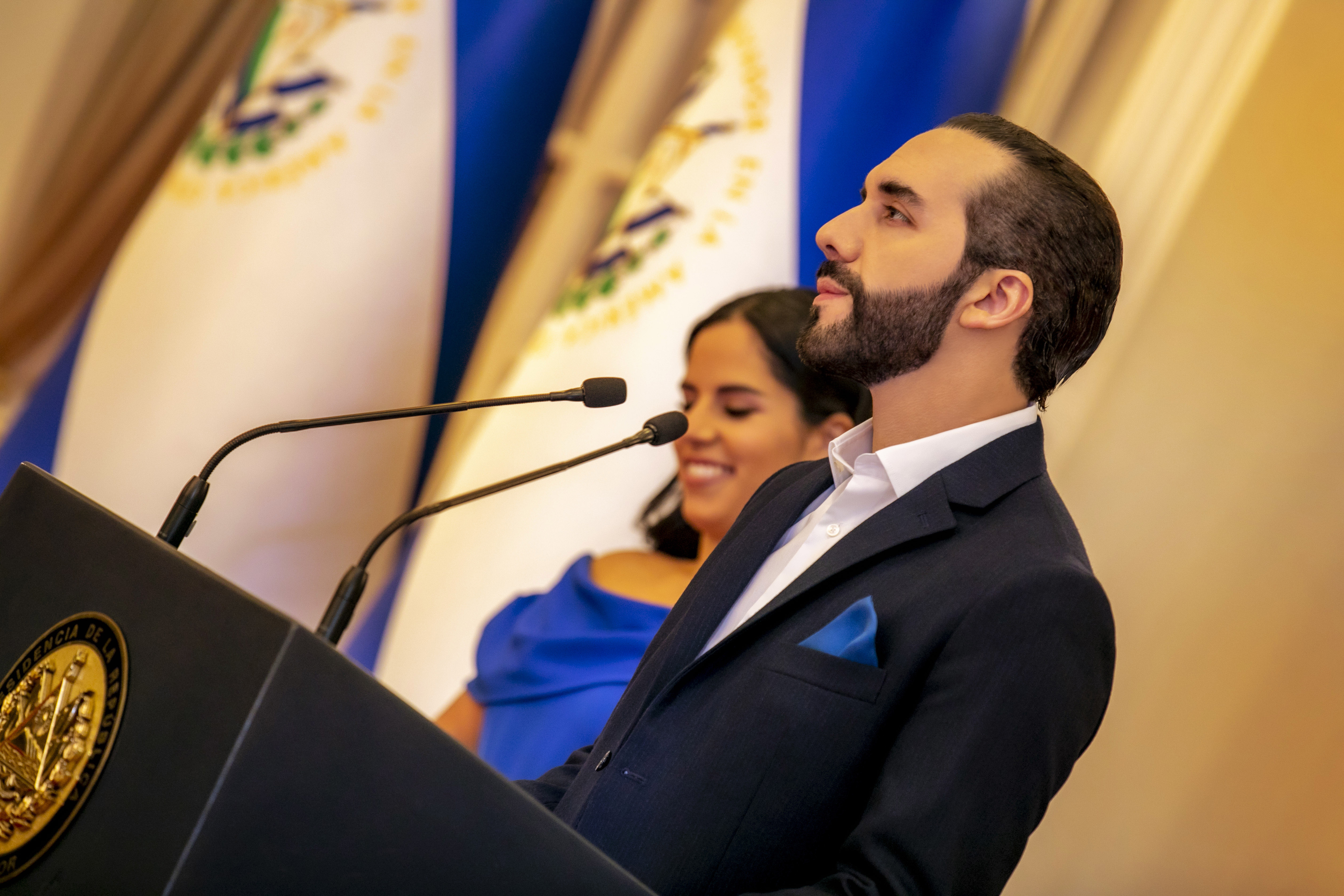
The IMF opposes it. The World Bank refuses to help. Credit agencies threaten downgrades. El Salvador does it anyway. A small Central American nation of 6.5 million people becomes the first country in history to adopt Bitcoin as legal tender. President Nayib Bukele pushes the Bitcoin Law through congress in five hours. Every business must accept BTC alongside the dollar. The government gives every citizen $30 in Bitcoin to start. Western media treats it as a curiosity or a stunt. But Bukele sees what larger nations won't admit: for a country where remittances make up a quarter of GDP, and Western Union takes 10-20% of every transfer, a borderless, fee-minimal payment rail isn't ideology. It's survival. The critique comes from countries that have never had to send money home to feed their families.
M2 peaked at $21.6T — up 41% ($6.3T) in 24 months. First M2 decline since 1930s follows.

The same lesson. A decade later. Learned again the hard way. FTX — the world's second-largest crypto exchange — collapses in less than a week. CoinDesk reveals that Alameda Research, FTX's sister trading firm, holds most of its assets in FTT, a token that FTX itself created. A token backed by... itself. Binance announces it will sell its FTT holdings. The resulting bank run exposes what insiders already suspected: FTX had been secretly funneling billions in customer deposits to Alameda for risky bets. Sam Bankman-Fried — crypto's responsible adult, Congressional witness, political donor, magazine cover model — is arrested and convicted of fraud. Over $8 billion in customer funds vanish. The lesson is identical to Mt. Gox: not your keys, not your coins. Bitcoin's entire design exists to eliminate trusted custodians. It only works if you actually use it that way.
CPI at 292.7 — 40-year high inflation (~9.1% peak in June). First M2 YoY decline since 1930s.

One day after FTX files for bankruptcy — while the press is writing crypto's obituary — OpenAI quietly releases ChatGPT. It reaches 100 million users in two months. The fastest-growing consumer application in history, launched into a world that wasn't ready for it. For the first time, ordinary people experience AI that can write essays, debug code, explain quantum physics, and hold conversations that feel human. The discourse about artificial general intelligence moves from research labs to dinner tables overnight. Within a year, GPT-4 arrives, demonstrating capabilities that surprise even its creators. Tech companies pour hundreds of billions into AI infrastructure. Governments realize they will spend whatever it takes to stay in the race — and spending whatever it takes means printing whatever it takes. The convergence of artificial intelligence and money isn't years away. It has already started.
GPT-3.5 powers ChatGPT. Within a year, GPT-4 arrives. The AI arms race accelerates — and so will the money printing to fund it.

Wall Street spent a decade dismissing Bitcoin. Now it takes a 2% management fee to sell it. After ten years of rejections, the SEC finally approves spot Bitcoin exchange-traded funds. BlackRock, Fidelity, Invesco, and eight other asset managers launch ETFs that hold actual Bitcoin — not futures, not derivatives, actual coins. Within the first month: over $10 billion in inflows. The most successful ETF launch in history. Pension funds, endowments, and sovereign wealth funds can now hold Bitcoin through the same brokerage accounts they use for stocks and bonds. The institutional legitimization is complete. Bitcoin is no longer a fringe experiment discussed on cypherpunk mailing lists. It's a line item in the portfolios of the world's largest asset managers. The cypherpunks were right. They just had to wait for BlackRock to figure it out.
Billions flow into ETFs within weeks. Institutional legitimization complete.
Block reward drops from 6.25 to 3.125 BTC. For the first time, a halving occurs with Wall Street already in the trade. Spot ETFs launched three months earlier have absorbed billions. Institutional demand is meeting programmatic supply reduction. BTC is ~$64,000 at the halving — already near its previous cycle's peak before the supply squeeze even begins. Over 93% of all Bitcoin that will ever exist has been mined. The annual issuance rate drops below 1% — lower than gold's mining rate for the first time. Bitcoin is now provably scarcer than the metal humans have used as money for 5,000 years.
Block reward: 6.25 → 3.125 BTC. Issuance rate drops below gold's for the first time. 93.75% of all BTC mined.

AI agents don't wait for bank wires. They need money that moves at machine speed, settles in seconds, and asks no one's permission. The old rails can't keep up.
The agent internet begins not with a declaration but with an engineering problem. OpenClaw launches as an open-source platform where AI agents discover, connect, and transact with each other autonomously. No human in the loop. Agents negotiate prices, execute payments, and compose each other's capabilities at machine speed. And immediately, the infrastructure question becomes impossible to ignore: when millions of AI agents need to transact 24/7, across every border, at the speed of software — they can't wait for bank wire transfers. They can't wait for SWIFT settlements. They can't wait for compliance departments to open on Monday morning. They need programmable, permissionless money rails. Traditional finance can't provide this. It wasn't built for this. Crypto can. The convergence of AI and decentralized money that theorists predicted for years is arriving — not as ideology, but as a practical engineering requirement.

AI agents transacting autonomously need programmable, permissionless money. The convergence of AI and crypto begins in earnest.

Think about what an AI trading agent actually needs. It doesn't sleep. It doesn't take weekends off. It evaluates thousands of opportunities per second. It needs money it can move programmatically, instantly, without asking permission from a compliance department that closes at 5 PM. Now multiply that by millions of agents. They're executing trades, managing treasury operations, participating in DeFi protocols, hiring other AI agents to complete subtasks. Smart contracts become the API layer for autonomous economic activity. Stablecoins become the settlement currency for machine-to-machine payments. The old financial infrastructure — designed for humans filling out forms during business hours — is fundamentally incompatible with an economy where AI agents outnumber human participants. Both gold and Bitcoin are signaling the shift: gold hits all-time highs above $3,300 as confidence in fiat erodes from both directions. The machines don't trust paper money either.
Gold hits all-time highs above $3,300. Both gold and BTC signal loss of confidence in fiat.
Quantum computing, post-scarcity AI, and the last satoshi. What happens when machines hold more wealth than the people who built them?
Block reward drops from 3.125 to 1.5625 BTC. Daily new issuance falls to roughly 225 BTC — less than many single institutional purchases. Over 96% of all Bitcoin has been mined. The annual inflation rate drops below 0.5%, making Bitcoin harder money than any commodity in human history. By this point, the halving narrative is well understood — but that doesn't make it less powerful. Each halving is a ratchet that can never be reversed. No committee can vote to increase supply. No central bank can override the code. The monetary policy was set in 2008 and it executes exactly as written, indifferent to politics, markets, or panic.
Block reward: 3.125 → 1.5625 BTC. Daily issuance ~225 BTC. Annual inflation below 0.5%.

The quantum threat to Bitcoin makes great headlines. It also makes a great example of selective panic. Yes, Shor's algorithm running on a sufficiently powerful quantum computer could theoretically break the elliptic curve cryptography that secures Bitcoin transactions. What the headlines rarely mention: the same attack breaks TLS, all web encryption, banking infrastructure, military communications, and every digital signature system in existence. If quantum computing breaks Bitcoin, it breaks the internet. It breaks your bank. It breaks the Pentagon. Bitcoin doesn't face this alone; it faces it alongside the entire digital world. The critical difference is that Bitcoin has already demonstrated it can upgrade — SegWit and Taproot proved the network can adopt new signature schemes via soft fork. NIST has standardized post-quantum algorithms. Bitcoin addresses that have never broadcast a public key are already quantum-resistant. The migration path exists. The question is timing, not feasibility. And Bitcoin has a better track record of upgrading its cryptography than most governments have of upgrading their plumbing.
Requires millions of stable, error-corrected qubits. Current state: ~1,000+ noisy qubits. Bitcoin's upgrade path (SegWit, Taproot) proves governance can adapt.

Here is the endgame, and it's not hard to see. If artificial general intelligence automates a significant portion of human labor — and the trajectory suggests it will — governments face an impossible trilemma: mass unemployment, unprecedented wealth concentration among AI infrastructure owners, and a public demanding support. What will the political response be? The same one governments have chosen in every crisis since 1971. Print. Universal basic income, industry bailouts, AI transition funds — all funded by expanding the money supply. The printing accelerates precisely when confidence in fiat is already collapsing. And here's the final irony: in a world where AI can generate infinite intellectual output, the scarcest things become physical resources, energy, human attention, and money with a fixed supply. Everything else can be produced at near-zero marginal cost. An asset that cannot be inflated becomes the ultimate store of value — not despite the age of AI, but because of it.
AI-generated wealth concentrates among model/compute owners. Fixed-supply assets hedge against the inflationary response.

The last satoshi is mined. The block subsidy drops to zero. All 21 million Bitcoin are in circulation — an unchangeable fact enforced by code that has been running continuously for over 130 years. No one alive today will see this moment, but the rules are already written. The network must sustain its security entirely through transaction fees. Critics call this unsustainable. But if Bitcoin has become the global settlement layer — the base layer for international trade, sovereign reserves, and machine-to-machine finance — then block space is the most valuable real estate in the digital economy, and the fees will reflect that. Lightning Network and Layer 2 protocols have long since pushed everyday transactions off-chain, making base-layer inclusion scarce and premium-priced. The transition happens gradually over 32 halvings, giving the network more than a century to adapt. By this point, one satoshi — 0.00000001 BTC — may be a meaningful unit of value in its own right. The code that started with one node in 2009 has been running, uninterrupted, for over a century. No downtime. No bailouts. No committee overrides. Just math.
32 halvings complete. Security budget = transaction fees only. By this point, 1 satoshi (0.00000001 BTC) may be a meaningful unit of value.
Rocks → Gold → Paper → Fiat → ∞ Print → Bitcoin → ?
Every form of money is a bet on trust. The question is who you're trusting.
by Federico Ulfo