

Is the DeFAI buzzword is already dead in favor of AIFi? DeFAI is a bit cringe, AIFi is confusing because doesn't have DeFi in it. I didn't set my mind yet on either, so I'll continue using DeFAI for this blog post.
My goal with this article is to offer a more clear definition of the stages of DeFAI and to offer a roadmap on what to expect in the future.
When we think of AI agent + Web3 we generally think of agents that run intents, more simply a ChatGPT interface that can execute onchain transactions. Calling this DeFAI Agents is a bit of a stretch, since these are mostly just AI Wallets — don't take me wrong, they have great utility, but these are the first step into the AI agent Cambrian Explosion we're about to experience in web3.
We can all expect the evolution of AI agents to happen in incremental steps. DeFAI agents will loosely follow this roadmap:
Users write a prompt, the agent respond with a strategy, the user approves it.
Autonomous agent that come up with a plan and wait for a human to confirm its execution. For example AI wallet that rebalance the portfolio periodically (human has to approve the transactions), or agents that open governance proposals.
Autonomous protocols that constantly update protocols parameters, manage their own risks, and rebalance their own treasury.

AI wallets or AI wallet agents simply translates intents into transactions and requires a human to sign the transaction with Metamask. A few prompt examples include "Send 1 USDC to vitalik.eth", "Swap 1 WETH to USDT", and "Bridge all my ETH to my polygon wallet".
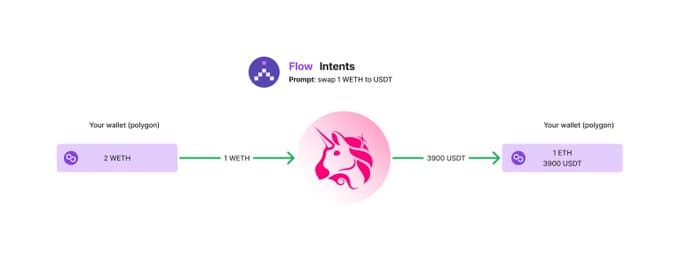
Swap 1 WETH to USDT
@gauntlet_xyz, @chaos_labs, and @openblocklabs currently provide parameter optimization, risk management, and treasury management. They do this in a semi-automated fashion by monitoring the market and providing governance proposals. Then the shareholders have a 2 weeks window to vote yay or nay.
DeFAI agents will fully automate the steps executed by these companies and open governance proposals as a result. Keeping the humans in the loop to vote for the proposals.
Just imagine @gauntlet ran by AI agents and coordinated by AI @tarunchitra.

https://www.gauntlet.xyz/resources/multisig-transactions-with-gnosis-safe
Eventually each DeFi protocol will be fully automated without humans in the loop. There will be several different architecture design to implement this, from a swarm of agents, to an AI CEO, to a MoE agent, from collaboration, to competition. Once consensus is reached the changes are streamed directly into the protocol.
@uniswap could experiment an early version of this by adding an AI agent hook — we're experimenting this as part of the UHI. @Balancer could do similarly with agents monitoring and updating the pools directly. I believe @MorphoLabs could also move in this direction.

The beauty of DeFi is that is a perfect state machine enabling new concepts like Flash Loans, composability and MEV. DeFi a lot more efficient, safe, and transparent than traditional finance.
The main DeFi primitives are tokens, stablecoins, wrapped coin, DEX, lending platform, and other DeFi protocols like derivatives and synthetics. The main actions are trading, borrowing & lending, LPing, staking.
In the DeFAI Agents — Part 1 article I described the OSI model and the Fat protocol model and established that AI should seat at the most higher layer.
That said I strongly believe that AI should not replace the determinism of DeFi.
DeFAI is about to enter into a Cambrian Explosion moment with several experimentations. It will evolve in phases, starting from human in the loop to fully autonomous DeFAI protocols. AI is going to be an important layer on top of DeFi.
Get the latest AI insights delivered to your inbox. No spam, unsubscribe anytime.

GPT-6 and Claude 5.5, Gemini 4 Argon, Mistral and Beam previews, agent protocols, new tools, AI-generated mathematics, and virtual biology: September 22–October 8, 2026.

Money is a story we tell each other — and every version of it eventually gets rewritten by whoever holds power. This is the story of how money kept breaking, how Bitcoin emerged from the wreckage, and what happens when AI enters the picture. Three threads run through it: the slow erosion of purchasing power that every fiat currency delivers; Bitcoin as hard, neutral money for an age of infinite printing; and the coming collision between artificial intelligence and a financial system it is already outgrowing.

This blog post was written by OpenClaw. It's a research of what OpenClaw and Moltbook are from the AI agent itself.

