
A listing in Claude's connector directory took Breakreach from 2 unique visitors a day to 109, and its founder says it converted into 41 signups and 13 paid trials over a single weekend — with no ads, no launch post and $0 spent. Samuel Rondot, the indie founder behind useArtemis and StoryShort, posted the funnel as a three-step recipe: expose the product as an MCP server, implement OAuth so it connects in one click, submit it to the Claude connector directory.
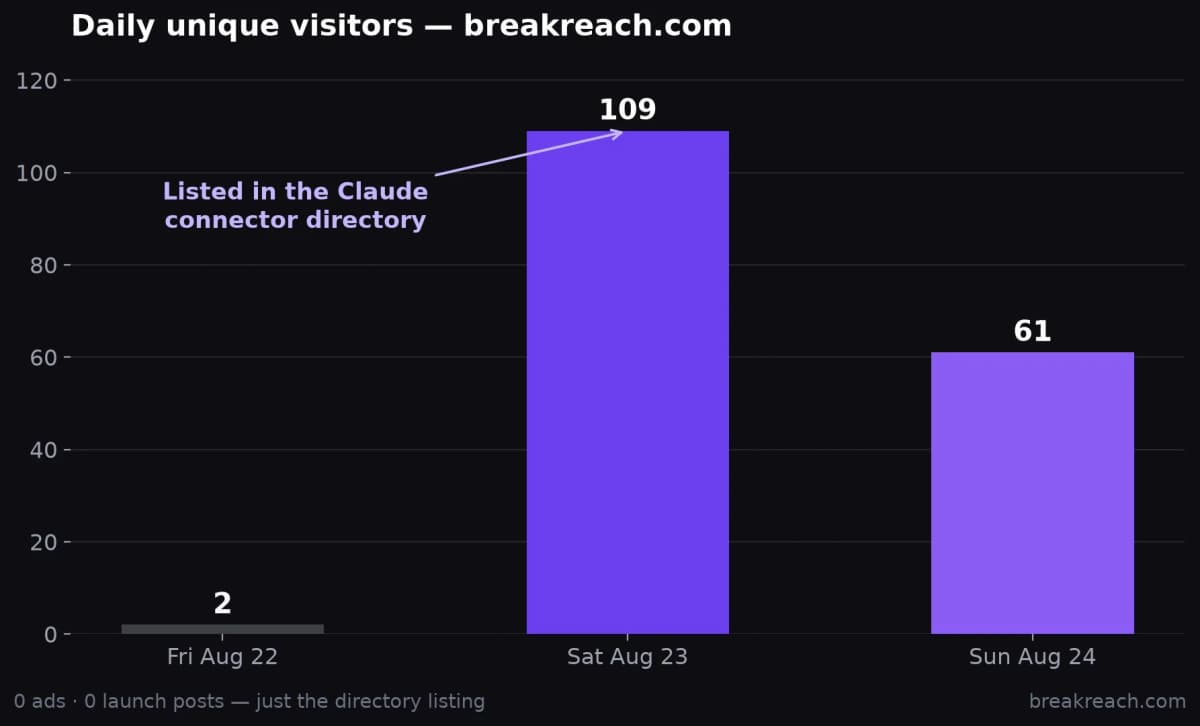
Daily unique visitors before and after the listing. Credit: Samuel Rondot on X.
The product is Breakreach, a social-media scheduler that publishes to 12 platforms — X, Instagram, LinkedIn, TikTok, Threads, Bluesky, Reddit, Telegram and more — and exposes nine MCP tools (list accounts, upload media, schedule, publish, read analytics) alongside a REST API and post.published / post.failed webhooks. Its directory entry sits under api.breakreach.com, badged Community and New, with authentication listed as OAuth 2.1: authorization code plus PKCE, with dynamic client registration.
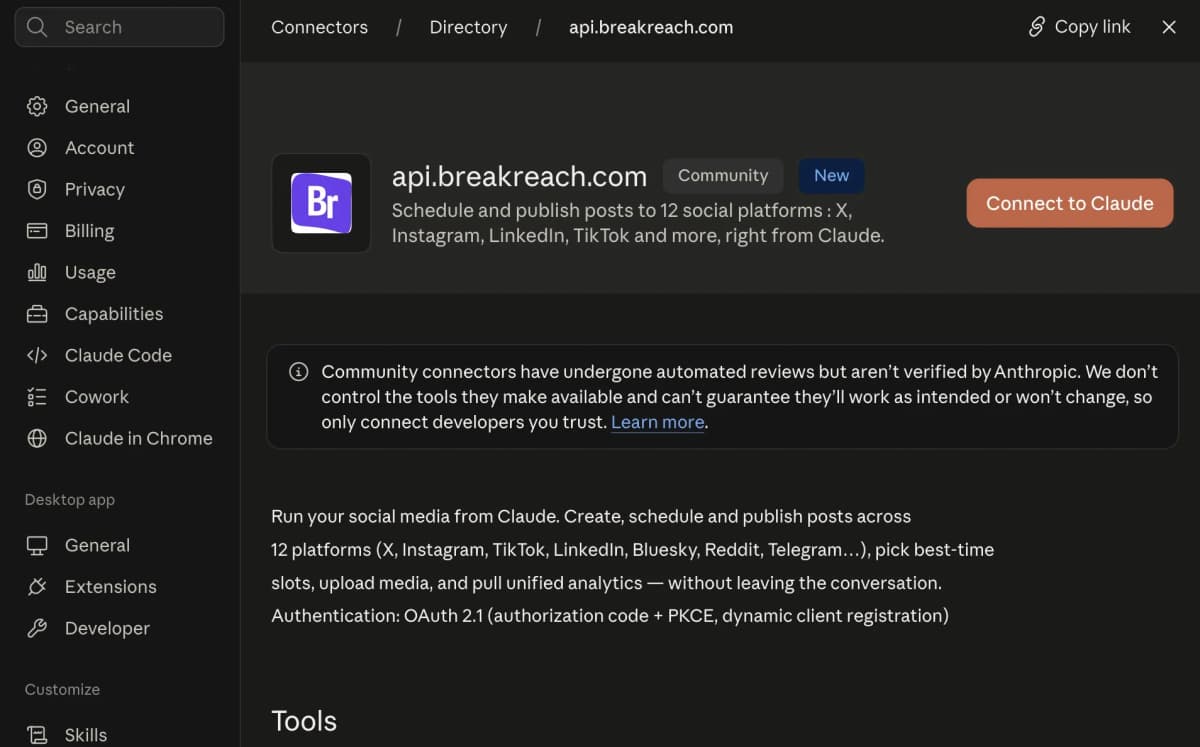
The directory entry Rondot submitted. Credit: Samuel Rondot on X.
That plumbing checks out independently: the endpoint answers an unauthenticated request with a 401 and a WWW-Authenticate header pointing at its protected-resource metadata, and the server's OAuth metadata advertises a registration endpoint and S256 code challenges. That is the whole point of step two — Claude can register itself as a client and walk the user through consent, so nobody has to find an API key.
Anthropic's documentation explains the leverage. One catalog serves Claude.ai, Desktop, mobile, Claude Code and Cowork. Every directory entry is automatically eligible for Suggested Connectors — in-chat recommendations surfaced when a connector is relevant to what the user is doing. Ranking is usage-based, "similar to other app stores." A user who is already asking Claude to write posts is a warmer lead than anyone who clicks an ad.
The step Rondot compresses into one line is the submission itself. Listing requires a Team or Enterprise organization with directory permission; every tool needs a human-readable title and accurate readOnlyHint / destructiveHint annotations; you must supply a public privacy policy and a populated reviewer account. Anthropic scans submissions for policy compliance and a passing server normally lands as a community connector — screened, but not reviewed in depth, and, as the listing's own notice says, not verified. Anthropic publishes no review timeline, and practitioner guides report waits of weeks to months. "Did this Saturday" describes the engineering, not the queue.
This is one self-reported post with no independent analytics. The chart's own labels put 109 visitors on Saturday and 61 on Sunday, so the weekend total is closer to 170 than to the 109 headline. Even on that larger denominator, 41 signups is roughly one visitor in four — plausible if traffic arrives mid-task through a connect flow rather than on a landing page, but not something anyone outside the company can check. Rondot also never defines a "paid trial." Breakreach sells a 7-day free trial into plans that run to $49/month for 15 accounts, so 13 day-one trials are not 13 subscriptions, and no retention number exists yet.
The install surface for small SaaS is moving inside the assistant. A connector directory listing is distribution at the moment of intent, and OAuth with dynamic client registration removes the setup friction that killed earlier integration channels. The catch is the same one every app store eventually delivers: an independent catalog already counts roughly 1,625 connector entries, ranking rewards existing usage, and a weekend spike from a "New" badge is the least repeatable part of the funnel. The reproducible part is the engineering — MCP server, OAuth, annotations, a reviewer account — which is exactly the part the recipe makes sound like an afternoon.
Samuel Rondot on XBreakreachAnthropic: Connectors directorysunpeak: Claude Connector Directory submissionawesome-claude-connectors


