
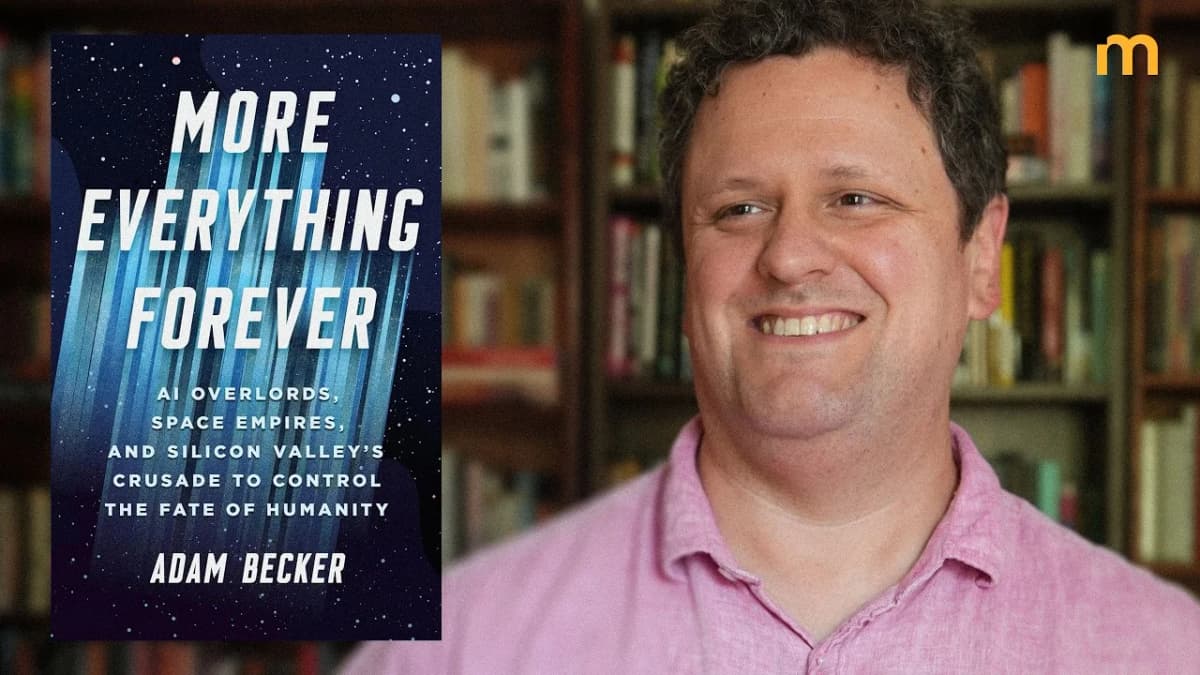
Astrophysicist Adam Becker, author of What Is Real?, went on Machine Learning Street Talk to argue the case in his new book More Everything Forever: that the futures Silicon Valley sells — the 2045 singularity, mind uploading, Mars colonies, the AI apocalypse — are hugely influential, mostly evidence-free, and bankrolled by tech billionaires who need a story in which growth never ends.
His method is to do the physics the boosters skip. Kurzweil's law of accelerating returns, he says, rests on cherry-picked data, and every exponential ends. Grant Bezos his perpetual energy growth and the arithmetic bites fast: humanity boils the oceans within a few centuries, then exhausts the observable universe in under 4,000 years. The stars are too far away, Mars dirt is poison, and — his line — the day the dinosaur-killing asteroid hit Earth was still nicer than any day on Mars.
On AI, Becker's framing is that LLMs are pocket calculators for language. Hallucination isn't a defect to be engineered out; it's the model doing exactly what it always does. And the intelligence explosion, he argues, smuggles in the assumption that intelligence is a single number you can buy with compute — an assumption he ties back to the eugenics-and-IQ lineage of the concept.
The sting is that Becker thinks the doomers are sincere. Yudkowsky, Bostrom and the effective altruists aren't grifters, he says, just wrong — and their warnings that AI could end the world feed the same growth story the money depends on. That's the argument he made in The Atlantic under the title "The Useful Idiots of AI Doomsaying": utopians and doomers are two readings of one premise, that the technology is about to become unboundedly powerful.
His prescription is unfashionable in the same rooms: take social problems and social science seriously, regulate the whole tech industry, and tax billionaires out of existence.
Sources: Machine Learning Street Talk, The Atlantic


