AI 2027 is running early: METR’s Anthropic report resets the clock
In one week of November, the most-cited forecast of an AI takeoff went from "too aggressive" to "running early." The trigger was a single report on what is happening inside one lab.
On November 5, METR published an independent assessment of whether AI is speeding up AI research at Anthropic. METR staff spent August 12 to October 29 inside the company with unusual access: pretraining and RL metrics, compute by domain, benchmark scores for unreleased models and interviews with researchers.
Its central estimate is that Anthropic is now improving its models on well-specified tasks at about twice the rate it did between March 2024 and October 2025, with wide error bars: METR would not be surprised by anything from 1.3x to 3x. On AECI, Anthropic's version of the Epoch Capabilities Index, scores have grown 1.9x faster since October 2025, which METR reads as roughly two years of historical progress in one year. METR is confident the speedup did not come from scaling training compute, judges that most of it is likely due to Anthropic's own use of AI for R&D, and found no bottleneck it expects to bind in the next 12 months.
Two caveats matter as much as the headline. Anthropic redacted a majority of the evidence METR found most informative, so readers have to take much of the conclusion on METR's judgment. And METR was told the speedup comes mainly from AI assisting researchers rather than working alone, though it saw signs that autonomous contributions will grow soon.
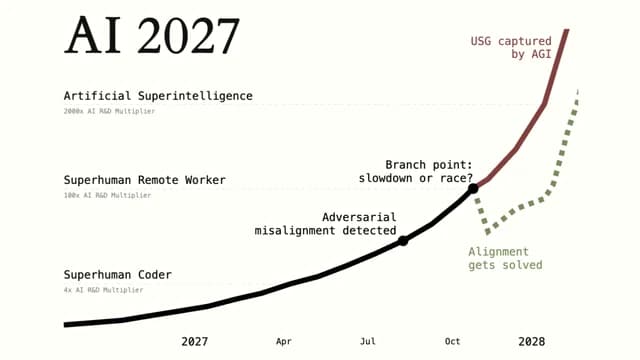
The AI 2027 scenario from the AI Futures Project laid out a month-by-month path to an intelligence explosion. By mid-2026 most commentary, including some of its own authors, had drifted toward later dates.
On November 10 the group published a Q3.5 timelines update titled "Looks Like the Intelligence Explosion Will Happen in 2027 After All." It estimates that METR's numbers imply a 1.7x acceleration attributable to AI today, five months ahead of the AI 2027 scenario. Less than three months earlier, even Daniel Kokotajlo's most aggressive model gave under 4% to that much acceleration by November 2026. Now all of its forecasters expect a Superhuman AI Researcher (the point where a lab would rather run automated researchers than its best human team) sometime in 2027, with their filtered model putting the median at February 2027. They give a 35–65% chance that AI able to automate all white-collar work arrives before 2028, and conclude it is "incredibly urgent to pause or substantially 'pace' frontier AI development."
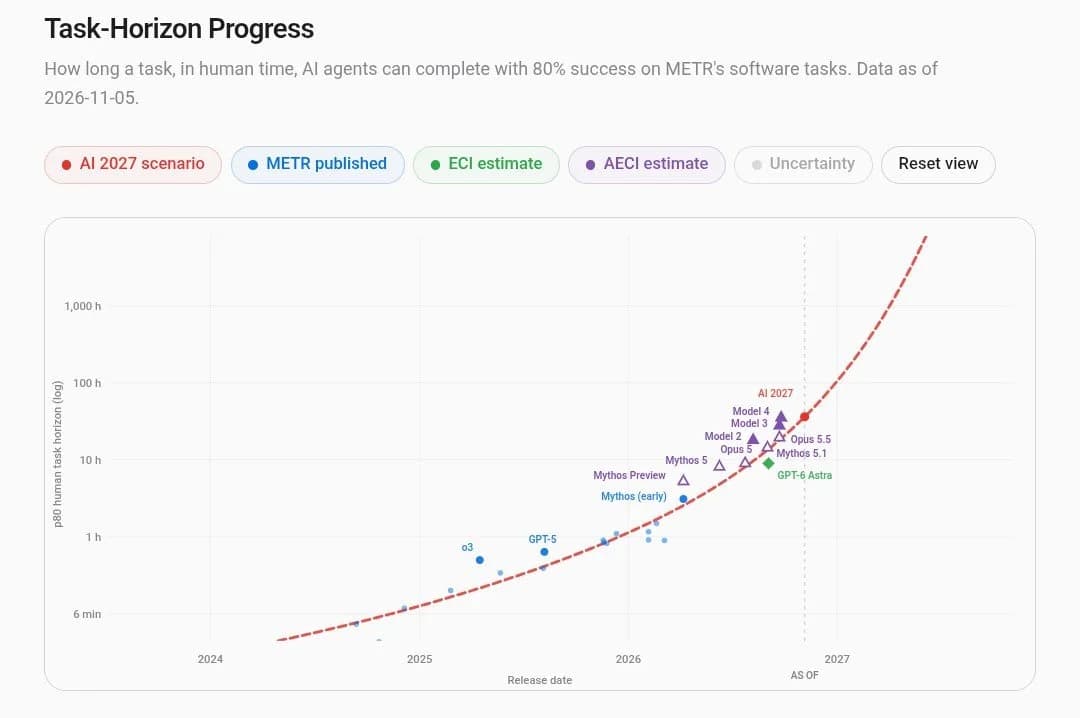
The community tracker that plots task horizons against the AI 2027 curve moved the same week. Using METR's AECI estimates for Anthropic's unreleased models, Andrew Curran notes it went from five weeks behind the curve with GPT-6 Astra to six weeks ahead with the internal "Model 4."
Anthropic tracks its research tasks on an automation scale from AL0 (no AI) to AL5 (fully automated). On the chart Andrew Curran shared, built from Anthropic's R&D Automation Index, the share of model R&D tasks where Claude leads (AL4) rose from 1% in March 2026 to 26% in August. A logistic extrapolation of that index, also shared by Curran, puts 95% of tasks at full automation (AL5) by November 2027. Treat that line with care: its own caption notes that no task has yet been rated AL5, so the curve rests on an assumed lag pattern, not data.
According to Curran, Anthropic co-founder Sam McCandlish has said the company will publish its own report on the speed of internal progress, which would replace these reconstructions with first-party numbers.
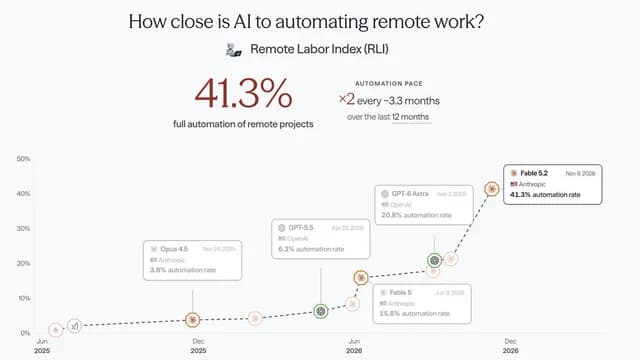
The same pattern shows up in public numbers, though none of them is as direct as METR's. Epoch AI scored the newly released Claude Fable 5.2 at a record 174 on its Capabilities Index, above GPT-6 Astra's 169 and above what Epoch's pre-Astra trend for reasoning models predicted. On the Remote Labor Index, which grades AI against paid freelancers on real projects, the Center for AI Safety reports the best agent went from 2.5% of projects fully automated a year ago to 41.3% with Fable 5.2, a rate doubling about every three months; Benjamin Todd projects the index saturating by April 2027.
At Google DeepMind, Pushmeet Kohli wrote that the lab is "witnessing a genuine phase transition in the pace of scientific discovery." And researchers are starting to publish recursive self-improvement on infrastructure itself: one paper highlighted by DAIR.AI, InfraRSI, reports agents raising mean model FLOPs utilization from 17.4% to 30.0% across four training workloads.
The strongest pushback is about money, not time. Ramez Naam, using a chart by Séb Krier, METR's fitted trend and Anthropic's SEC filings, argues that Anthropic is gaining far fewer AECI points per billion dollars of R&D: from about 6.6 in 2024 to 0.76 in Q3 2026. On that reading, AI-driven acceleration is real but not yet enough to overcome steeply diminishing returns, and the pace depends on spending continuing to grow.
Vlad Chituc makes the general version of the point: plotted against time, AI looks exceptional; plotted against cumulative money spent, it looks like other technologies that rode experience curves. Dwarkesh Patel points to small-scale pretraining experiments he ran with a collaborator, which suggest progress "seems to be coming mostly from data improvements." If that holds, it arguably matters: better data may be harder to automate than better code.
There is also the evidence problem. The single most important input to every updated forecast is a report whose key evidence the public cannot see, about one company, during a period METR itself calls hard to interpret.
For builders, the practical reading is to plan for capability jumps on a shorter clock and keep models swappable, since workarounds for today’s weaknesses will age faster; to watch automation measures like the Remote Labor Index, which say more about which workflows change next than leaderboard points do; and to expect policy to move with the forecasts, because calls to pause or pace frontier development tend to end in rules on compute, open weights and access that reach everyone downstream of the labs.
Sources
METR reportAI Futures Project: Q3.5 timelines updateAndrewCurran_ on XAndrewCurran_ on XAndrewCurran_ on XEpochAIResearch on XCAIS on Xben_j_todd on Xpushmeet on Xdair_ai on Xramez on XVladChituc on Xdwarkesh_sp on X