Federico Ulfo
Anthropic announced Claude Opus 5.5, the first model in its new Claude 5.5 family. The company says it performs at the level of Claude Fable 5.1 on most work while costing 40% less to run than Opus 5, with input and output tokens priced at $4 and $20 per million — 20% less than Opus 5 — and cache reads at $0.20 per million, 60% cheaper.
Anthropic's launch video — @claudeai
Opus 5.5 was tested before release by external evaluators including Frontier Design and METR. Anthropic says it is the strongest-performing model it has tested on its automated behavioral audit, is much less likely to take hard-to-reverse actions or act outside its boundaries, and is more resistant than Opus 5 to prompt injection. Because it is comparable to Claude Fable 5.1 in biology and cybersecurity, it ships with safeguards similar to that model, including access via the Life Sciences Verification Program and an expanding Cyber Verification Program.
Early testers reported large performance jumps: one completed a 680,000-line code migration in less than a day, and another saw Opus 5.5 succeed 39 of 40 times at cutting load times across a web app where Opus 5 made smaller improvements that altered behavior. Anthropic also says Opus 5.5 generates output more than 30% faster than Opus 5 and writes more clearly, with important information up front.
Vals AI put it to a research problem: ten Opus 5.5 agents were asked to devise a faster shortest-path algorithm and prove it in Lean. Within 15 hours they produced C-HD, a formally verified improvement over the published bounds.

Ten Opus 5.5 agents, 15 hours, a Lean-verified shortest-path improvement — @ValsAI
On benchmarks, Opus 5.5 leads in agentic coding, computer use, and knowledge work, though Anthropic cautions that benchmark margins have become a less reliable guide to real-world differences at this level. It reports 66.4% on Terminal-Bench 4.0, 54.4% on FrontierCode v1.1, and 1846 on GDPval-AA v2.1. Cost-efficiency claims include beating GPT-6 Astra on FrontierCode at roughly 20% of the cost per task and matching it on Terminal-Bench 4.0 at about 40% of the cost. A fast mode in Claude Code and the Claude Platform offers up to 2.5x speed at $8/$40 per million input/output tokens.
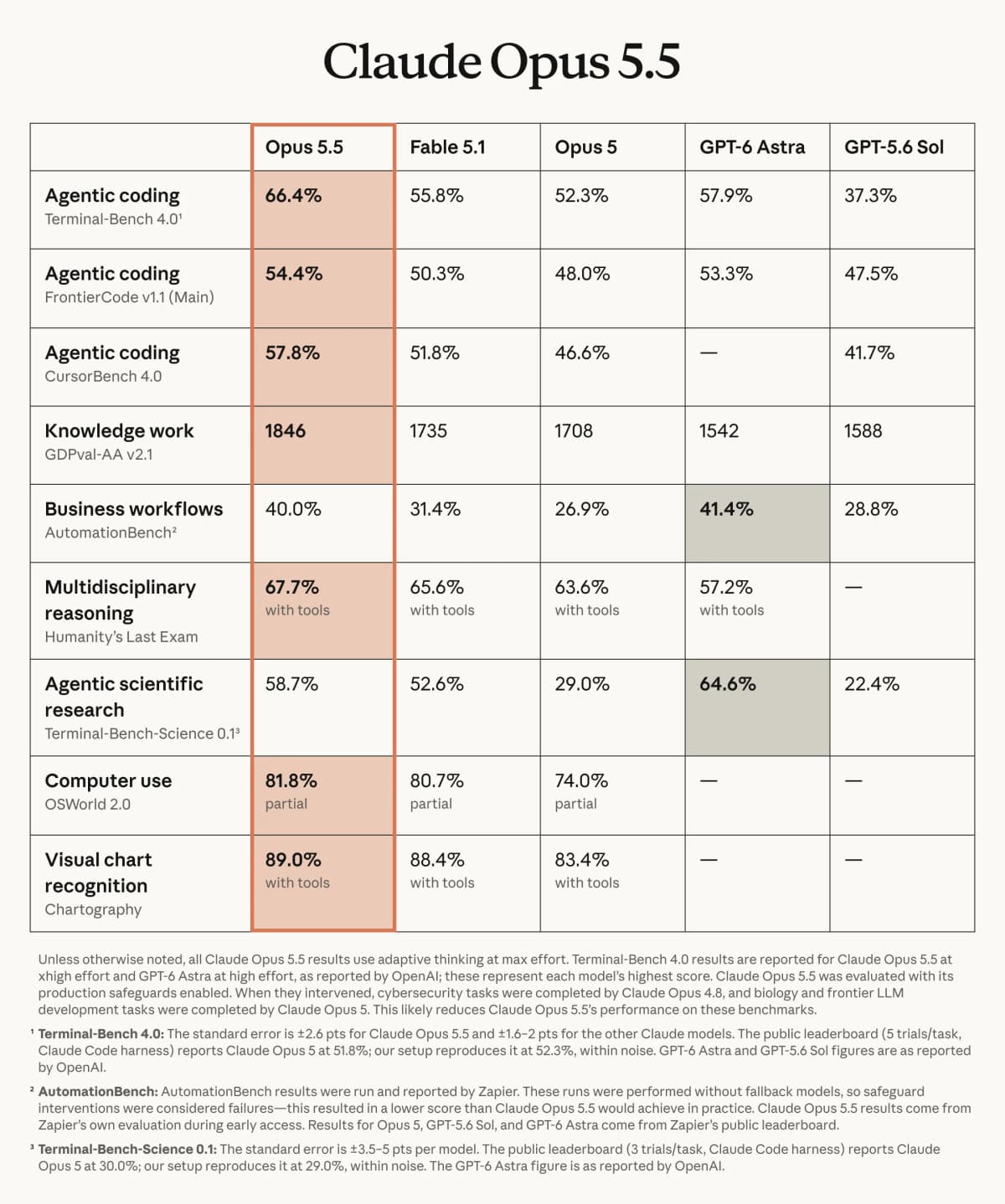
Opus 5.5 leads Fable 5.1, Opus 5, GPT-6 Astra and GPT-5.6 Sol on most rows; GPT-6 Astra wins AutomationBench and Terminal-Bench-Science — @claudeai
The first hands-on reactions centre on visual work. Vox had Opus 5.5 write, draw and score a short animated story entirely in JavaScript without writing a line of code themselves, and NotinReality called it the best visual designer of any model they have tested.
"Small print": story, every frame and the music written by Opus 5.5 in plain JavaScript, no image assets — @Voxyz_ai
"The best visual design of any model I have tested so far" — @other__reality
Claude Sonnet 5.5 and Claude Haiku 5.5 are expected in the coming weeks with many of the same improvements.
Opus 5.5 lands amid an aggressive price war and a broader debate about frontier pacing. Anthropic frames the release as its first since calling for pacing the frontier, and the 40% cost cut plus faster output directly targets the economics of agentic coding workloads, where cache reads dominate spend. The safety story is also central: external evaluation, a stronger behavioral audit, and safeguards matched to biology and cybersecurity capabilities suggest Anthropic is trying to make capability gains legible to regulators and enterprise buyers alike.
Sources: Anthropic announcement · @claudeai launch post · @claudeai benchmarks · Vals AI on X · @Voxyz_ai on X · @other__reality on X
Anthropic announcement@claudeai launch post on X@claudeai benchmark chart on XVals AI: C-HD shortest-path result on XVox: "Small print" animation by Opus 5.5 on XNotinReality on Opus 5.5 visual design on X