A new paper from multiple institutions introduces Continual Harness, a reset-free architecture that lets embodied agents rewrite their own prompts, sub-agents, skills, and memory while acting in the environment — formalizing an emergent self-improvement pattern first noticed in an AI that beat Pokémon.
The paper first documents Gemini Plays Pokemon (GPP) experiments, where iterative human-in-the-loop harness refinement produced the first AI system to complete Pokémon Blue, Yellow Legacy on hard mode, and Crystal without losing a battle. Crucially, in the hardest stages the agent began iterating on its own strategy via long-context memory — surfacing self-improvement signals alongside human guidance.
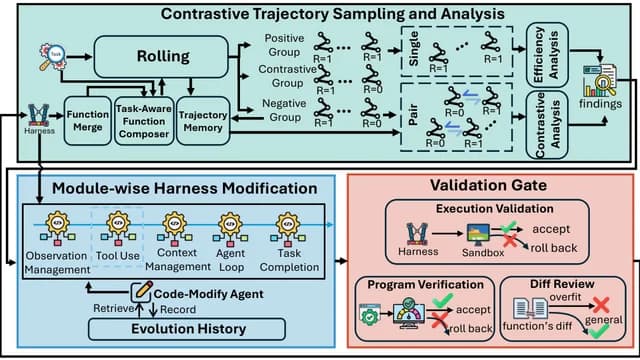
Continual Harness removes the human from that loop entirely. Starting from only a minimal environment interface, the agent alternates between acting in the game and refining its own operating configuration, drawing on any past trajectory data.
On Pokémon Red and Emerald across frontier models, Continual Harness starting from scratch substantially reduces button-press cost relative to a minimalist baseline and recovers a majority of the gap to a hand-engineered expert harness — despite having no curated knowledge, hand-crafted tools, or domain scaffolding.
The paper then closes the loop with the model itself: an online process-reward co-learning loop in which an open-source agent's rollouts through the refining harness are relabeled by a frontier teacher and used to update the model. This drives sustained in-game milestone progress on Pokémon Red without resetting the environment between training iterations.
Coding harnesses such as Claude Code and OpenHands wrap foundation models with tools, memory, and planning, but no equivalent existed for embodied agents tackling long-horizon, partial-observability decision-making. Continual Harness provides that missing piece — and its online, reset-free self-improvement loop points toward agents that can get better at their own jobs while doing them, without human retuning.
Sources: Source 1