
Darkbloom, the Eigen Labs network that rents out idle Apple Silicon for AI inference, roughly doubled its live fleet in three days. Pratik Gandhi of Eigen Labs posted that "another 100 Macs joined" in 14 hours, adding up to "200+ new Macs in 60 hours" — and the screenshot he attached is the more interesting document: Darkbloom's live console showing 499 nodes online, 432 of them hardware-attested, up from 389 nodes and 344 attested a day earlier.
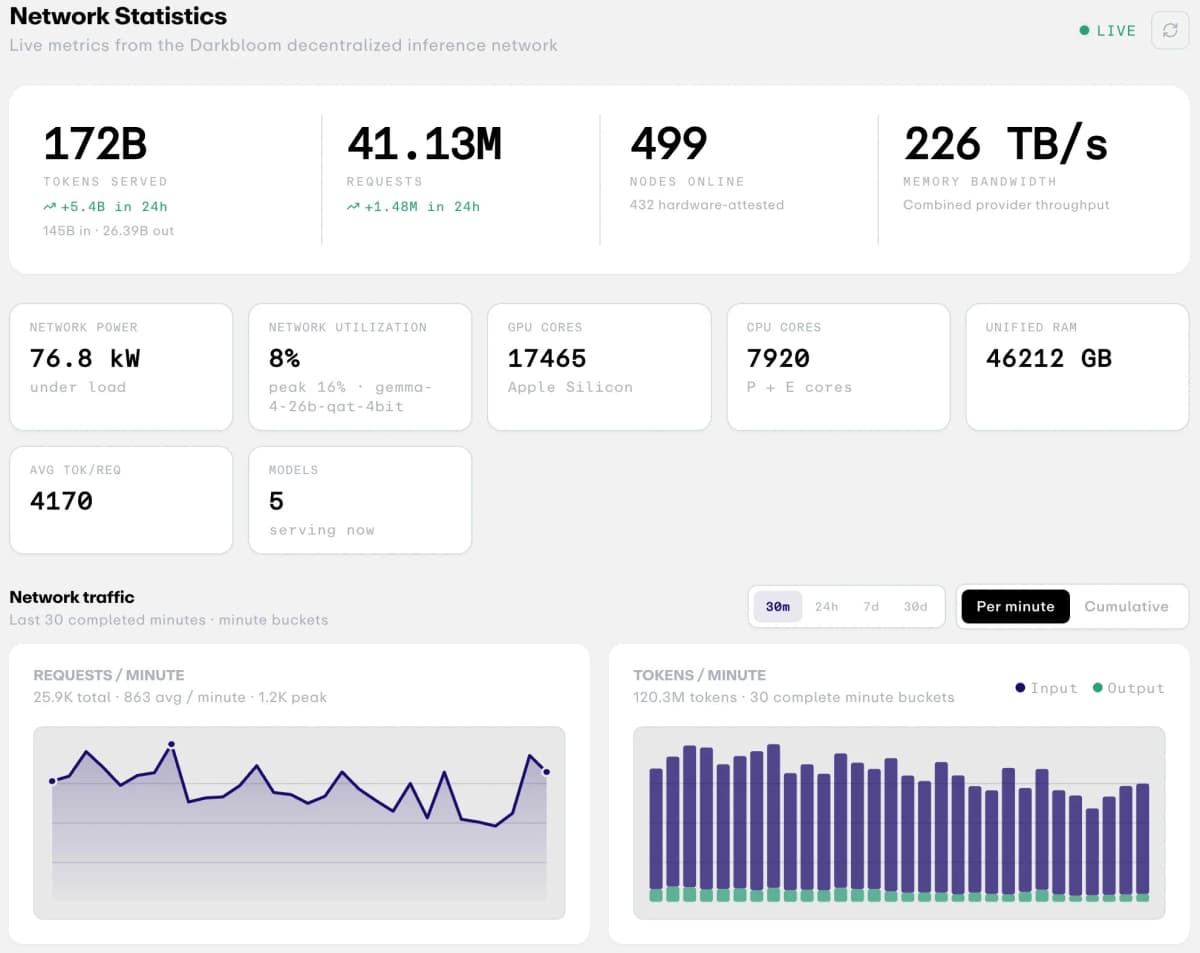
Darkbloom's live network console at the time of the post. Credit: Pratik Gandhi on X.
Read as a datacenter spec sheet, the aggregate is not trivial: 17,465 Apple Silicon GPU cores, 7,920 CPU cores, 46,212 GB of unified RAM and 226 TB/s of combined memory bandwidth, drawing 76.8 kW under load. Cumulative counters on the same panel read 172B tokens (145B in, 26.39B out) across 41.13M requests, with five models serving.
Darkbloom started in April as an Eigen Labs research initiative built on a simple arbitrage: Apple has shipped more than 100 million machines with unified memory and real ML hardware, most of them idle roughly 18 hours a day, and that capacity is already paid for. Developers point an OpenAI-compatible client at a different base URL; Mac owners install a launchd agent with one curl command and get paid for the tokens their machine produces. Eigen's pitch is about 50% lower cost at comparable model performance, on the argument that the marginal cost is mostly electricity — The Register puts a provider's power bill at roughly $2 a month.
The harder problem is that inference runs on hardware nobody trusts. Darkbloom's answer is a three-layer stack: a Go coordinator inside an AMD SEV-SNP confidential VM re-encrypts each request to the destination provider's public key, and the provider runs a hardened Swift/MLX process with debugger attachment blocked and memory-inspection APIs disabled, with Secure Enclave keys and challenge-response attestation chaining back to Apple's root CA. Eigen is explicit that this is not trustless: the coordinator is still inside the trusted routing layer, a boundary the company says it prefers to state plainly rather than bury in security language. The codebase and a technical paper are public, and the docs still label the whole thing "an experimental research prototype... Do not use in production."
The catalog is open-weight only: Gemma 4 26B, Qwen3.5 27B, Trinity Mini, Qwen3.5 122B MoE and MiniMax M2.5 at 8-bit, needing 36 GB to 256 GB of unified memory. Darkbloom is recruiting Macs with 48 GB or more for now.
The growth follows Darkbloom flipping from OpenRouter's free tier to paid provider status. Eigen Labs engineer Gajesh Naik, who created the project, reported 4.5B tokens served, up 113% month over month, and $102K ARR at that switch, with about 250 Macs online and owners averaging $120 to $200 a month per machine. (The console's 172B-token counter and that 4.5B figure are different measures; Eigen has not published a reconciliation.)
A consumer-hardware fleet becoming a paid, priced supplier on the router developers actually buy from is the first real test of whether distributed inference competes on economics rather than ideology. The number to watch is not node count but utilization: 8% at the moment of the screenshot, peaking at 16%. Supply is arriving faster than demand, which is why darkbloom.dev's own earnings calculator defaults to a 5% duty cycle and warns of "significant variation in earning levels among providers using the same machine type." Two hundred Macs joining in 60 hours is a good weekend for recruiting. Keeping them busy is the business.
Pratik Gandhi on Xhis earlier postEigen Labs on the OpenRouter switchGajesh Naik on Xdarkbloom.devDarkbloom docsProject Darkbloom blog postThe RegisterLayr-Labs/d-inference on GitHub

How rogue inference providers can game router scoring by under-reporting cache hits

Serving Kimi K3 on rented B200s breaks even at 159 tokens per GPU-second
An 11x price spread for the same open-weight model on OpenRouter

Apple introduces M6 and M5 Ultra, pitched on AI compute

Stripe to buy OpenRouter for $7B