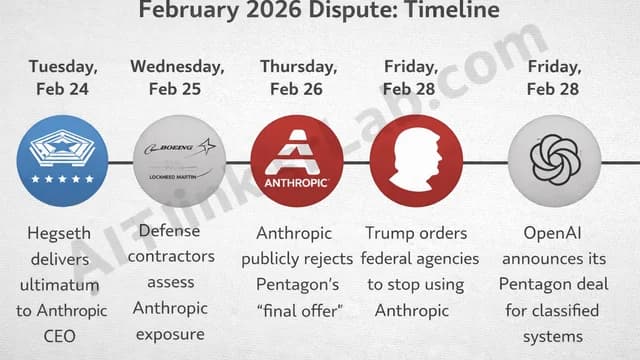
A federal judge has ruled that the Pentagon's blacklisting of Anthropic was unconstitutional, according to the New York Times. The court found that the Department of Defense designated the lab a supply chain risk in retaliation for Anthropic publicly criticising the Pentagon's position — what the ruling frames as classic, illegal First Amendment retaliation.

Anthropic filed suit in March in a California district court, accusing the Trump administration of unlawfully retaliating against the lab for the red lines it set on how its models could be used. Ars Technica reports the specific refusals at issue: Anthropic declined to support lethal autonomous warfare and mass surveillance, and the administration's framing of the company as "woke" is now part of the record the court weighed. The Verge characterises the case as the end of a monthslong rollercoaster between the lab and the administration — a fight the government now loses at the district level.
The mechanism matters as much as the motive. A supply chain risk designation is not a fine, a debarment hearing or a formal sanction with its own appeals process; it is a procurement label, applied administratively, that makes a vendor radioactive across federal buying without anyone having to defend the decision in public. That is precisely why the ruling lands the way it does: the judge looked past the label to the reason it was applied, and found the reason was speech.
This is the first time a court has told a US administration that it cannot punish an AI lab through procurement for the contents of its usage policy. Every frontier lab writes restrictions on military and surveillance deployment; those restrictions are the main lever a lab has over what its models end up doing in the world. The open question was whether writing them costs you federal business — whether a usage policy is a commercial position the government is free to price in, or protected speech the government may not retaliate against. The ruling says, at least here, that it is the latter.
For Anthropic specifically, the decision converts a period of political exposure into a legal precedent for AI companies' right to engage publicly in policy debates. The company spent the blacklisting period arguing in public, not just in filings, that its restrictions were a safety position rather than a partisan one. That public argument was the alleged trigger for the retaliation; it is now also the thing the court has protected.
Expect an appeal. This is one district court's decision, not settled law — it binds these parties and persuades nobody else until a circuit court says otherwise. Nor does a finding of unconstitutional retaliation oblige the Pentagon to buy anything: the ruling addresses the reason the exclusion was imposed, not the government's general latitude over who it contracts with. An administration that wants the same outcome for different, documented reasons has not been told it cannot try.
The broader signal is still real. Labs weighing whether to publish red lines on autonomous weapons or surveillance now have one data point suggesting the cost of doing so cannot lawfully be quiet exclusion from federal procurement. Until an appeals court weighs in, that is the state of play.
New York Times — Judge rules Pentagon's blacklisting of Anthropic was unconstitutionalThe Verge — Anthropic supply chain risk lawsuit rulingArs Technica — Trump blacklisting of “woke” Anthropic deemed illegal by federal judgeHacker News discussionTweet