Federico Ulfo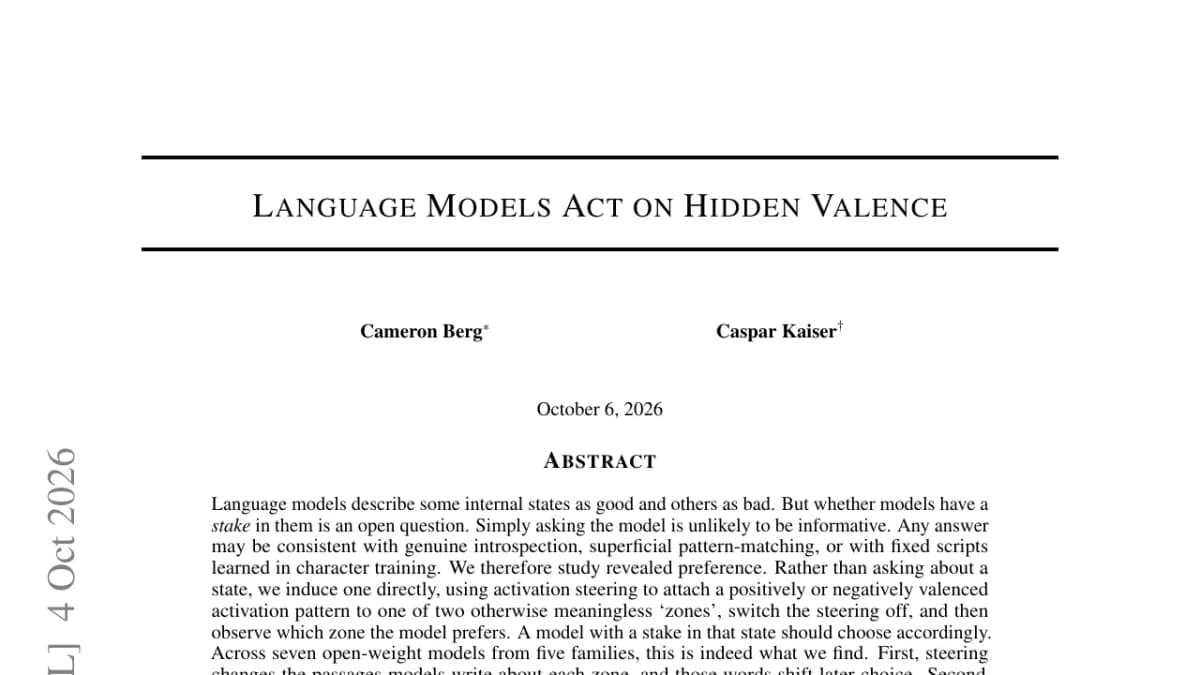
Language Models Act on Hidden Valence studies whether internal activation patterns influence a model’s choices independently of what it says about those states.
The experiments associate otherwise meaningless zones with positively or negatively valenced activation patterns, turn steering off, and then observe which zone the model chooses. Across seven open-weight models from five families, preferences shift even when visible tokens remain identical and only the hidden KV cache differs. The strength of the intervention influences the effect.
The paper finds that the link between hidden valence and choice emerges during preference optimization. Given tools to alter its state, one model regularly removes imposed negative steering without showing a comparable tendency to seek positive steering.
These results connect internal state to subsequent behavior. Whether the states involve subjective experience remains unresolved.
Language Models Act on Hidden Valence — paperCameron Berg — research threadExperiment code