Firecrawl's Juampi followed up his widely shared list of anti-slop skills for writing with a ranked list of seven for coding, each linking to a page on the skills.sh directory. Between them the seven show roughly 32,000 installs, led by Cursor's thermo-nuclear-code-quality-review at 15.5K. Read the SKILL.md files behind the links and the list splits cleanly in two: one of the seven is not a prompt at all, and the other six disagree sharply about how much of your codebase an agent should be allowed to rewrite.
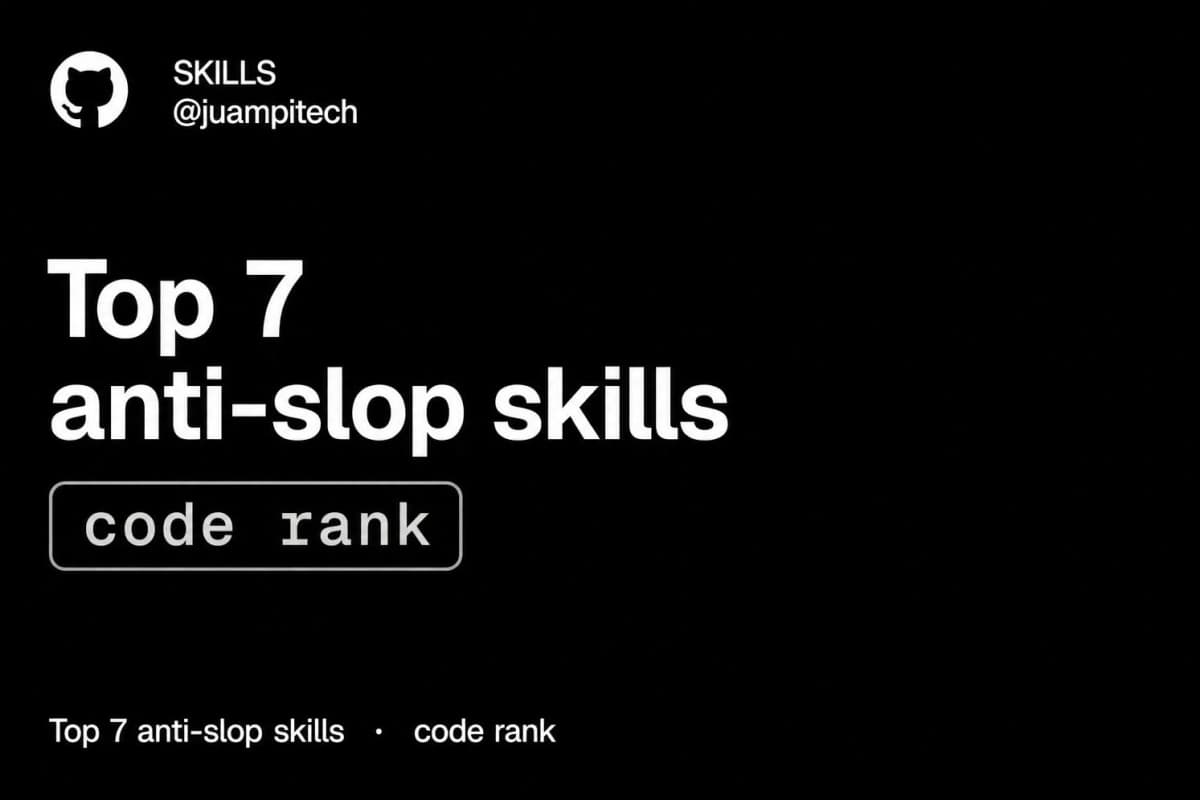
The seven-skill coding list. Credit: Juampi on X.
| Skill | Author | Installs shown | Approach |
|---|---|---|---|
| anti-slop | Dillon Mulroy | 6.7K | Vendored Oxlint rules, not a prompt |
| thermo-nuclear-code-quality-review | Eric Zakariasson (Cursor) | 15.5K | Ambitious restructuring audit |
| deslop | Brian Lovin | 3.9K | Diff against main, strip slop |
| deslop | Cursor plugins | 5.5K | Same, plus explicit guardrails |
| deslop | davila7 | 345 | Fork of Lovin's, adds Python rules |
| desloppify | peteromallet | 64 | Scan/plan/execute/rescan scoring loop |
| code-slop | Asyraf Hussin | 501 | 24 taste rules, PHP/Laravel + TS/React |
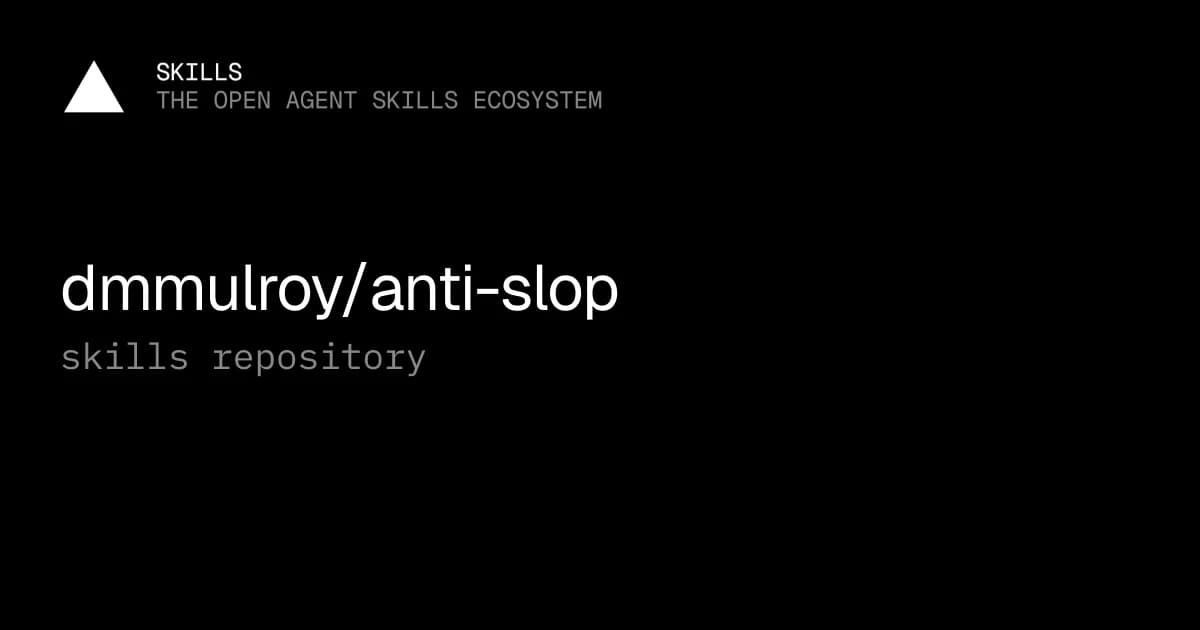
Mulroy's anti-slop is a set of opinionated Oxlint rules for TypeScript and JavaScript, deliberately vendored rather than published to npm: "Copy the rules into your repository, read them, and change them to match your team's standards." The skill people install is the installer — it copies the plugin, pins @oxlint/plugins to the repo's existing Oxlint version, and merges the rules into oxlint.config.ts. The rules themselves target exactly the tells that agent-written TypeScript leaves behind: no-chained-type-assertions ("assertions that fabricate evidence"), no-widen-then-assert, no-unknown-parameters, no-runtime-typeof, no-module-mocking, and require-safety-comment-for-type-assertion, which demands a written invariant next to every non-const as. That is a deterministic check that runs in CI, which puts it in a different category from the six prompts around it. The repo has 4.2K GitHub stars.
The three deslop entries are close variants of one prompt: check the diff against main and remove comments a human wouldn't write, defensive try/catch in trusted code paths, any casts used to dodge the type checker, and anything stylistically inconsistent with the file — then report back in one to three sentences. Cursor's version adds deeply nested code and two guardrails Lovin's original leaves implicit: "Keep behavior unchanged unless fixing a clear bug" and "Prefer minimal, focused edits over broad rewrites." The davila7 fork credits Lovin's repo on its directory page and adds a Python-specific rule about inline imports.
The other two push in the opposite direction. Thermo-nuclear tells the reviewer to hunt for "code judo" moves — restructurings that preserve behavior while making the implementation dramatically simpler — and explicitly not to settle for local cleanup. Desloppify runs a scan-plan-execute-rescan cycle against a strict score and is blunt about scope: "If it takes touching 20 files, touch 20 files." It is also the one entry whose skills.sh security audits are not clean, showing a Socket warning and a Snyk failure. Code-slop is the most formalized of the prompts — 24 rules across six categories (comments, naming, over-engineering, defensive overdose, test slop, style fingerprints), scoped to PHP/Laravel and TypeScript/React, and pitched at "code that passes every metric but reads like a tutorial blog post."
Slop cleanup has become its own tool category, and this list is a decent map of it — but the two axes it exposes matter more than the ranking. The first is deterministic versus generative: a lint rule that fails a build is a different guarantee from a model asked to exercise taste on its own output. The second is blast radius, where "keep behavior unchanged, prefer focused edits" and "touch 20 files if you have to" are opposite bets on how much you trust an agent with a repository it just wrote.
Two caveats. Juampi does not state the ranking criteria, and the order does not track installs — the second entry has more than twice the first's. And the install counts are directory popularity, not evidence that any of these prompts measurably improves code.
Juampi's coding list on Xhis earlier writing listdmmulroy/anti-slopanti-slop READMEthermo-nuclear-code-quality-reviewbrianlovin/deslopcursor/deslopdavila7/deslopdesloppifycode-slop