

Fei-Fei Li's World Labs has introduced Atlas, a world model it calls an "omni model" — pretrained from scratch to operate natively on text, images, video and 3D, and built to generate, reconstruct and simulate scenes rather than just render pretty clips. The headline capability is control: Atlas takes camera poses as a native input type, and can output up to one minute of video at 1440p along a camera path you design, from as little as a single reference image.
The architecture is the part worth reading twice. Atlas is a multimodal autoregressive diffusion transformer: a rectified flow model that generates one sequence element at a time, where each image and depth map is grounded at an explicit 3D position to form what World Labs calls a spatial context. Because it is autoregressive like an LLM, the company says it inherits LLM serving tricks (KV-caching, cache-aware routing, disaggregated serving); because it is a latent diffusion model, it also gets diffusion distillation, classifier-free guidance and VAE work. World Labs frames the control story bluntly: "you are staging the scene, not pulling the lever of a slot machine."
Outputs are not just pixels: Atlas natively predicts depth alongside frames, so it can emit point clouds or 3D Gaussian splats — the same representation used in Marble, World Labs' existing product, which Atlas is slated to power in future versions.
For camera control, third-party human raters were shown a single input image plus a cinematic camera path and asked which model followed it better. World Labs' reported share of voters choosing Atlas:
| Competing model | Share choosing Atlas |
|---|---|
| MiniMax H3 | 75% |
| Gemini Omni Flash | 81% |
| Happy Horse 1.1 | 86% |
| FLUX 3 | 93% |
| Seedance 2.5 | 94% |
For sparse-view 3D reconstruction, mean absolute-relative pointmap error averaged across benchmarks (AbsRel ×10⁻³, lower is better): Atlas 25.3, Pi3X (posed) 28.7, π³ 34.7, VGGT-Ω 1B 36.4, Depth Anything 3 39.3, MapAnything 47.7 — a generalist beating models trained only to reconstruct.
One caveat comes from World Labs itself: Atlas received the camera path in its native camera format, while the baselines got it as text, since they accept nothing else. The post concedes "more sophisticated prompt engineering or creative multimodal prompts could improve camera following for some models." There is no paper, no evaluation code and no released splits to check any of it against.
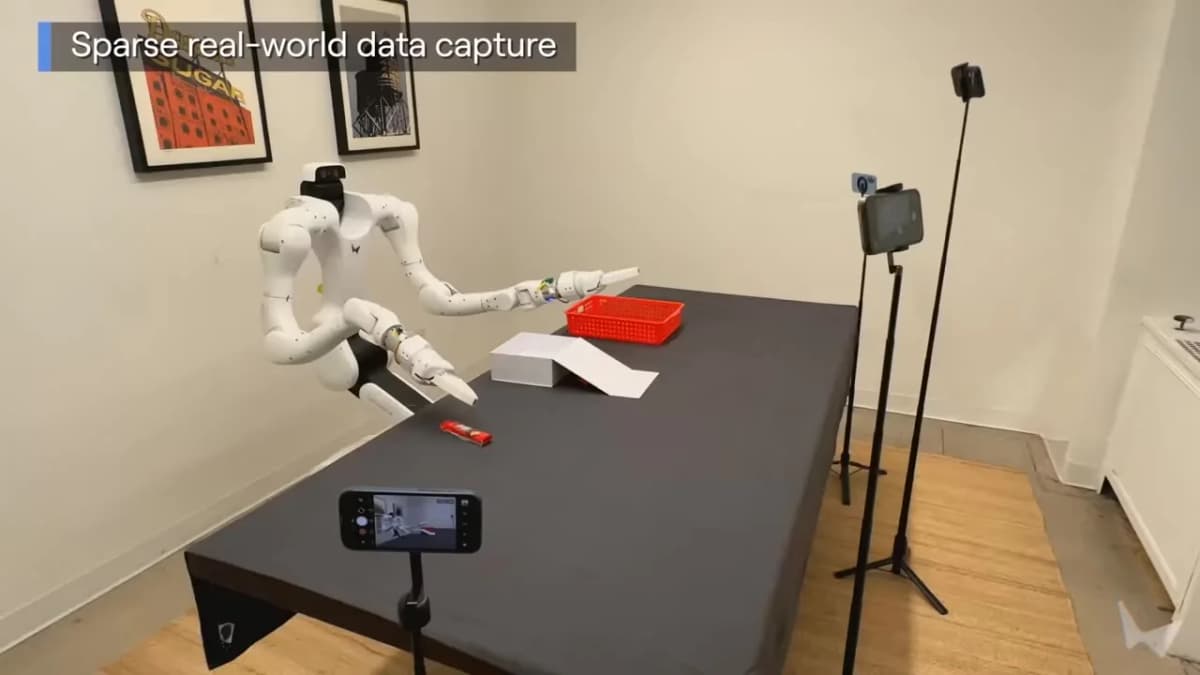
The real-to-sim capture setup: manipulation footage shot on ordinary phones, not a capture studio. Credit: World Labs.
The robotics pitch is the one with the clearest economics. World Labs captured two large environments with a cell-phone video, 24 frames each, then simulated robots navigating them while Atlas generated the RGB and depth its body-mounted cameras would see — world and sensor view from the same model. For manipulation, a few casual recordings become a simulation whose objects, positions, lighting and background can be varied to mass-produce training data. That is a direct attack on the cost of real-to-sim, which today wants expensive rigs.
The other claim is a scaling one: World Labs says each increase in training compute unlocked new capabilities during development, and expects the trend to hold. Whether that holds up is untestable from outside for now. Atlas is entering early access with select partners — no public API, no pricing, no disclosed model scale. World Labs has raised over $1.2 billion, from backers including Nvidia, AMD, Autodesk and Fidelity, per SiliconANGLE, so it can afford to keep the model behind a partner gate while it decides what the product is.
World Labs: Atlas: A World Model for Spatial IntelligenceWorld Labs' announcement on XSiliconANGLE