AI Socratic

DSpark: Confidence-Scheduled Speculative Decoding with Semi-Autoregressive Generation

Federico UlfoFederico Ulfo
June 28, 20263 min read
DSpark: Confidence-Scheduled Speculative Decoding with Semi-Autoregressive Generation

@Hesamation captured the spirit perfectly: put a lab like DeepSeek under GPU restrictions, and they don't slow down — they invent their way to 51% to 400%+ throughput boosts.
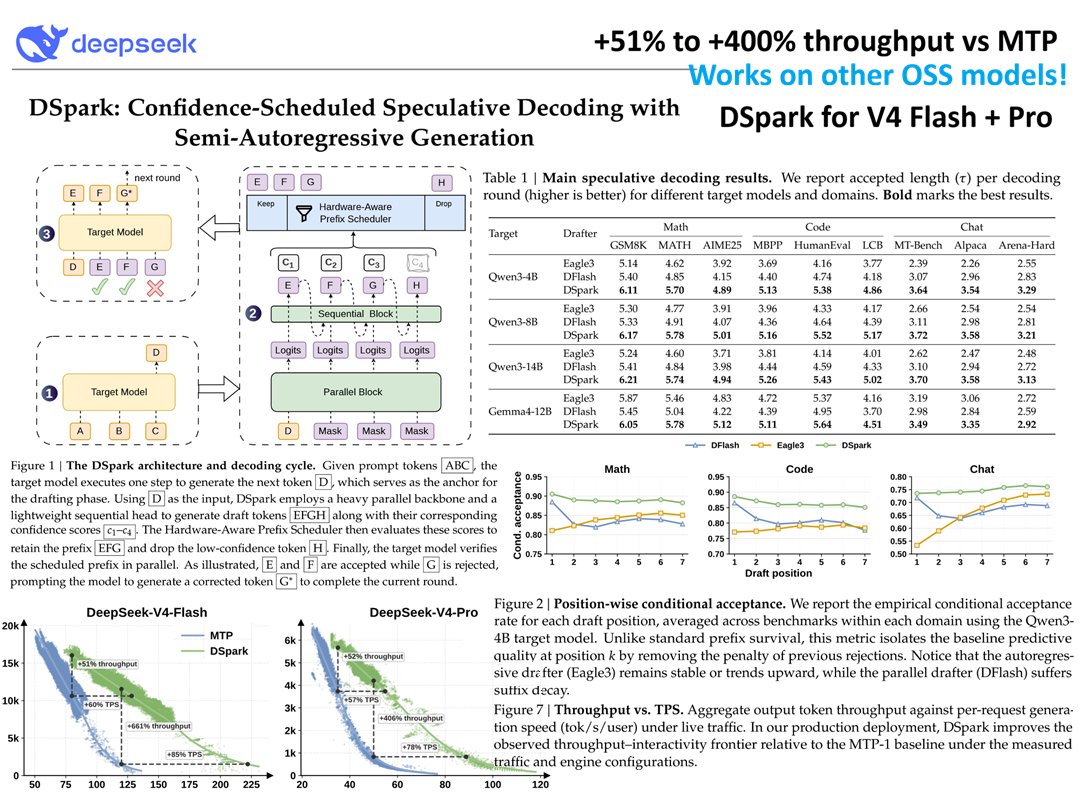
DeepSeek DSpark throughput charts — baseline (blue) vs DSpark (green) across batch sizes and sequence lengths

In the main post, @danielhanchen (of Unsloth) broke it down cleanly: DeepSeek just released DSpark, a new confidence-scheduled speculative decoding method for their V4 Flash and Pro models. It's open-sourced with the full GitHub repo, paper, and Hugging Face checkpoints. Impressively, they also demonstrated strong results when applying it to other open models like Gemma and Qwen.

Why DSpark stands out

  • It combines a lightweight sequential drafter with hardware-aware prefix scheduling and conditional acceptance.
  • Unlike standard speculative decoding, it maintains stability across varying loads and delivers big real-world speedups (see the throughput charts jumping from baseline blue to green DSpark territory).
  • The gains are especially striking at production-relevant batch sizes and sequence lengths.

The deeper context

This isn't just another incremental paper. It's another data point in DeepSeek's pattern of simultaneously advancing models and the surrounding inference stack. While much of the industry focuses on pretraining scale, DeepSeek keeps shipping practical inference breakthroughs that immediately lower the cost of intelligence.

A few thoughts

  • Geopolitical tailwind for open source: Hardware export limits are forcing Chinese labs to optimize ruthlessly. The result? Techniques that spread quickly across the open ecosystem, benefiting everyone running local or cost-sensitive deployments.
  • Inference is the new frontier: Training gets the headlines, but compounding wins in speculative decoding, quantization, and scheduling are quietly making powerful models accessible at a fraction of the price.
  • What doesn't kill you…: The 28–34x cost advantage some are quoting for V4-Pro doesn't come from one trick — it comes from a culture of stacking every efficiency layer possible. DSpark is the latest brick in that wall.

If you care about running capable models cheaply and at scale, this is the kind of release that moves the needle today. Highly recommended to skim the paper — the diagrams on the decoding cycle and position-wise acceptance rates are particularly clean.

Sources: Hesamation's post · Daniel Han's announcement · DeepSeek DeepSpec GitHub & Paper

About the Authors

Federico Ulfo

Federico Ulfo

Founder, Engineer

New York City