Extropic just released a new type of hardware called Thermodynamic Sampling Units (TSUs). Their approach, called thermodynamic computing, flips traditional computing on its head. Instead of fighting against the random "noise" (thermal fluctuations) in electronics to force clean 0s and 1s, they embrace that noise as the core of the computation.
There's a lot of controversy around it, from the hardware design that looks like a 3d printed mesh with unnecessary symbols around it, to the obfuscated technical details.
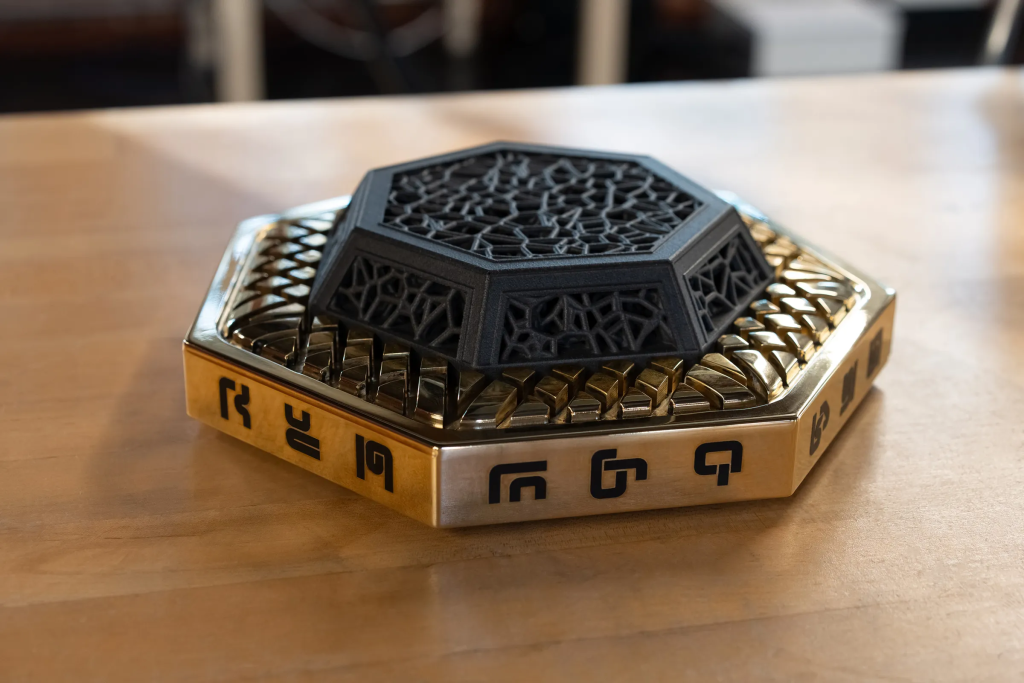
OK let's see how it works (according Extropic writing itself).
The Hardware Foundation: Probabilistic Bits (p-bits) in CMOS Chips
- Traditional chips (CPUs/GPUs) use transistors to suppress thermal noise, locking electrons into binary states (0 or 1) for deterministic logic.
- Extropic runs CMOS circuits (standard silicon tech) in "subthreshold" mode: low voltage, low frequency, where thermal noise dominates. Electrons aren't forced into fixed states—they fluctuate naturally between high and low-energy "wells" defined by neighboring voltages.
- These fluctuations create p-bits, which act like tiny switches that probabilistically flip based on energy. Low-energy states happen more often (higher probability), mimicking natural sampling from a distribution. It's like the electrons are "voting" on the best configuration through physics alone.
The Computation Process: Annealing via Energy Minimization
- You program the chip by setting "starting conditions and constraints" (e.g., voltages that define the energy landscape for your problem, like a Sudoku puzzle or an AI model's probability graph).
- The system "anneals": Electrons interact across the network, redistributing energy until it settles into the lowest-energy state. This happens in parallel—millions of p-bits explore possibilities simultaneously via thermal jitters, drawing samples from the target distribution in essentially one "settling" step.
- Analogy from X: It's like shaking a box of bouncy balls on a hilly landscape—they all roll to the valleys (optimal solutions) at once, instead of one ball searching sequentially. @EarningsNugget This is similar to quantum annealing (e.g., D-Wave systems) but at room temperature, no exotic cooling needed.
The Software Layer: Denoising Thermodynamic Models (DTMs)
- Extropic pairs this with DTMs, an algorithmic architecture for tasks like generative AI. It includes:
- Energy-Based Models (EBMs): Encode your problem as a probabilistic graph (e.g., word probabilities in a sentence).
- THRML Library: A framework (currently simulatable on GPUs/CPUs) that maps these to the hardware. It scales to 1 million p-bits for real demos, like solving optimization puzzles.
- The chip reads analog voltages, computes biases, lets noise settle the state, measures the output, and digitizes it. No heavy numerical simulation—physics handles the sampling natively.
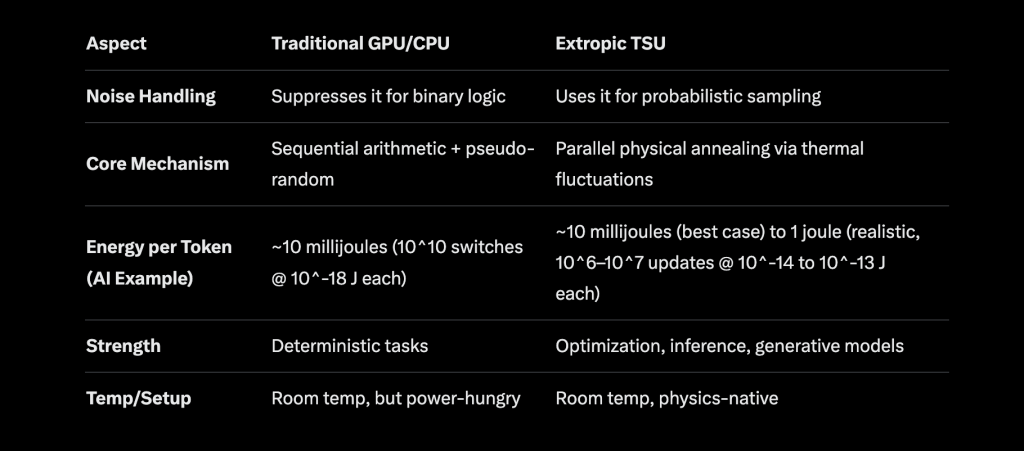
Comparison between regular GPU/CPU and TSU
THRML: (simulated) probabilistic programming language
Extropic also released a probabilistic programming language and a python library to simulate how it runs. How to run THRML by David Shapiro.
