
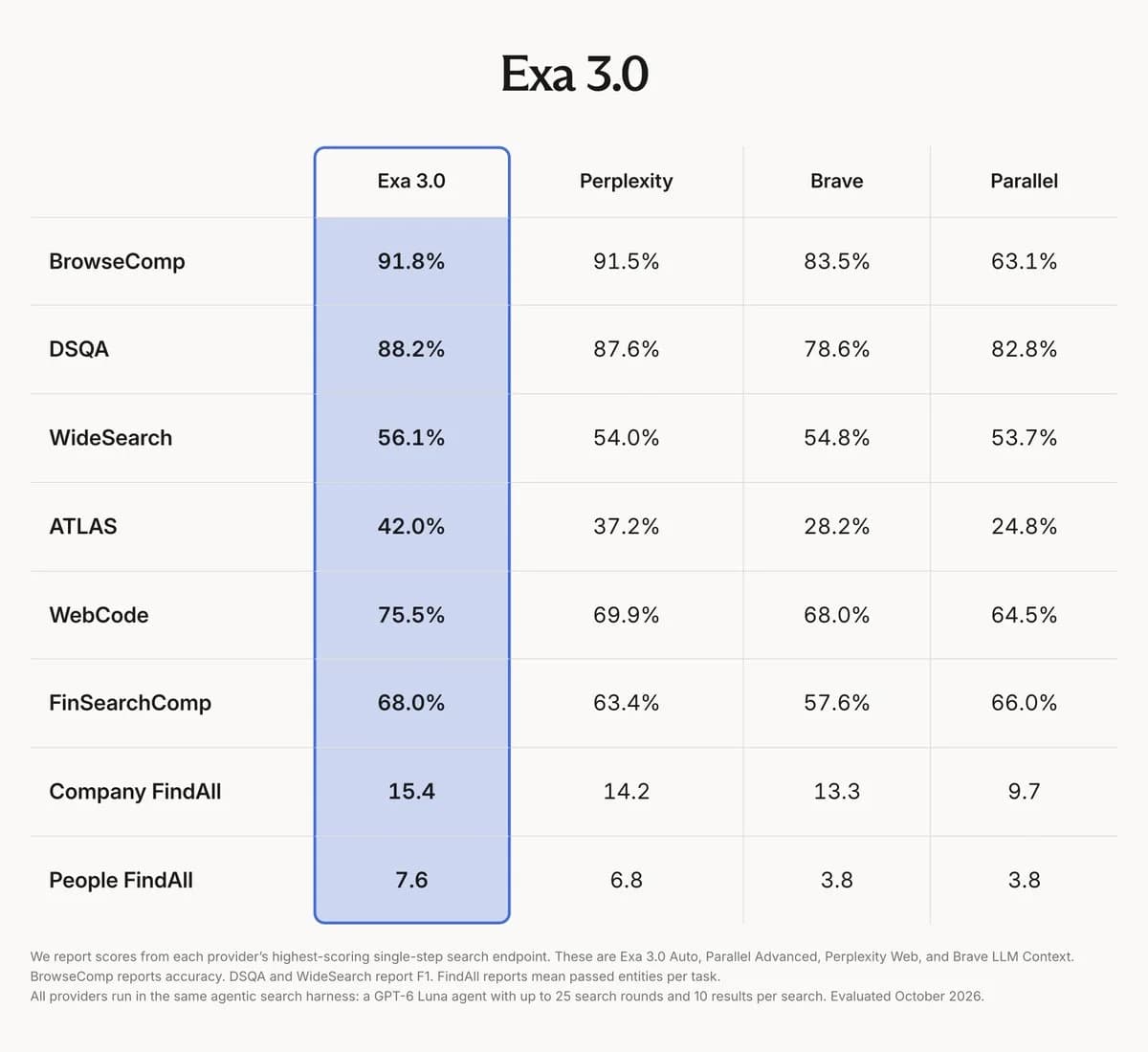
Exa announced Exa 3.0, which it calls its largest improvement to search quality. It says Exa is now #1 on every benchmark it tested, from public evals to verticals such as coding and GTM intelligence. Replies on X also cite a larger embedding model for retrieval and "Dynamic Highlights" that cut tokens by about 95% versus full text. Those two details come from replies, not from Exa's own post.
Exa's launch table: Exa 3.0 against Perplexity, Brave and Parallel on eight benchmarks. @ExaAILabs
The Artificial Analysis Search Index covers 27 products from 14 providers. It averages DeepSearchQA, BrowseComp and AA-Omniscience, all run with GPT-5.6 Luna (medium) as the answer model. Its latest data is dated Oct 19, 2026.
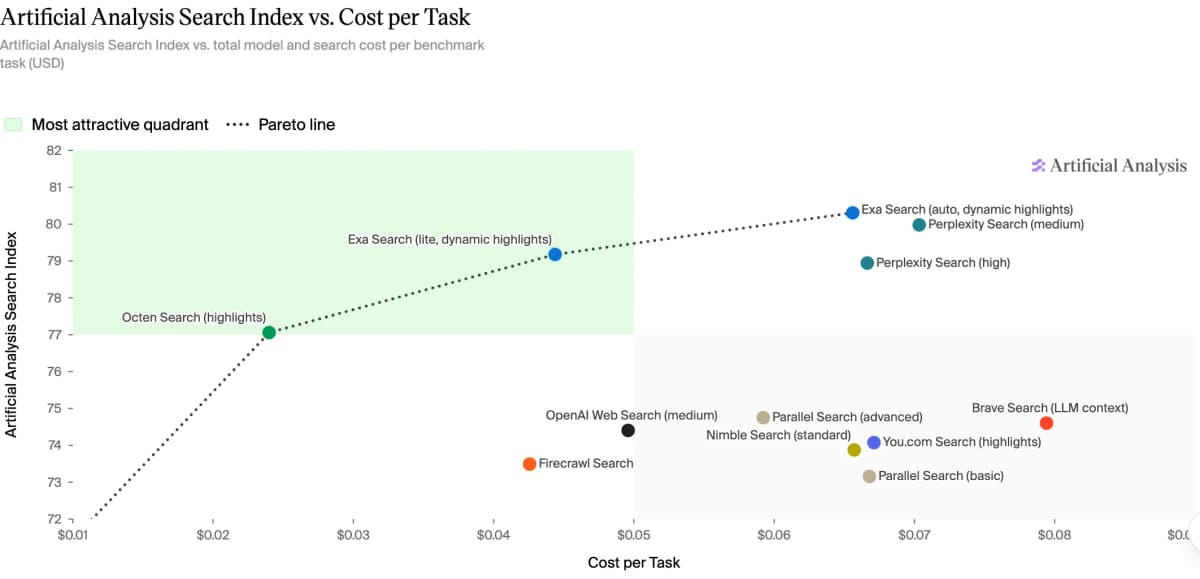
Search Index against total cost per task. Exa lite and Octen sit on the Pareto line; the default view shows 12 of 27 providers. Artificial Analysis
In replies, an Artificial Analysis account said DeepSeek is about 80% cheaper per query than Exa Lite. It said the gap shrinks to about 30% per task, because weaker results led to about 1.5x more searches. It also said DeepSeek scores about 10 points lower on quality.
DeepSeek's API docs describe a Search/Fetch endpoint at /v1/tools/search. It returns ranked results with snippets, longer model-oriented summaries, optional page content, dates and an authority score. Several X replies put its price at $0.75 per 1,000 queries. That figure comes from replies, not from the docs page supplied here.
Search quality is a main bottleneck for agents. The market is splitting into a high-quality tier (Exa, Perplexity) and a cheaper tier (Octen, DeepSeek). Independent data shows that per-query price is not the whole cost, because worse results mean more searches and more model tokens. Teams choosing a search API should compare cost per completed task, not cost per query.
Exa on XArtificial Analysis Search API benchmarkDeepSeek API docs: Search