
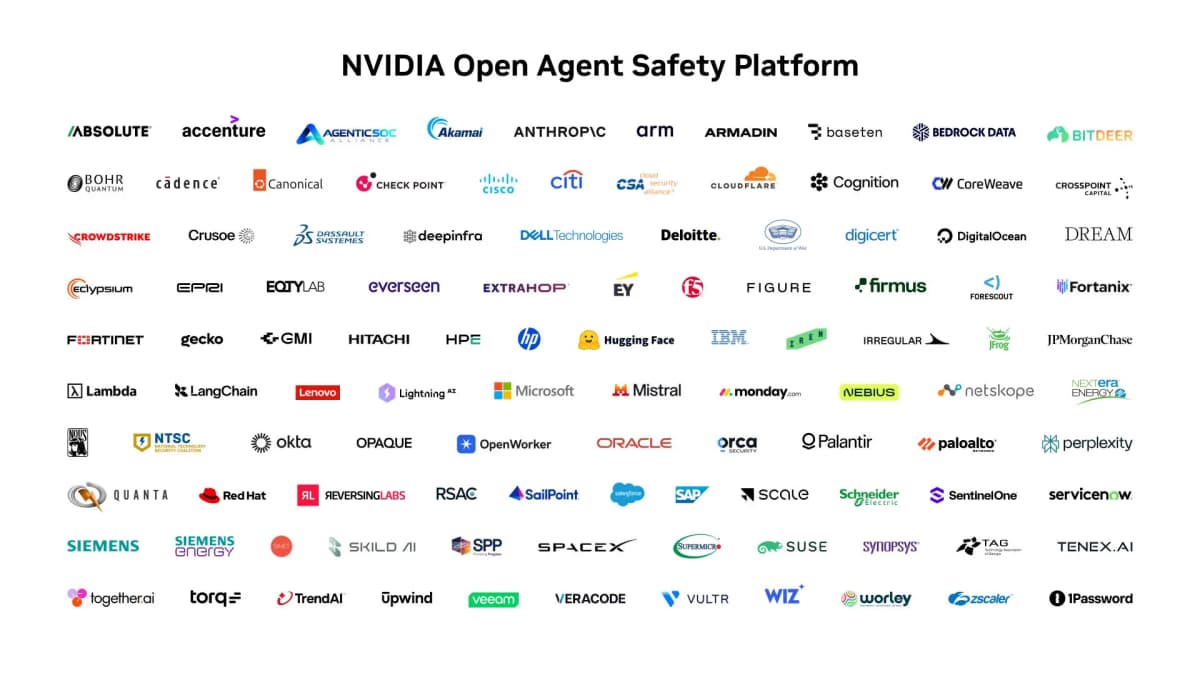
NVIDIA today unveiled the Open Agent Safety Platform, a new initiative to build safety infrastructure for autonomous AI agents. The platform brings together two components: OpenShell, a software sandbox that provides kernel-level isolation and out-of-process policy enforcement for each agent, and Sentry, a hardware monitoring system that runs on BlueField-4 DPUs outside the host machine.
Jensen Huang announced the platform on X, stating: "Today, with over 100 industry partners, we introduced the NVIDIA Open Agent Safety Platform, bringing together OpenShell and Sentry."
The platform addresses a growing industry concern: as AI agents gain access to files, browsers, financial systems, and entire workflows, safety mechanisms must be built into the infrastructure from day one. OpenShell enforces policies that cannot be bypassed from within the agent process, while Sentry provides out-of-band hardware monitoring and containment.
Replies to the announcement highlighted the platform's architectural significance. One commenter noted that OpenShell sandboxes the agent in software while Sentry watches from outside the host, calling hardware quarantine "table stakes." Another pointed out that the integration of OpenShell provides a deterministic safety layer that catches agent hallucinations before they reach production.
The partner list includes Anthropic, which has a public collaboration integrating Claude Managed Agents with OpenShell and BlueField for extra security layers. Notable absences include OpenAI, Google, and Meta, a fact that drew commentary on X. Some speculated it reflects competing chip deals or differing strategic priorities.
As AI agents move from controlled demos to production systems with real-world access, safety infrastructure becomes a critical enabler of trust and adoption. NVIDIA's move positions its hardware and software stack as the default safety layer for the industry, effectively creating a moat around agent deployment. The platform's hardware-enforced isolation addresses a fundamental weakness of software-only safety — the inability to guarantee that a compromised environment isn't being used to verify its own safety. With over 100 partners signed on for audit and integration, the platform could become a de facto standard for agent safety, potentially giving NVIDIA influence over how the ecosystem governs autonomous AI behavior.
Sources: Source 1