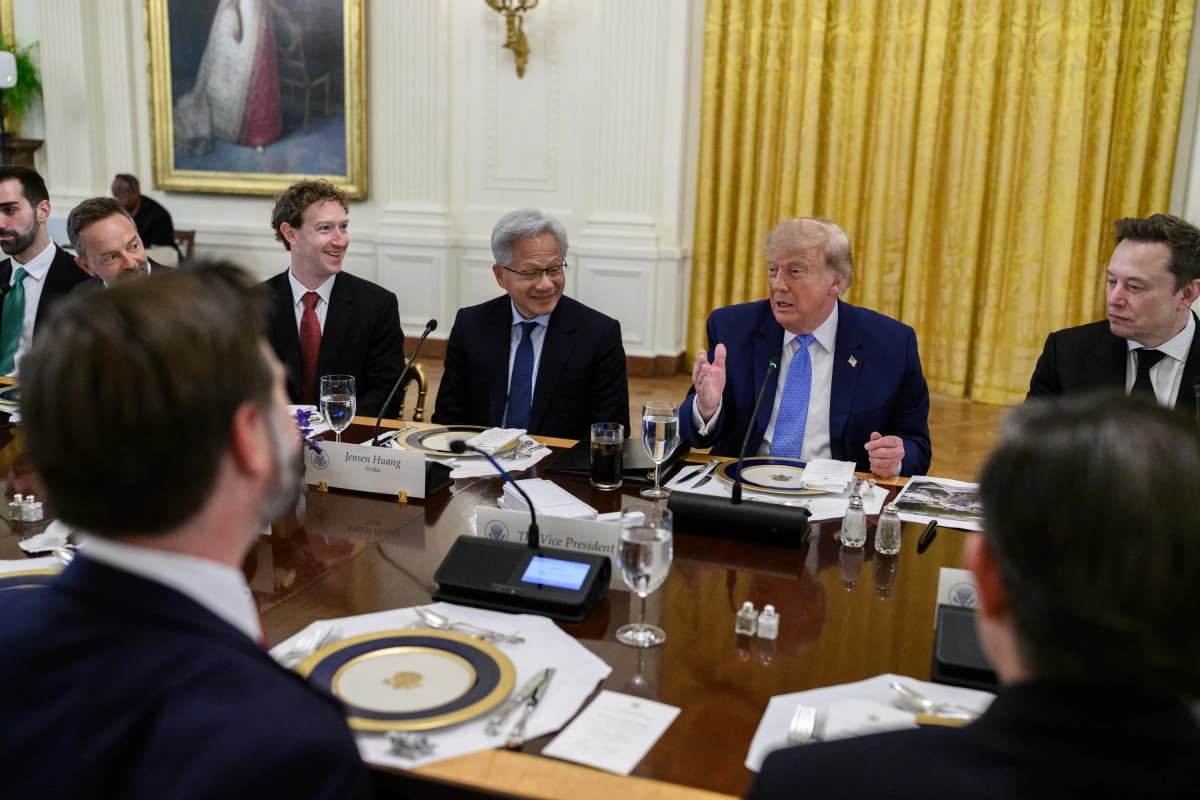
President Donald Trump brought more than two dozen technology leaders to the White House on Tuesday, September 29, for a Super Intelligence Luncheon. Nvidia CEO Jensen Huang sat immediately to his right and Elon Musk to his left. The gathering produced a voluntary safety accord and a new official name for AI in the executive branch, while Trump backed industry self-regulation.
Official White House photo by Daniel Torok, public domain. White House photo gallery.
The East Room guest list included Meta’s Mark Zuckerberg, Google’s Sundar Pichai, Anthropic’s Dario Amodei, OpenAI President Greg Brockman, Amazon’s Jeff Bezos, Microsoft’s Satya Nadella, AMD’s Lisa Su and Palantir’s Alex Karp. House Speaker Mike Johnson co-hosted. OpenAI sent Brockman while Sam Altman remained at the company’s conference in San Francisco.
Trump shared the seating chart on Truth Social beforehand. Huang and Musk occupied the seats beside him, Zuckerberg and Pichai sat nearby, and Amodei and Brockman were farther down the table.
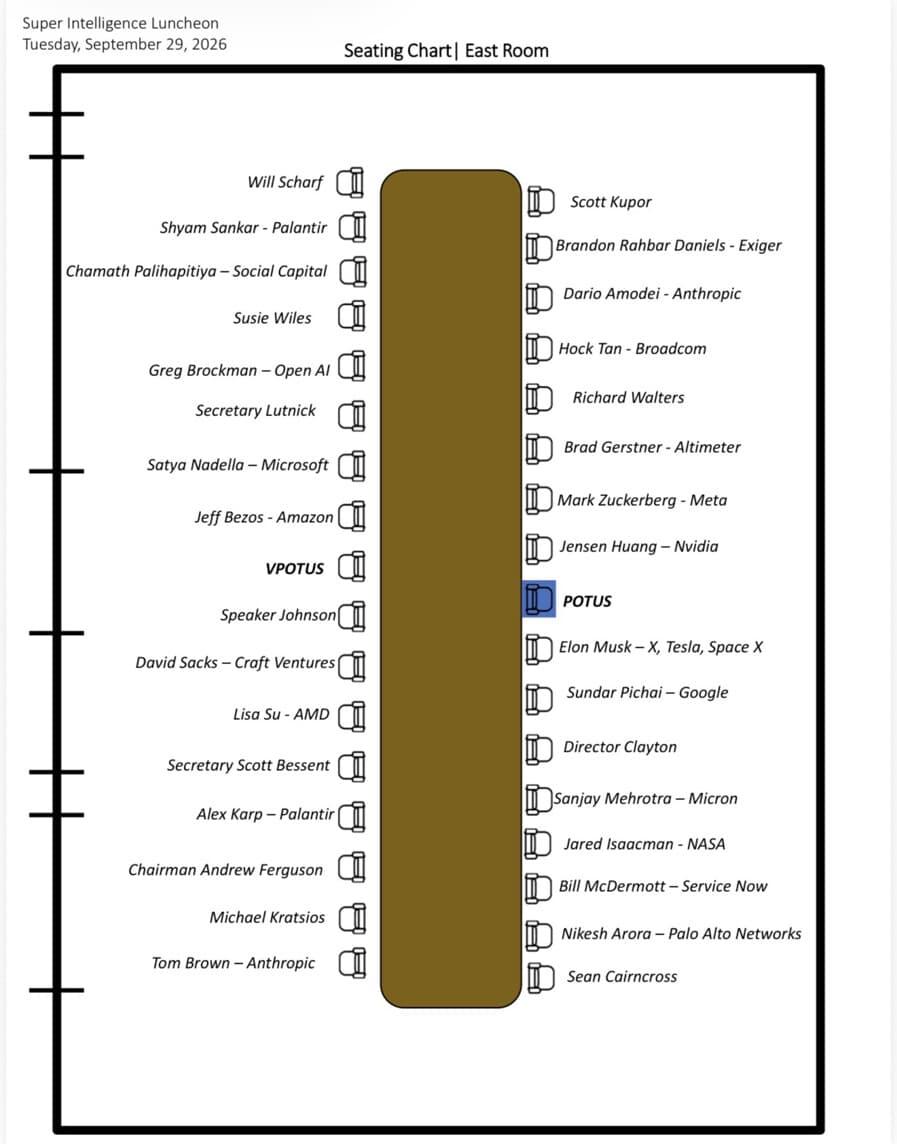
The seating chart Trump shared before the lunch. Source: Trump’s Truth Social post, preserved by Trump Archive.
Official White House footage of the meeting and luncheon. Watch at the White House.
The centerpiece was the White House Accord on Super Intelligence: Joint Commitment on Frontier Responsibilities. Trump and executives including Amodei, Brockman, Huang, Musk, Pichai and Zuckerberg signed the one-page agreement. It calls for internal controls, external audits and board-level review of cybersecurity, biosecurity and unintended model behavior. The pact sets voluntary commitments rather than new mandatory federal safety rules.
Trump called it “morally binding” and compared it to a constitution. He said existing law enforcement would still have a role, while companies should take responsibility for regulating themselves. He also floated a committee of about 10 people to oversee the industry and said he would name an AI policy lead in the coming days. Read his post-lunch remarks.
The same day, Trump signed an executive order directing agencies to use “Super Intelligence” and “SI” in official correspondence, public communications, policy documents and other non-statutory executive-branch documents. He had promoted the name at the United Nations the previous week, arguing that “artificial” made the technology sound fake. The order changes government terminology; it does not establish that today’s systems have achieved technical superintelligence.
Data centers were also on the agenda. Trump welcomed their expansion and said companies would work to address local opposition. He argued against slowing development and cast maintaining a U.S. lead over China as a priority. That lead was the president’s characterization, rather than a measured finding presented at the lunch.
Trump and technology executives answer reporters outside the West Wing. Recorded September 29; posted by the White House September 30. Official video.
The lunch followed Trump’s private dinner with Amodei on Sunday, their first one-on-one meeting. The outreach came amid tensions between Anthropic and the administration over safety. According to reporting by The Next Web, Amodei raised safety concerns during the luncheon, and Karp said on his way in that the industry needed to acknowledge risks it already understood.
The agreement therefore leaves a practical question: how will companies’ voluntary promises translate into enforceable accountability as their systems become more capable? The public message from Trump was clear: rapid development, industry-led safeguards and competition with China.
The seating chart supplied material for very different political readings. These are individual social-media reactions, not evidence of consensus or verified measures of the guests’ wealth and employment.
The politics of proximity. @carolelucky paired a seating infographic with commentary about Musk and Huang’s proximity to Trump and Amodei’s more distant seat. The infographic is the poster’s interpretation; seating alone cannot establish political motives.
Infographic from @carolelucky’s post, reproduced as social-media commentary.
A partisan meme. @Rosainc77 celebrated the guests as builders and innovators, asserted a combined $1.8 trillion net worth and 2.5 million jobs, and attached a horse-and-rider meme mocking Democrats. The attached image is a partisan joke rather than the seating chart. The financial and employment figures are the poster’s unverified claims.
Meme attached to @Rosainc77’s post. It expresses the poster’s political opinion.
The chart as a flex. An earlier post from the same account used similar wealth-and-jobs rhetoric, this time with the actual seating-chart screenshot attached.
The seating-chart screenshot in @Rosainc77’s earlier post.
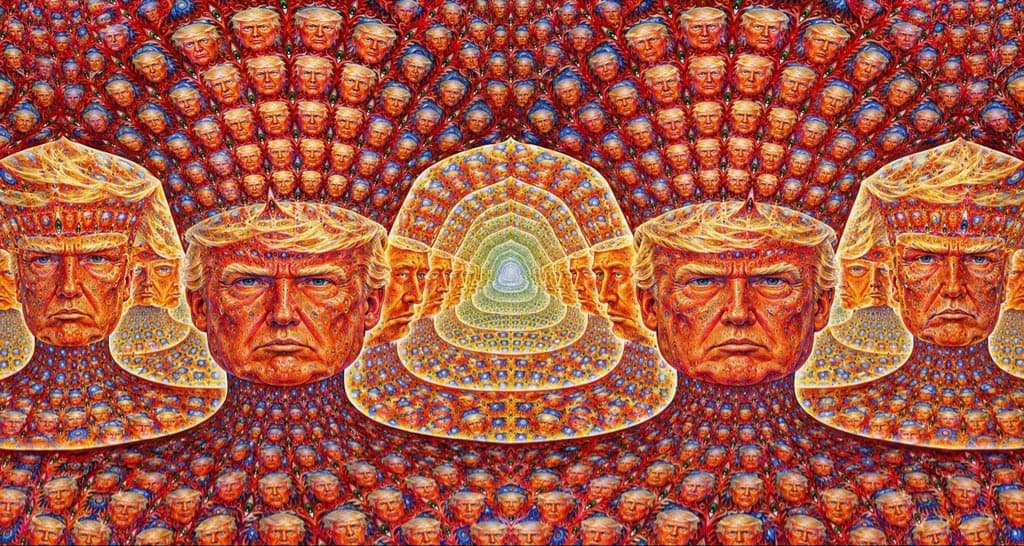
@jiratickets jokes about Dario Amodei’s point of view after a “cough drop” from Alex Karp. This is a surreal meme, not a factual claim about the luncheon.
@kyliebytes shares the clip with the caption “i have watched this video 20 times.” Video credited by X to Eric Daugherty.
Sources: White House executive order · Official photo gallery · Luncheon video · Post-lunch video · Post-lunch transcript · The Next Web · Reuters · Axios on Amodei’s dinner
White House executive orderOfficial White House photographsOfficial luncheon videoOfficial post-luncheon press videoPost-luncheon remarks transcriptThe Next Web reportingReuters: voluntary accordSeating infographic reaction on XPartisan meme reaction on XSeating-chart reaction on X@jiratickets meme reaction on X@kyliebytes meme reaction on X