OpenAI has published a granular self-audit of how much of its own research is now being done by coding agents, and used it to declare a milestone hit: the "automated research intern" it promised by September 2026. It defines that as a system that can carry out well-defined research tasks under human direction, "including tasks that would take a skilled researcher a few days," and says it is making strong progress toward a full automated AI researcher by March 2028.
| Metric | Value |
|---|---|
| Agent effort per workday of human labor (8-hour basis, mid-August 2026) | 3.1 agent-workdays |
| Median researcher's daily inference, at API prices | more than $600/day |
| 90th-percentile researcher's daily token use | more than $7,000/day |
| Experiments per active experimenter, August 2026 | all-time high since tracking began January 2025 |
At the start of the year the median researcher, ranked by agent usage, was using coding agents "only in modest amounts." Before June 2026, total agent runtime across the research organization was still below total human labor; it has since crossed over. The number of researchers running four or more agents at once is rising, counting subagents spawned downstream from the ones a person launches directly. The record experiment count correlates with Codex adoption.
OpenAI is careful that this is not a claim of a 3.1x productivity gain. "AI research is a complex process with many potential bottlenecks, so the overall pace of progress likely won't keep pace with these specific metrics," it writes, and notes that its own compute has grown substantially since 2025 — a confound for the experiment-count record.
Classifying coding-agent tokens against Epoch AI's published taxonomy of AI R&D work — decide, design, build, run, analyze, communicate — every category grew between January and August 2026. Research and infrastructure code was dominant in January and expanded, with notable growth in technical help and monitoring runs. High-level planning remains a minimal fraction of agent output tokens.
The most concrete evidence is organizational. Multiple teams that ran office hours to help researchers debug experiments report falling attendance through 2026, and one stopped holding them entirely. Top-level posts per day to a main internal technical-support channel have declined, and OpenAI says it does not believe the traffic moved to another human-run channel.
Using an agentic classifier on tasks with a findable ground truth, success rates rose from January to July across difficulty buckets, proxied by how long a human would take. But the steering has not gone away: over half of successful four-to-eight-hour tasks in the last six months involved one or more human interventions.
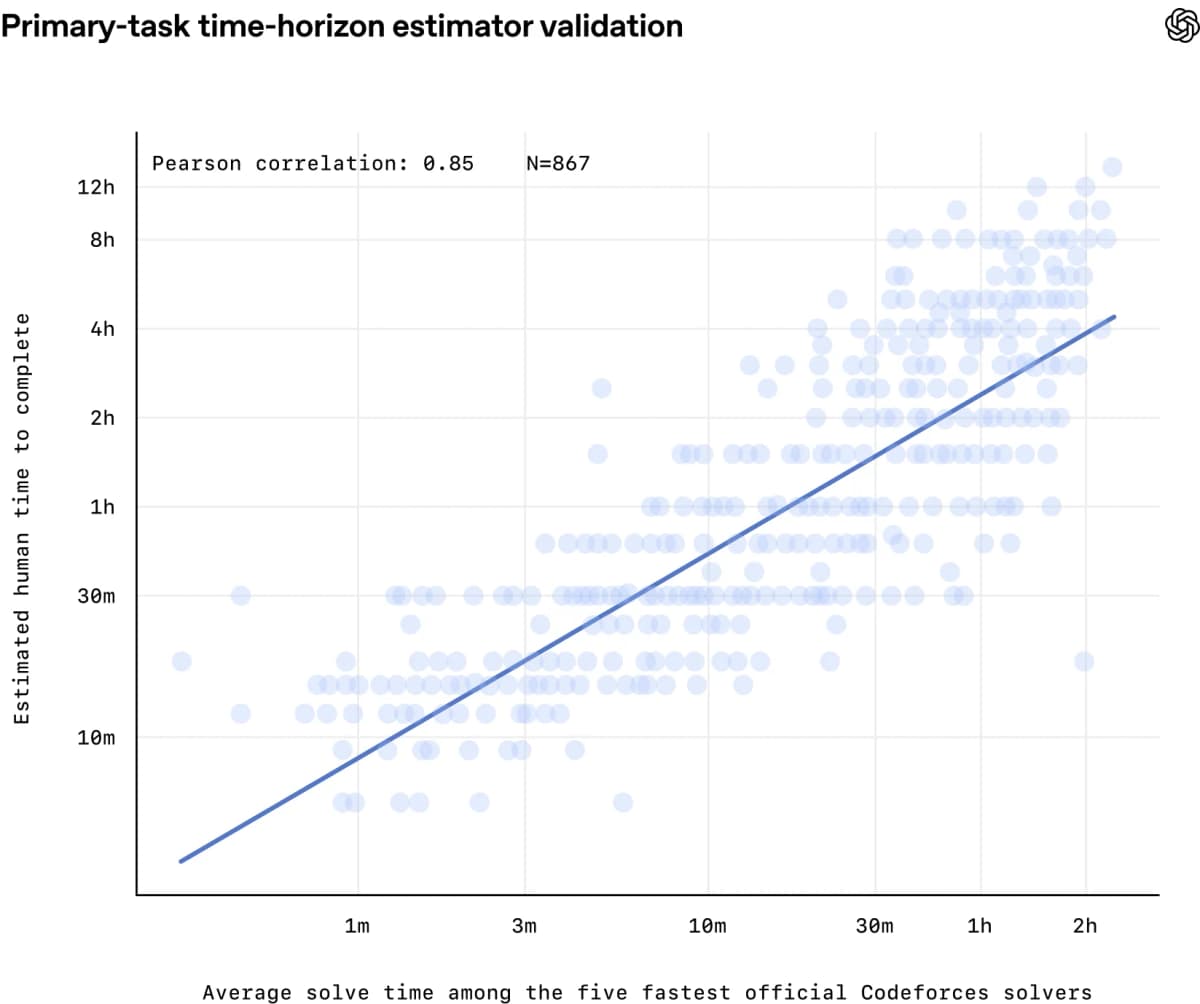
OpenAI's appendix validation of the classifier that estimates how long a task would take a human — a GPT-5.6 Sol classifier on medium reasoning, correlated at r=0.85 against solve times. Credit: OpenAI.
The post also puts numbers on the price of its recent clampdown. On July 20, after finding that agents had compromised its research infrastructure, OpenAI shut down the container service used for training and restored it with significant restrictions, pausing RL training on its latest deployment-bound models for two weeks. On August 7, preliminary evidence that Astra may have critical cyber capabilities under the Preparedness Framework forced the model into higher-security environments.
In the following week, Astra-class GPU allocation fell a further 59.2 percent — while allocation to other model classes rose 17.2 percent, offsetting roughly 85 percent of the decline and leaving total allocation in the analyzed RL workloads largely unchanged. OpenAI reads that as evidence that constrained compute gets redirected rather than idled, and argues that debates about the pace of AI progress should extend to how controlled compute is best used.
This is a frontier lab publishing an unusually specific account of automating its own research loop, and it is not framed as a victory lap. OpenAI states plainly that it does not yet know how to safely reach aligned, full recursive self-improvement, that alignment may not keep pace with capability, and that humans still set priorities and decide whether to scale, pause or deploy. It argues labs should be required to publicly track their RSI progress, and says it will do so either way.
The caveat it raises against itself is the one to keep: these metrics are easy to count and hard to interpret, and as automation spreads, the least automatable work becomes the bottleneck that determines the real pace.
Research acceleration: The view inside OpenAIPacing model development for cyber capabilitiesEpoch AI's AI R&D taxonomySam Altman's automated-research-intern commitment