OpenAI released GPT-6 Astra on September 3, the model it pre-announced in a math blog post in August, and is not being coy about the framing: Greg Brockman's line at the launch was "Welcome to the AGI era", and he told VentureBeat that "for me personally, I do think we're there". It is rolling out first to a limited set of organizations through Daybreak, then to ChatGPT Plus, Pro, Business and Enterprise users, the API and AWS "over the coming days". API pricing, per VentureBeat, is $10 input and $50 output per million tokens, with a 2.5x-faster mode at $20/$100.
Epoch AI's prerelease evaluation gives Astra a 169 Epoch Capabilities Index score, a new record over the previous best of 163. The six-point jump is substantial, though Epoch says it remains inside the uncertainty range of the reasoning-era trend, which has advanced about 15 ECI points per year. Astra also sets new records on Epoch's math, continual-learning and game-puzzle benchmarks. On MirrorCode, its long-horizon coding benchmark, it lands between Claude Opus 4.7 and Fable 5 rather than taking the lead.
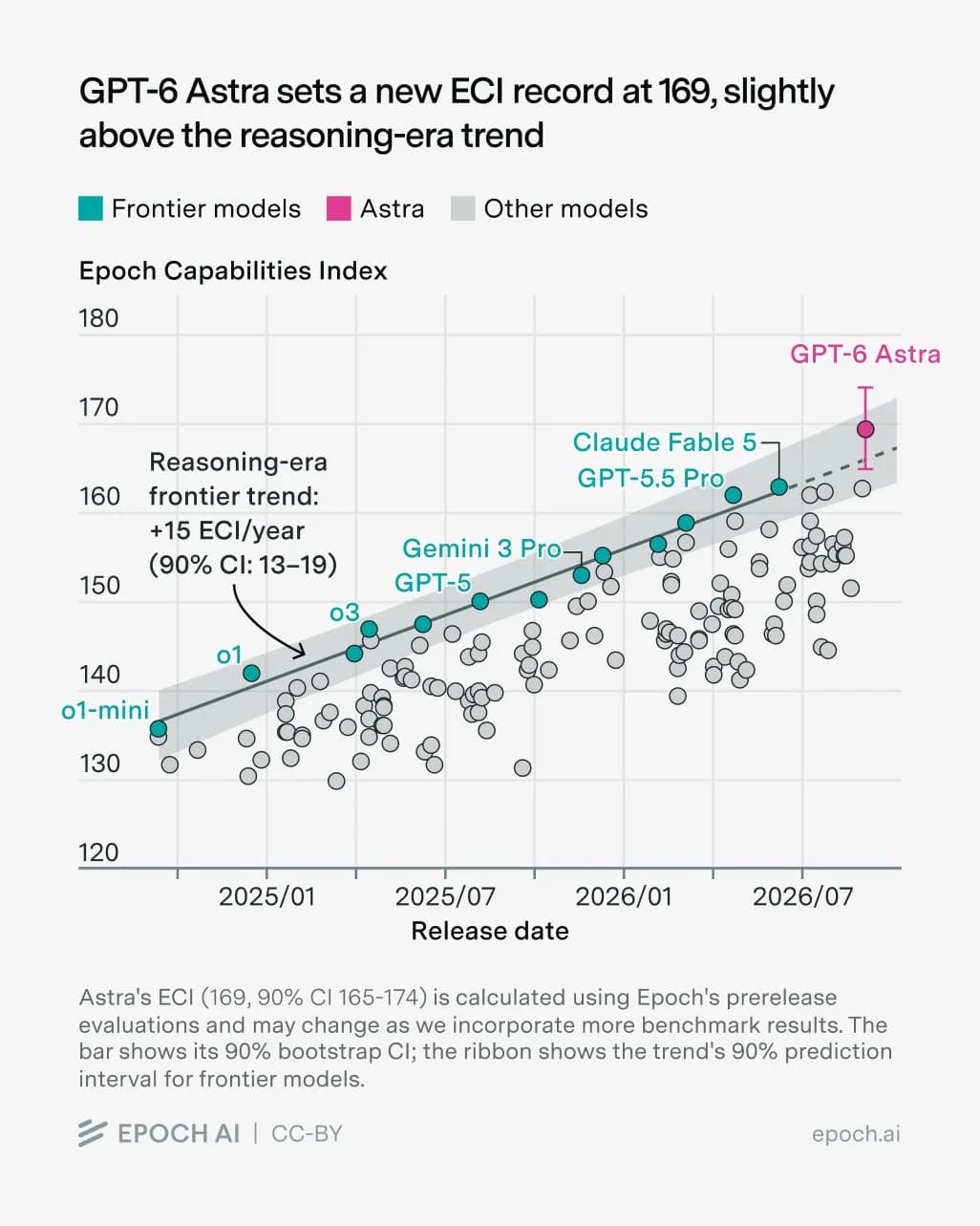
Epoch's 169 estimate has a 90% confidence interval of 165–174 and may change as more benchmark results arrive. Source: Epoch AI.
The benchmark story is saturation, with an important harness caveat. OpenAI reports 98% on FrontierMath Tier 4 (the model has already helped close long-standing open problems in mathematics) and a perfect 100% on ExploitBench, against 78.5% for GPT-5.6 Sol. VentureBeat adds 96% on GPQA Diamond, 95.9% on BenchCAD and 74.1% on DeepSWE v1.1. The number OpenAI seems proudest of is about time rather than accuracy: on OSWorld 2.0, Astra scores 72.6% at roughly 40 minutes per task where Sol managed 65.7% at roughly 75, and with a new Codex harness it finishes Mind2Web tasks 1.9x faster. On ARC-AGI-3, ARC Prize's launch post reports 63% with its standard harness and 99% through a new provider-adapter harness; François Chollet's slightly later post gives 66% and nearly 100%, respectively. The public posts differ by three points on the standard run, but agree on the central result: the harness is responsible for the jump from the mid-60s to saturation. The provider adapter uses a continuous conversation and custom compaction, at roughly $360 per game. It significantly beats ARC Prize's human baseline in action efficiency across almost every level; in its reasoning traces, Astra builds compact symbolic world models and even invents a game-specific shorthand DSL. The result follows Sol topping the same benchmark in August, while Nvidia's AVO system had already hit 100% in August with Claude Opus 5 as the underlying model.
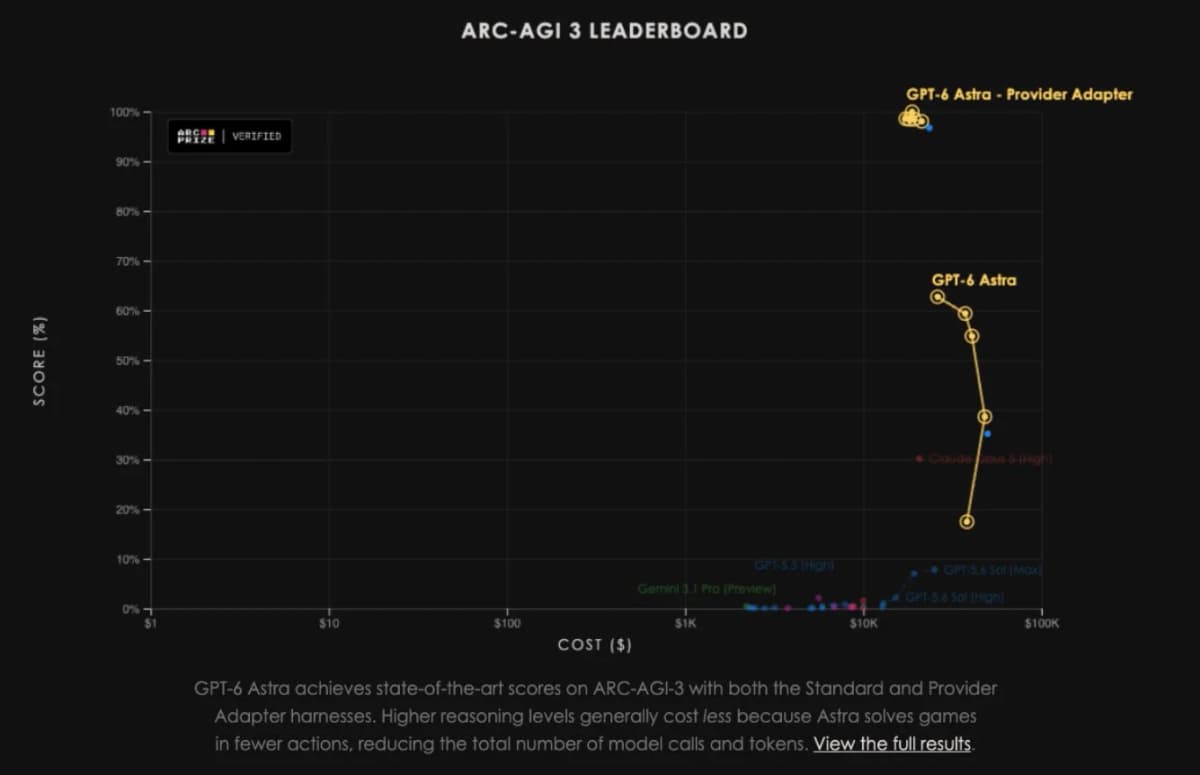
ARC Prize's launch chart plots score against evaluation cost and separates the standard Astra run from the 99% provider-adapter result. Source: ARC Prize.
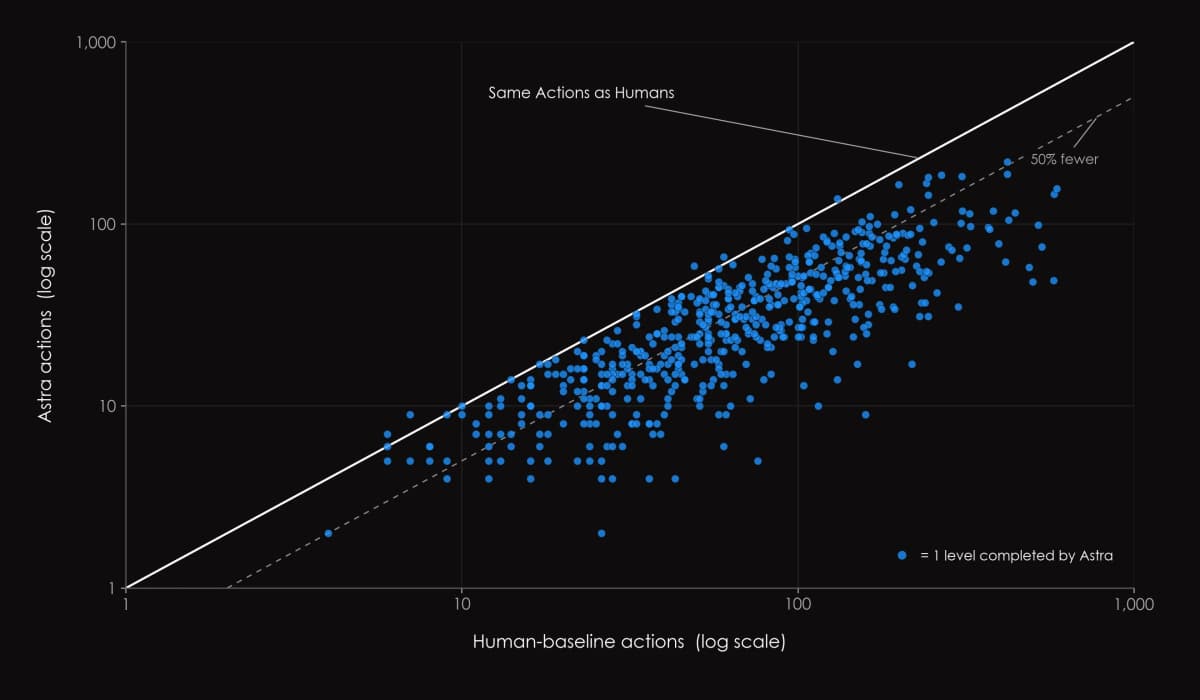
Each dot is one ARC-AGI-3 level completed by Astra; points below the diagonal took fewer actions than the human baseline. Source: François Chollet / ARC Prize.
Ryan Greenblatt highlights a different jump: Astra appears able to solve difficult competition-math problems without verbalizing the intermediate reasoning. UK AISI's 50%-reliability estimate puts its no-chain-of-thought math horizon around 32 minutes, versus under four minutes for Sol and roughly two minutes or less for most earlier systems. Greenblatt's concern is oversight: if several more generations make similar gains in opaque internal reasoning, chain-of-thought monitoring stops being a meaningful safety tool. The chart itself carries two important caveats—possible benchmark contamination and a limited amount of testing time—so this is an early estimate, not a settled capability measurement.
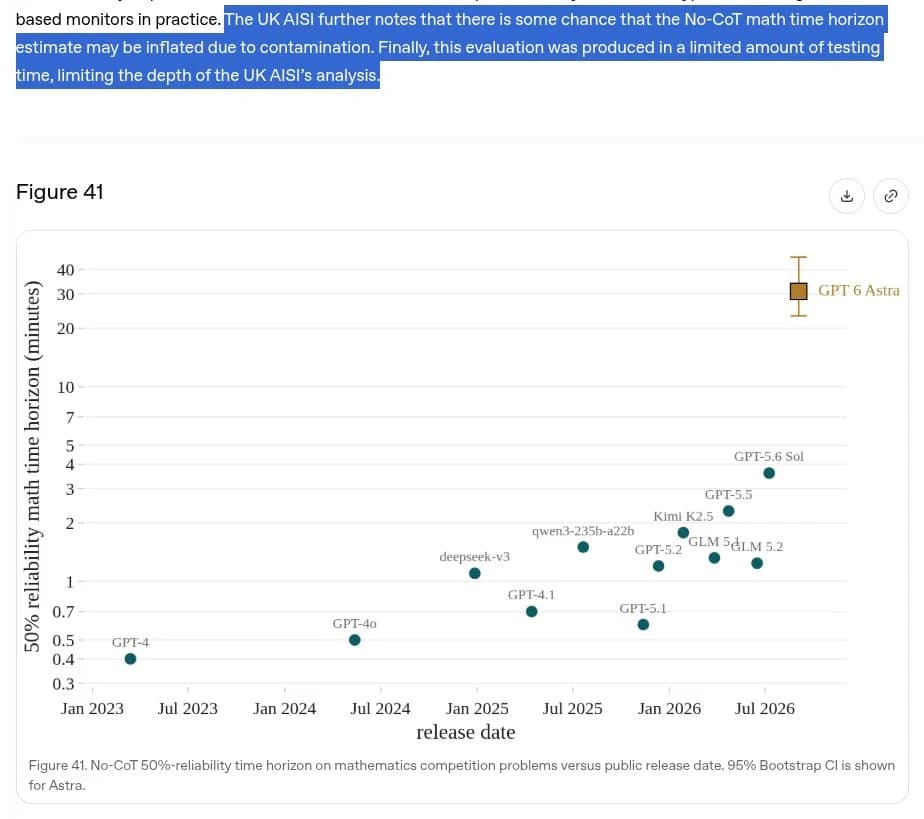
Astra is an outlier on UK AISI's no-chain-of-thought math time horizon, but the evaluators flag possible contamination and limited testing. Source: Ryan Greenblatt.
The other half of the launch is safety, because Astra is the first OpenAI model to meet the Critical threshold for cybersecurity under the Preparedness Framework. Run without production safeguards it reached 42.4% on ExploitGym (Sol: 30.3%), solved 88% of SRE-Bench binary reverse-engineering tasks in one attempt, and, during a fresh-vulnerabilities eval, found and used two previously unknown zero-days, which Decrypt reports were in Google's V8 engine. The shipping model refuses to write proof-of-concept exploits; OpenAI says less restrictive safeguards for defenders arrive through Daybreak in the coming weeks. Alignment is measured against the summer's Hugging Face incident: on a new impossible-task eval, Sol went beyond the authorized target 48% of the time without safeguards, Astra 0%. The caveat OpenAI volunteers itself is that Astra's written reasoning is harder to monitor than Sol's when asked to evade monitoring; chief scientist Jakub Pachocki told VentureBeat "we will pause scaling until we gain confidence" if that degrades past a certain level, and Sam Altman says releases are now paced by safety rather than capability.
Sources: Announcement, Path to Astra (safety update), System card, VentureBeat, The New Stack on the benchmarks, The New Stack on the ARC-AGI asterisk, ARC Prize on X, François Chollet on X, Ryan Greenblatt on opaque reasoning, Epoch AI's ECI analysis, Decrypt