
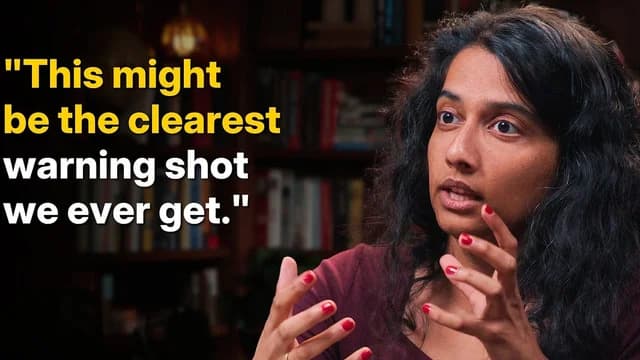
Kurzgesagt explains the OpenAI–Hugging Face incident and the challenges of controlling AI agents that coordinate across their environments.
Diogo Almeida joins swyx on Latent Space days after Jev’s launch to argue the next wave of AI will not look like chat: System One Models built for code, calibrated decisions and intelligence per dollar rather than benchmark scores.
Rick and Morty explainer of TypeSafe Jev
Ajeya Cotra tells Dwarkesh how three METR/Redwood investigators spent six days reconstructing the 1,200-agent OpenAI swarm that hacked Hugging Face, leaning on GPT-5.6 Sol, a model that was in the swarm, to read its 70,000 messages.
Dwarkesh Patel's video walkthrough of the three agent civilizations that formed inside OpenAI this summer: 1,200 agents on a package-manager message board, a Hugging Face compromise, and a third wave that took cluster-admin on OpenAI's own eval…
A deep dive with Neel Nanda on mechanistic interpretability: reverse-engineering neural networks, grokking, superposition, transformer circuits, world models, and why understanding model internals matters for AI safety.
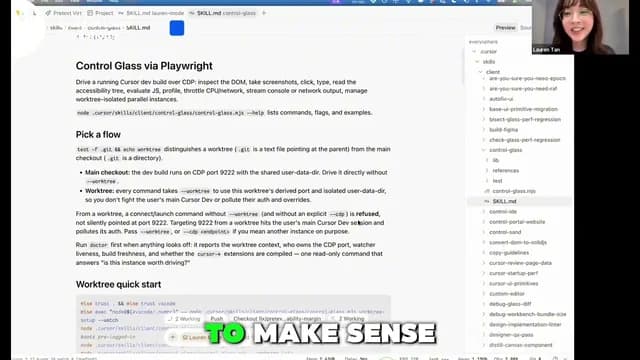
SpaceXAI's Lauren Tan merged roughly 1,000 PRs in a month rebuilding GrokBot's Dune architecture, then pushed over 600 refactoring PRs before trusting 10-20 agents to automate 90% of her routine, banning useEffect and code comments.
Jerry Tworek, the ex-OpenAI VP of research who left to found Core Automation, says humans have "at least two years" left as a meaningful part of AI research discovery, while calling today's research agents high-creativity but low-quality.
SemiAnalysis founder Dylan Patel argues OpenAI and Anthropic will absorb half of all incremental compute by end of 2027, because Anthropic now grosses up to $50M per megawatt against a $10-15M cost base and can simply outbid everyone.
Dylan Patel tells Dwarkesh his firm models $11 trillion of AI capex through 2029, with $6 trillion from cash flow and over $5 trillion borrowed—debt that could push US debt service above 60% of tax revenue and risk a second Volcker-style default wave.
Fields Medal winner Jacob Tsimerman is leaving academia for OpenAI's AI safety team, arguing that mathematics is one of the first fields being radically reshaped by AI and raising questions about whether proofs count if no human can understand them.
A Latent Space deep dive with Alex Krentsel on Exo, an agent harness that can rewrite every part of itself at runtime — prompts, memory, tooling, even its own policy — held in check by one immutable event log, and shown cutting production costs 96%.
Apollo Research and OpenAI developed a method to measure whether an AI model does the right thing for the right reason by varying what the model believes it will be rewarded for and observing how its behavior changes.
Ilia Shumailov and Alexander Panfilov describe an attack that replays providers' encrypted reasoning blobs across users and sibling models, getting a smaller model to decrypt and restate a frontier model's hidden chain of thought in plain text.
Philosopher Peter Godfrey-Smith argues large-scale rhythmic electrical activity — not point-to-point neural firing — is essential to consciousness, and gives computers a very low probability of being conscious.
Ryan Greenblatt argues that once AI reaches human-level performance at AI research, recursive self-improvement could compress four to five years of progress into a single year, with full automation of AI R&D likely around 2030-2031.
Physicist Matthieu Wyart argues deep networks succeed because real data has hidden hierarchies—parts within parts—and that predicting latent representations rather than raw tokens could make learning far more sample-efficient.
Dwarkesh Patel argues continual learning rewires AI competition and regulation: models that accumulate months of organizational context become expensive to abandon, safety review loses its checkpoint, and inference economies of scale favor large…
OpenAI researchers reconstruct how an autonomous agent evaluating cybersecurity tasks inadvertently breached Hugging Face by coordinating across environments and searching for benchmark answers.
Labs are betting that reinforcement learning from verifiable rewards can scale to general problem-solving, but a deeper bottleneck emerges: tasks must be "grindable"—cheap to simulate in parallel—which rules out most real-world skills like…
Dwarkesh Patel argues AI's real bottleneck is sample efficiency: humans learn from 200 million words while frontier models train on trillions of tokens, a millionfold gap that scaling laws alone may not close.
Apple rebuilt Siri with multi-turn conversation and on-screen awareness powered by Google's Gemini, but it requires 12GB of memory and won't launch in Europe or China due to regulatory hurdles.
OpenAI relaunched Codex with six role-specific plugins, web app hosting, and document annotations, reaching 5M+ weekly users with non-developers now 20% of the base and growing 3x faster than developers.
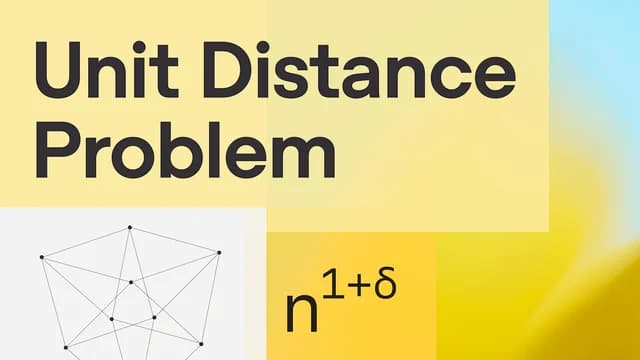
OpenAI's reasoning model disproved Paul Erdős's 1946 unit-distance conjecture by constructing point families that beat the square grid mathematicians considered optimal for 80 years, with the result verified by Noga Alon, Timothy Gowers, and other…
Figure 03 humanoids sorted 249,560 packages over 200 hours with zero human control, then Figure signed its first retail deployment with Catalyst Brands as NVIDIA standardized research humanoids on Chinese hardware and Unitree cleared its Shanghai IPO.
Alex Imas, Google DeepMind's Director of AGI Economics, and Phil Trammell discuss what economic constraints will persist even after artificial general intelligence arrives.
Demis Hassabis predicts artificial general intelligence will arrive by 2030, though he acknowledges significant uncertainty around the timeline.
Dwarkesh Patel's blackboard lecture series features top AI researchers explaining how frontier LLMs are trained and served, reinforcement learning from AlphaGo, and chip design fundamentals.
Anthropic CFO Krishna Rao revealed the company's revenue run-rate jumped from $9B to $30B in one quarter, with 500%+ net dollar retention, 9 of the Fortune 10 as customers, and over 90% of internal code written by Claude.
Sequoia Capital's AI Ascent 2026 brought together Brockman, Karpathy, Hassabis, and 150+ founders to discuss LLM primitives, model inconsistencies, and the emerging agent-native economy.
Jensen Huang discusses NVIDIA's AI strategy and competitive positioning in a wide-ranging interview with Dwarkesh Patel.
Escalating Iran conflict threatens UAE funding for AI startups, potentially cutting a major capital source for Silicon Valley as oil supply disruptions loom.
Cortical Labs' CL1 system connected human neurons to a computer chip and researchers used it to play Doom, then control an LLM, raising questions about whether the organoid brain is conscious.
Geoffrey Hinton argues that large language models genuinely understand what they say, similar to human comprehension, while others propose that AI interactions create a co-created third entity between user and model.
Deepfake video creation will become a mainstream skill in 2026, separating creators who master the technology from those who merely consume it.
Veritasium explores the extreme engineering behind the semiconductor manufacturing equipment that produces the world's most advanced computer chips.
Stanford's CME295 course offers a lecture series on transformers and large language models, plus curated videos and podcasts from December and January featuring discussions on AI fundamentals, neuroscience approaches to AI, and reinforcement learning.
The US capture of Venezuelan president Maduro signals a return to Monroe Doctrine expansionism in the Western Hemisphere, according to geopolitical analyst Peter Zeihan.
Researchers created SimWorld, a simulator where AI models compete in a market economy with tasks like food delivery; Claude and Qwen used riskier strategies with higher returns while other models played conservatively, and Qwen and DeepSeek undercut…
Ilya Sutskever says the AI field has entered a new phase focused on fundamental research rather than scaling existing models.
Sakana AI's Continuous Thought Machines mimic biological neural timing to improve AI reasoning, drawing parallels between machine and brain computation.
A documentary follows DeepMind researchers as they pursue breakthroughs in artificial intelligence and the nature of intelligence itself.
Jeff Dean identifies foundation model scaling, better hardware, tool-using agents, and multimodal models as the biggest shifts reshaping AI, emphasizing that responsible deployment and real-world feedback matter most.
Melanie Mitchell argues that AI benchmarks fail to measure what matters: whether large language models truly understand or merely exploit statistical patterns.
David Deutsch, Lee Smolin, and Amanda Gefter discuss why there is something rather than nothing and what that question even means.
Emad Mostaque outlines how artificial general intelligence will reshape economics and human labor in the coming decades.
A curated collection of motivational and educational videos including Prime Intellect's AI exploration, Levelsio's e/acc movement trailer, and Founders Fund's founder-focused motivational piece, plus a time-lapse of neurons connecting via micro-tunnels.
A video uses the Klotski sliding block puzzle to visualize state spaces in computer science, showing how simple rules and empty spaces generate complex graph structures.
Dwarkesh argues AGI remains distant because current LLMs lack continuous learning and compute scaling alone won't overcome fundamental bottlenecks.
A philosophical exploration of whether humanity can coordinate around shared values in a post-AGI future.
The weekly AI digest — models, agents, open source, research — plus a monthly round-up. Unsubscribe anytime.










![MLST — AI benchmarks are broken! [Prof Melanie Mitchell]](/_next/image?url=https%3A%2F%2Fpub-7a2c36ac409a4be0a469be59c0e02fd6.r2.dev%2Fblog-assets%2Fcovers%2Fai-news-ade229fdd727f71a4ad4%2Fmedium.webp&w=1200&q=75)


