
 z.AI
z.AIThe anonymous model that took over OpenRouter for a week turned out to be GLM-5.3-Flash, and Z.ai (Zhipu AI) says every token of that traffic was served on a cluster of more than 100,000 domestically produced Chinese chips, reaching "hardware efficiency and per-token cost comparable to mainstream NVIDIA GPUs." SemiAnalysis called the hardware, not the model, the shocking part: "the 100T tokens per day is served on Chinese chip", framing it as the CUDA moat being tested again, a day after OpenAI's Jalapeño inference chip announcement.
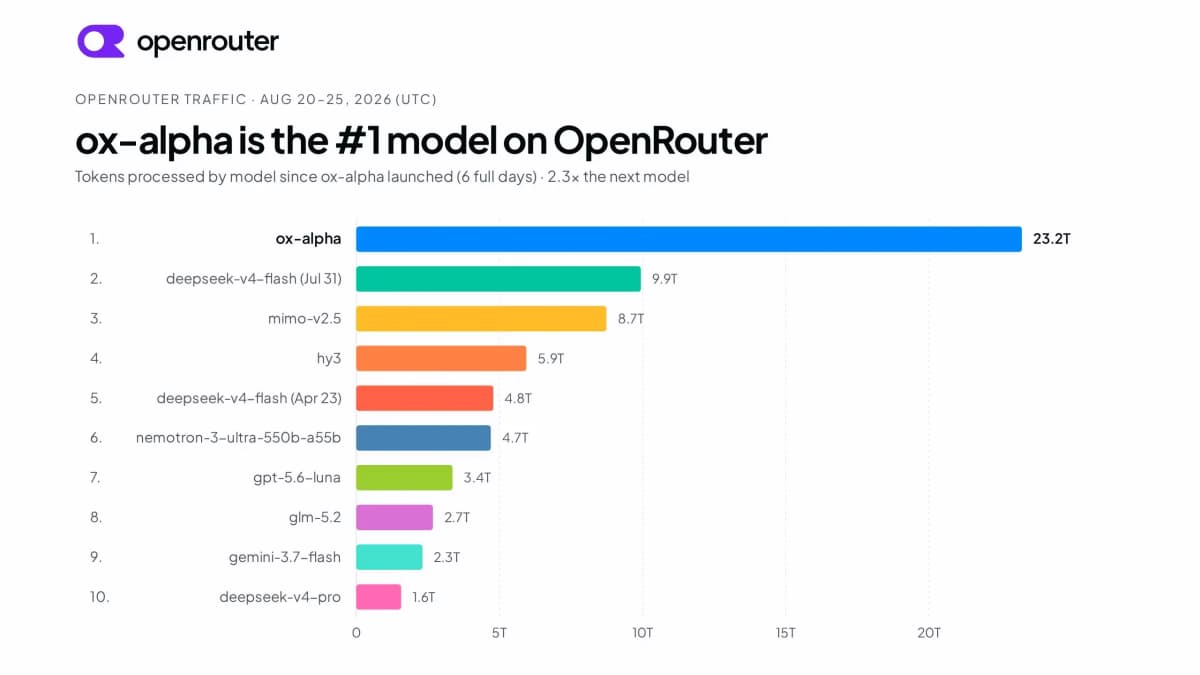
ox-alpha processed 23.2T tokens in six days on OpenRouter, 2.3x the runner-up deepseek-v4-flash at 9.9T. Credit: SemiAnalysis, OpenRouter data.
GLM-5.3-Flash is a 320B-parameter mixture-of-experts model with 18B active per token, released under the MIT License with weights on Hugging Face. It is the first natively multimodal model in the GLM-5 series — video, image, text and file in, text out — with a 1M-token context and 128K maximum output tokens.
It is also the first GLM model to use a hybrid of sparse and linear attention: linear attention captures local dependencies through state modeling, sparse attention retrieves global context through a lightweight indexer, and an IndexPool step compresses four indexer key vectors into one by weighted pooling to hold down cost at 1M tokens. It adopts Manifold-Constrained Hyper-Connections (mHC) and a new 30T-token multimodal pre-training corpus. Versus GLM-5.3, Z.ai measures 3.01× less attention compute and a 4.44× smaller KV cache. Against the GLM-4.5 series it has a similar total parameter count (320B vs 355B) but roughly half the activated parameters (18B vs 32B) and half the layers (45 vs 92).
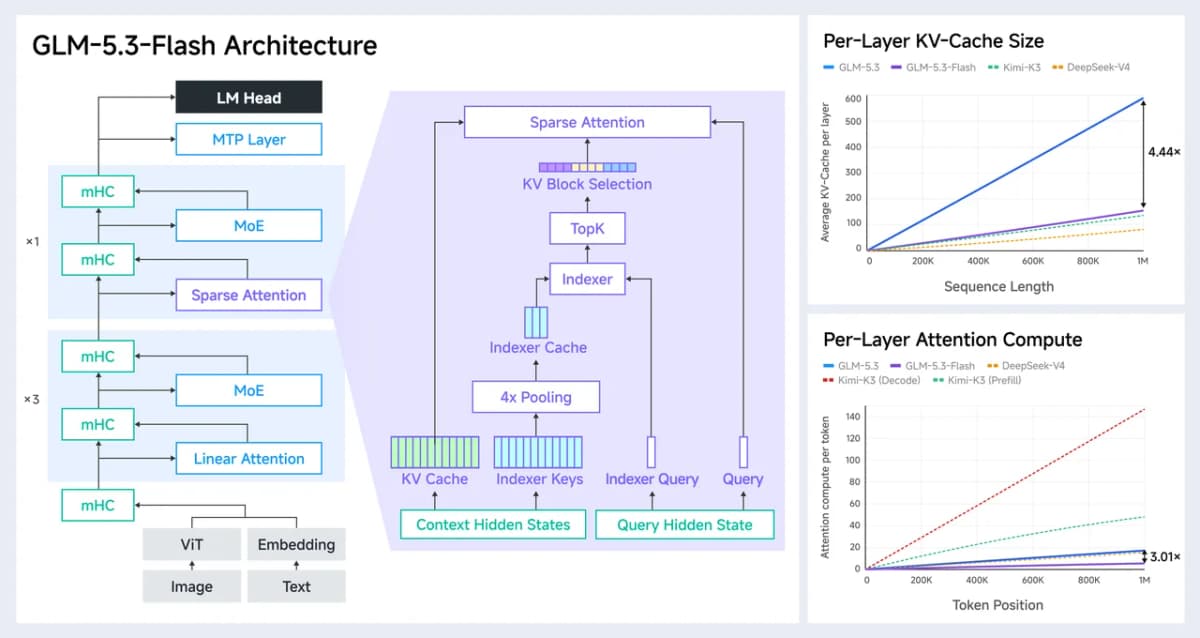
The hybrid attention design, and the 4.44× KV-cache and 3.01× attention-compute reductions it buys at 1M tokens. Credit: Z.ai.
Artificial Analysis puts GLM-5.3-Flash at 57 on its Intelligence Index (v4.1.1) at maximum reasoning effort — three points behind the larger GLM-5.3 (60) and level with GPT-5.6 Terra — at $0.09 per task against $0.68 for GLM-5.3, roughly 7.5x cheaper; Z.ai quotes $0.045 per task on discounted pricing. Its API charges $0.15 per million input tokens and $0.50 per million output, about a tenth of GLM-5.3. Artificial Analysis notes it is not token-efficient: roughly 90% of its output tokens go to reasoning.
Z.ai reports it beating GLM-5.2 across six coding and agentic benchmarks — 63.4 vs 46.2 on DeepSWE v1.1, 48.8 vs 26.2 on AutomationBench, 84.3 vs 81.0 on Terminal-Bench 2.1 — landing near Claude Opus 4.8 (85.0 on Terminal-Bench, 29.5 vs 29.0 on Z.ai's in-house code bench at max effort).
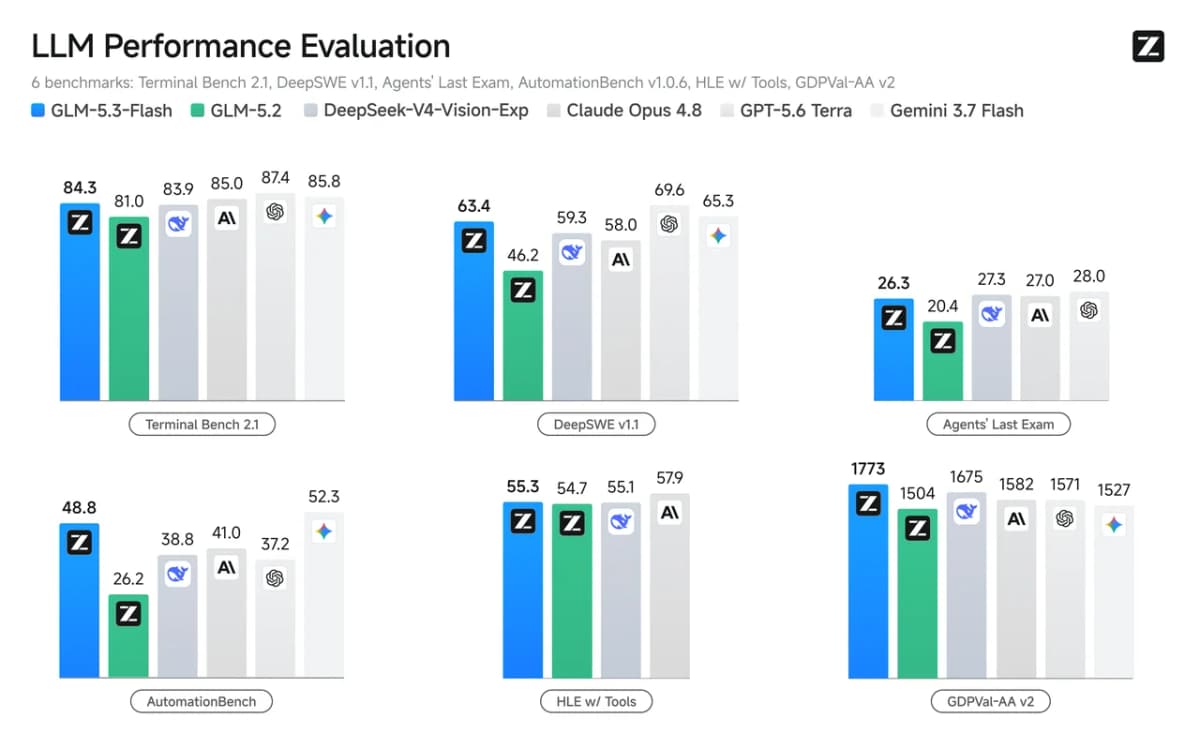
GLM-5.3-Flash against five other models on Terminal Bench 2.1, DeepSWE v1.1, Agents' Last Exam, AutomationBench, HLE with tools and GDPval-AA v2. Credit: Z.ai.
The interesting engineering is the serving stack, and Z.ai's account of it is unusually specific for a vendor post. It built a dedicated inference engine on top of SGLang, because the individual chips are constrained on compute and, more importantly, on memory capacity and bandwidth at million-token contexts. The stack combines intra-node tensor parallelism for linear attention and the LM head, ReplaySSM, W8A8 quantization, hybrid INT8/FP8/BF16 cache quantization and Layer Split. At cluster scale it runs a production Encode–Prefill–Decode (EPD) disaggregated architecture, splitting multimodal encoding, prompt prefill and token-by-token decoding into independently scheduled worker pools across what the post calls "tens of thousands of domestically developed accelerators." Against its own first baseline on the same hardware, Z.ai reports a 3× improvement in end-to-end serving performance — with a GLM-5.3-powered infrastructure agent helping its engineers write and optimize kernels and diagnose bottlenecks.
The preview ran as "ox-alpha" on OpenRouter and OpenCode. Zhipu says it processed 62 trillion tokens before the formal release, including more than 11T in its first three days on OpenRouter — the platform's biggest launch to date. OpenRouter data circulated by Z.ai founder Jie Tang shows 23.2T tokens in six days, lifting Z.ai to roughly 19% of weekly tokens on the platform, ahead of DeepSeek for the first time; his summary is "Powered by pure Chinese chips," at "1/100 frontier price." Per the South China Morning Post, the model accounted for 10.3T tokens, nearly 31% of OpenRouter's total weekly volume, and Zhipu's Hong Kong shares closed 12% higher at HK$1,160.
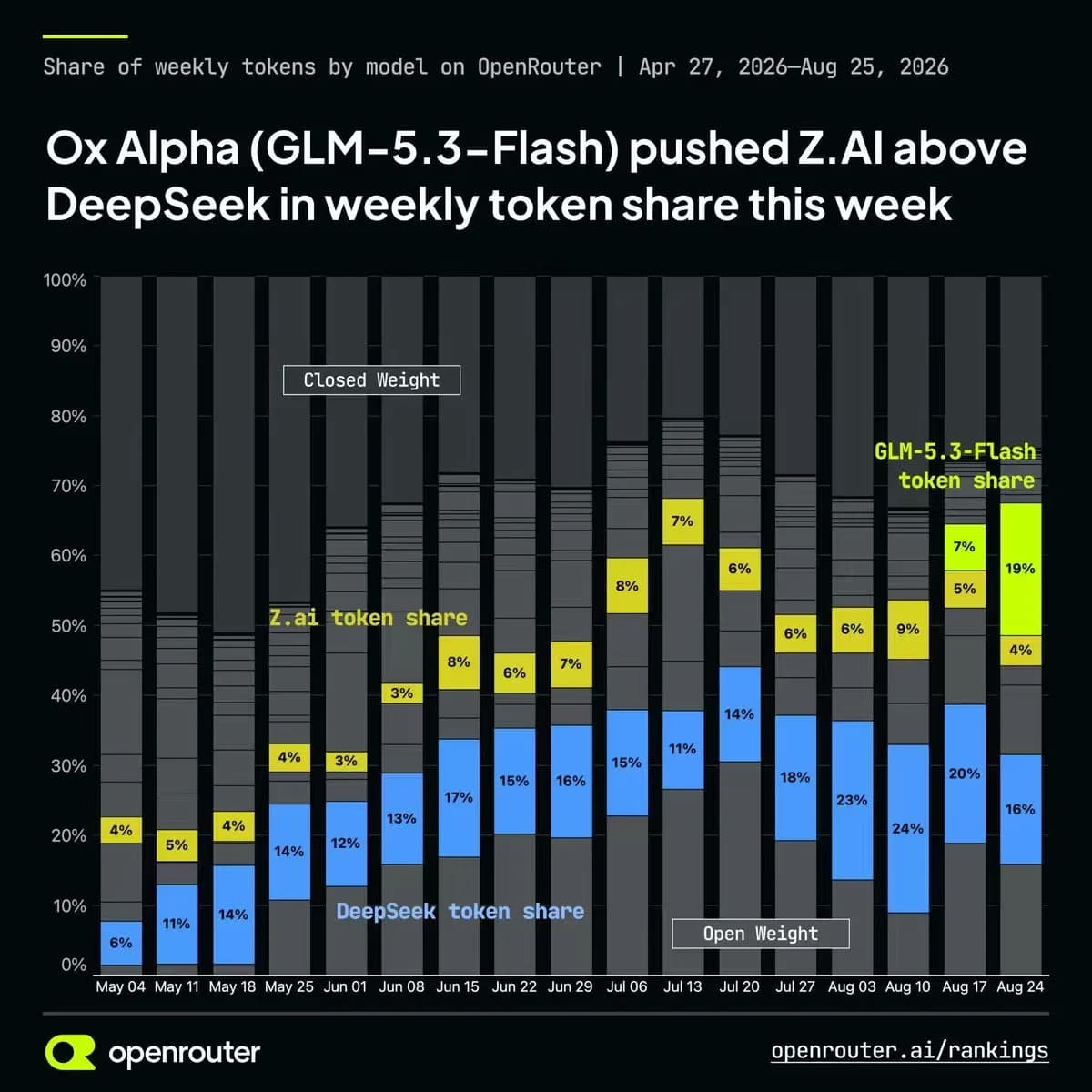
Z.ai's weekly token share on OpenRouter passing DeepSeek's, with GLM-5.3-Flash contributing 19 points. Credit: Jie Tang, OpenRouter.
Z.ai names no chip vendor, no chip model and no cluster configuration, and publishes no throughput, utilization or power figures; nothing has been independently audited. Chinese media point to Huawei, Moore Threads and Hygon; Zhipu will not confirm. The claim is also about inference, not training — DeepSeek's earlier attempt to train on Huawei Ascend hardware reportedly failed even with on-site engineers. The 100T-tokens-per-day figure is SemiAnalysis's, and it sits awkwardly next to Zhipu's own 62T-over-a-week preview number; it most plausibly covers Zhipu's entire serving footprint, domestic traffic included, rather than the OpenRouter run alone.
Software engineer Martin Alderson's read is the useful counterweight: Huawei's 910c pairs 96GB of HBM2e with roughly 1.6 PFLOP/s of INT8 at about 600W — around 60% of a four-year-old H100, an order of magnitude behind a Rubin VR200 — and without EUV lithography that gap is unlikely to close before 2030. China's answer is quantity: build ten times as many chips. His estimate is that the real penalty lands near 5x worse tokens per watt once small KV caches, small batches and interconnect overhead are counted, which turns electricity from 10-20% of cluster cost into roughly half the bill. Fine as a strategic subsidy; hard to price into a competitive global inference market.
Still, the demonstration stands. If the disclosure holds, the export-control moat is narrower on the inference side than on the training side: a Chinese lab absorbed a week of the world's heaviest open-model traffic, at the top of a Western marketplace, without an Nvidia GPU in the loop.
Z.ai launch postZ.ai developer documentationHugging Face model cardZ.ai's announcementJie TangSemiAnalysis on XScottSouth China Morning PostImplicator.aiThe DecoderGlobal TimesMartin Alderson on the hardware constraints


