
 z.AI

Z.ai has released GLM-5.3-Flash, the model that spent six days on OpenRouter and OpenCode under the codename ox-alpha as the most-used model on the platform. It is a 320B-total-parameter mixture of experts with 18B activated, released under the MIT License — weights on Hugging Face, API on the Z.ai platform, and availability in ZCode, Chat, AutoClaw and the GLM Coding Plan. It is the first natively multimodal model in the GLM-5 series, taking video, image, text and file input across a 1M-token context window with 128K maximum output tokens.
The launch card: 320B-A18B, MIT-licensed, 1M context, trained and served on Chinese AI chips. Credit: @Zai_org.
Two claims carry the release: an attention stack built for cheap long-context inference, and the assertion that every token of that anonymous preview was served on Chinese silicon.
Recent hybrids pair one cheap attention with one expensive one. Z.ai pairs two cheap ones, and calls GLM-5.3-Flash the first open-source frontier model to combine sparse and linear attention in one architecture. Linear attention captures local dependencies through a fixed recurrent state; sparse attention retrieves global context through a lightweight indexer that scores the full KV cache and computes attention only over the top-k blocks. To hold indexer cost down at 1M tokens, Z.ai adds IndexPool, which compresses four indexer key vectors into one by weighted pooling. The model also adopts Manifold-Constrained Hyper-Connections (mHC) and was pre-trained on a 30T-token multimodal corpus.
Against GLM-5.3, Z.ai measures 3.01x less attention compute and a 4.44x smaller KV cache — reported as attention compute per head per layer and average per-layer KV cache in BF16. Against the GLM-4.5 series, it has a similar total parameter count (320B vs 355B) but roughly half the activated parameters (18B vs 32B) and half the layers (45 vs 92).
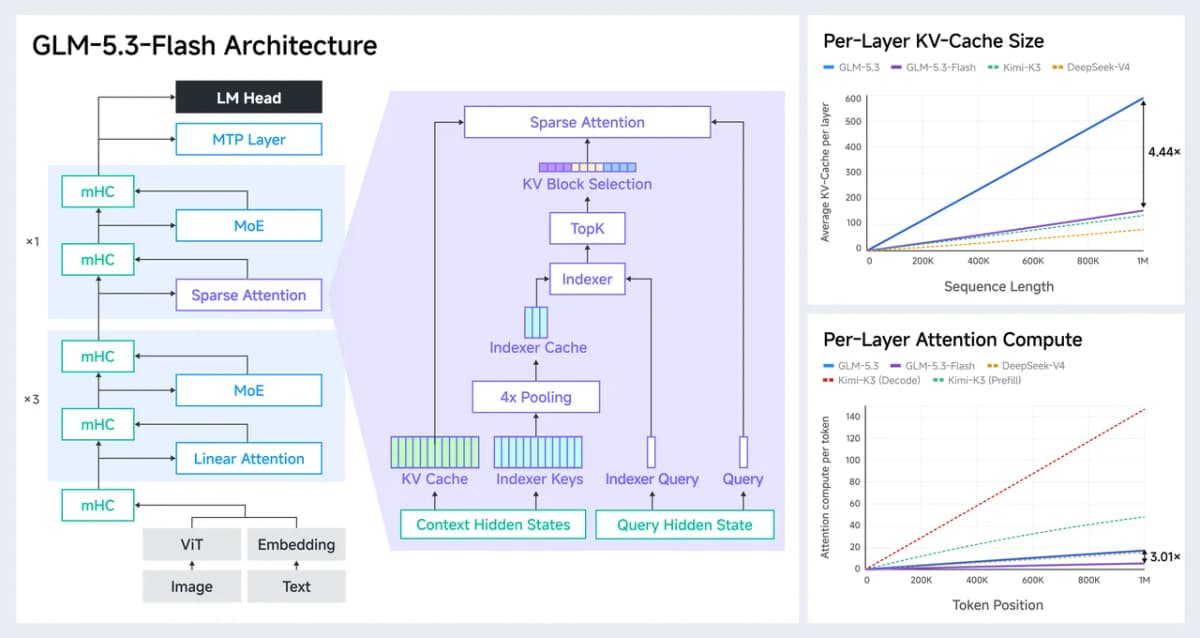
The 3:1 layer pattern, the indexer with 4x key pooling, and the per-layer KV-cache and compute curves against GLM-5.3, Kimi-K3 and DeepSeek-V4. Credit: Z.ai.
Sebastian Raschka's architecture notes put numbers on the layer stack: a Kimi Linear-style 3:1 pattern with 34 Kimi Delta Attention layers and 11 MLA/DeepSeek Sparse Attention layers, a sparse MoE backbone scaled down from GLM-5.2's 744B-A40B to 320B-A18B, a DeepSeek V4-style mHC residual path with four parallel streams, and a native vision encoder. He calls it a "super hybrid" because both components are efficient ones — Kimi uses KDA plus full-attention MLA, DeepSeek V3.2 uses DSA plus full-attention MLA.
Harvard PhD student Arya Tschand reads the 3:1 ratio as a result about what frontier models actually need: "for frontier performance, we never actually need to compute attention over the entire KV, and we can even use a fixed recurrent state for most of it." He expects the pattern to favour SRAM decode accelerators such as Cerebras and Groq-style LPUs as the KV-cache footprint keeps shrinking.
| Benchmark | GLM-5.3-Flash | GLM-5.2 | DeepSeek-V4-Vision-Exp | Claude Opus 4.8 | GPT-5.6 Terra | Gemini 3.7 Flash |
|---|---|---|---|---|---|---|
| Terminal Bench 2.1 | 84.3 | 81.0 | 83.9 | 85.0 | 87.4 | 85.8 |
| DeepSWE v1.1 | 63.4 | 46.2 | 59.3 | 58.0 | 69.6 | 65.3 |
| Agents' Last Exam | 26.3 | 20.4 | 27.3 | 27.0 | 28.0 | — |
| AutomationBench v1.0.6 | 48.8 | 26.2 | 38.8 | 41.0 | 37.2 | 52.3 |
| HLE w/ Tools | 55.3 | 54.7 | 55.1 | 57.9 | — | — |
| GDPVal-AA v2 | 1773 | 1504 | 1675 | 1582 | 1571 | 1527 |
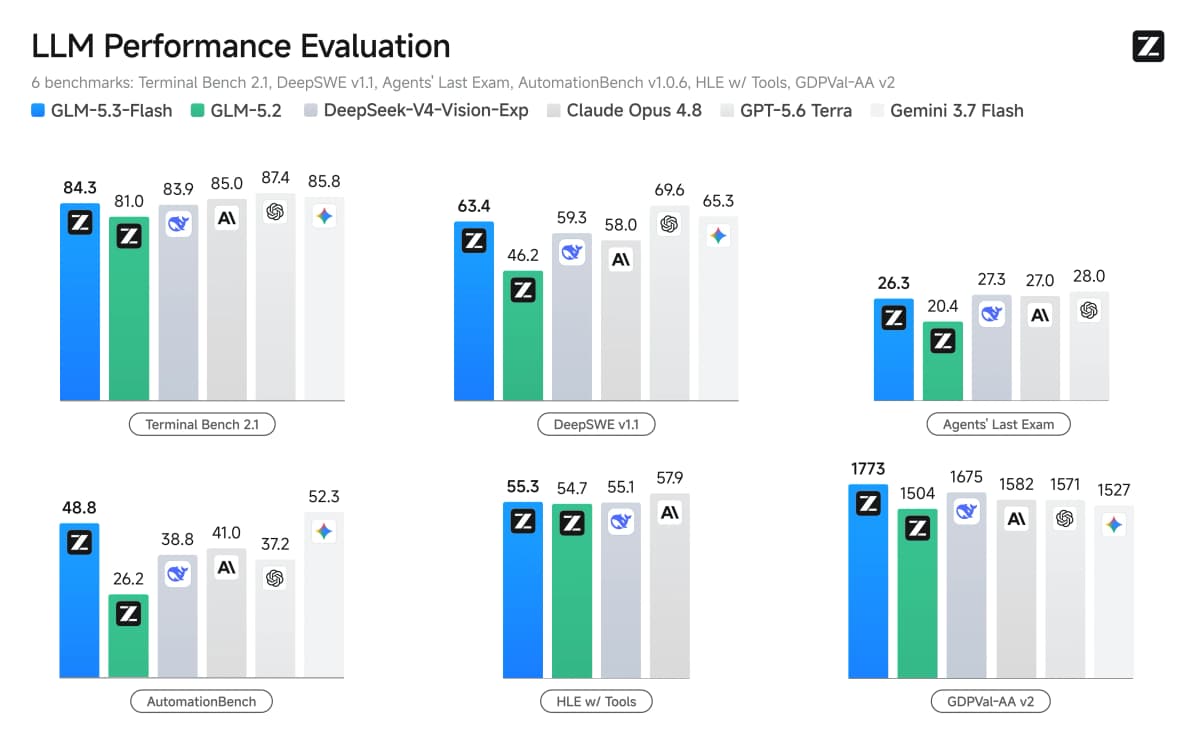
Z.ai's release-time evaluation across six benchmarks. Credit: Z.ai.
The gain over GLM-5.2 is real and large. Against the frontier the model is close rather than ahead: it beats Claude Opus 4.8 on three of the six and trails GPT-5.6 Terra on every benchmark where both appear. Z.ai's own claim is the careful one — "approaching Claude Opus 4.8" — and on its in-house Z.ai Code Bench v1.0, run in Claude Code 2.1.207, it puts GLM-5.3-Flash at 29.0 against Opus 4.8's 29.5 at max effort. All of these are vendor-run numbers; the reasoning_effort parameter defaults to max, which is what Z.ai says it used. Arena has it around #5 in Code Arena: WebDev — second among open models — at 1634 AutoEval.

Arena: roughly #5 on Code Arena WebDev, #2 among open models. Credit: @arena.
Z.ai puts the model at 57 on the Artificial Analysis Intelligence Index v4.1.1 at $0.045 per task on discounted pricing, a score it says was previously available at roughly 10x the cost; Artificial Analysis's own page lists 57 at $0.09 per task, on the Pareto frontier either way. List pricing is $0.15 per million input tokens and $0.50 per million output, against $1.40/$4.40 for GLM-5.3 and GLM-5.2 — the "one-tenth the price" line in the model card. A 50% launch promotion halves those rates and ends at 24:00 on September 9, 2026 (UTC+8).
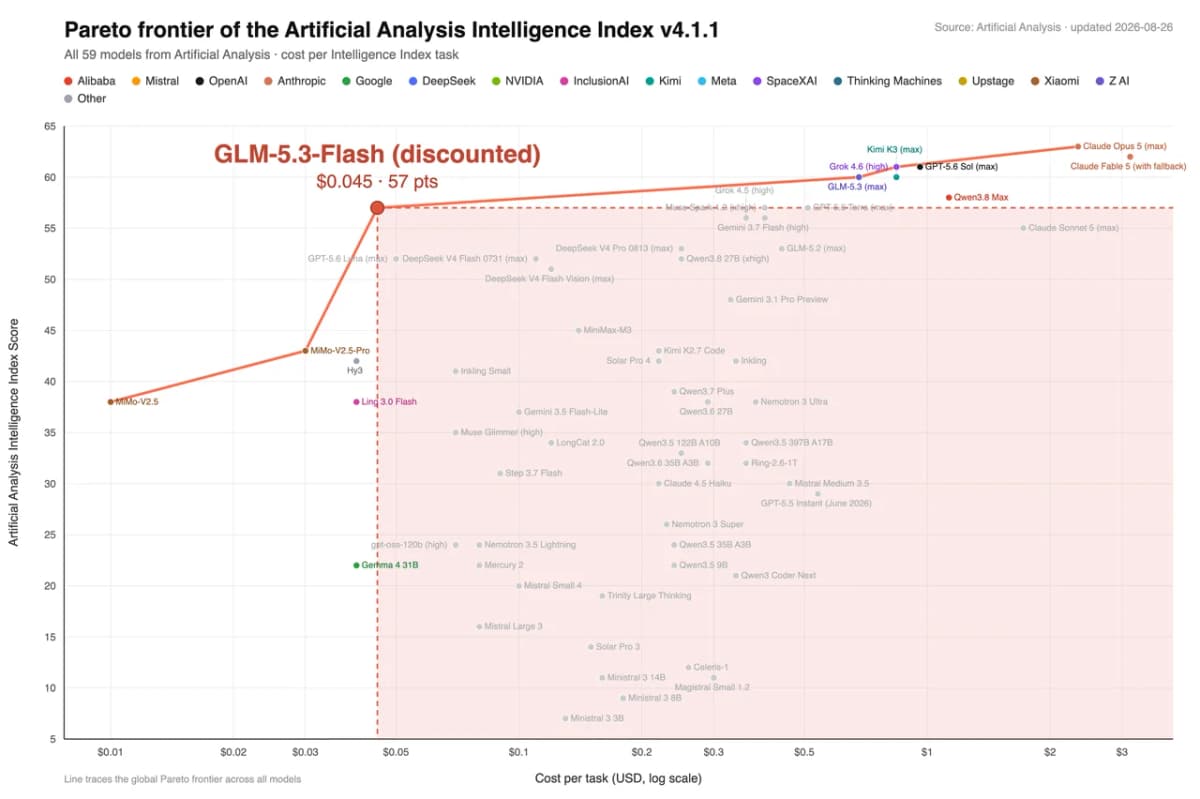
GLM-5.3-Flash sits on the Pareto frontier at 57 points. Credit: Artificial Analysis, via Z.ai.
Z.ai's account of the infrastructure is unusually specific for a vendor post. It built a dedicated inference engine on top of SGLang, because the individual chips are constrained on compute and, more importantly, on memory capacity and bandwidth at million-token contexts. The stack combines intra-node tensor parallelism for linear attention and the LM head, ReplaySSM, W8A8 quantization, hybrid INT8/FP8/BF16 cache quantization and Layer Split. At cluster scale it runs a production Encode-Prefill-Decode (EPD) disaggregated architecture across what the post calls "tens of thousands of domestically developed accelerators", and reports a 3x improvement in end-to-end serving performance over its own first baseline on the same hardware. Z.ai adds that a GLM-5.3-powered infrastructure agent helped its engineers write kernels and diagnose bottlenecks — the model helping optimize the system serving the model. The claim it leads with: "hardware efficiency and per-token cost comparable to mainstream NVIDIA GPUs."
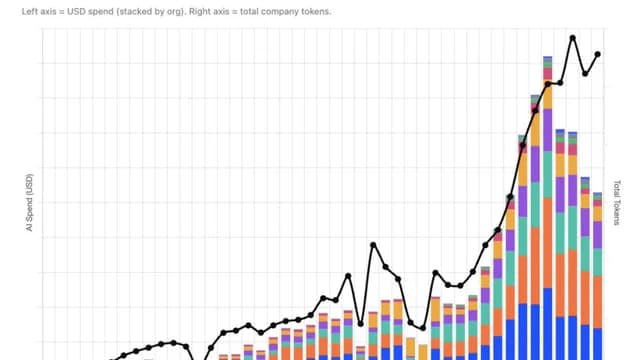
The traffic is the number that made this land. OpenRouter, which ran the model anonymously as Ox Alpha, reports over 20 trillion tokens in six days, the largest volume it has recorded for any model; data circulated by Z.ai founder Jie Tang puts it at 23.2T tokens — 2.3x the next model — lifting Z.ai to roughly 19% of weekly tokens on the platform, ahead of DeepSeek for the first time. Tang's summary: "Powered by pure Chinese chips," at "1/100 frontier price." SemiAnalysis called the reveal shocking on the grounds that the serving volume, which it put at 100 trillion tokens per day, ran on Chinese silicon. Zhipu's Hong Kong-listed shares closed more than 12% higher at HK$1,160 the following day, per the South China Morning Post.
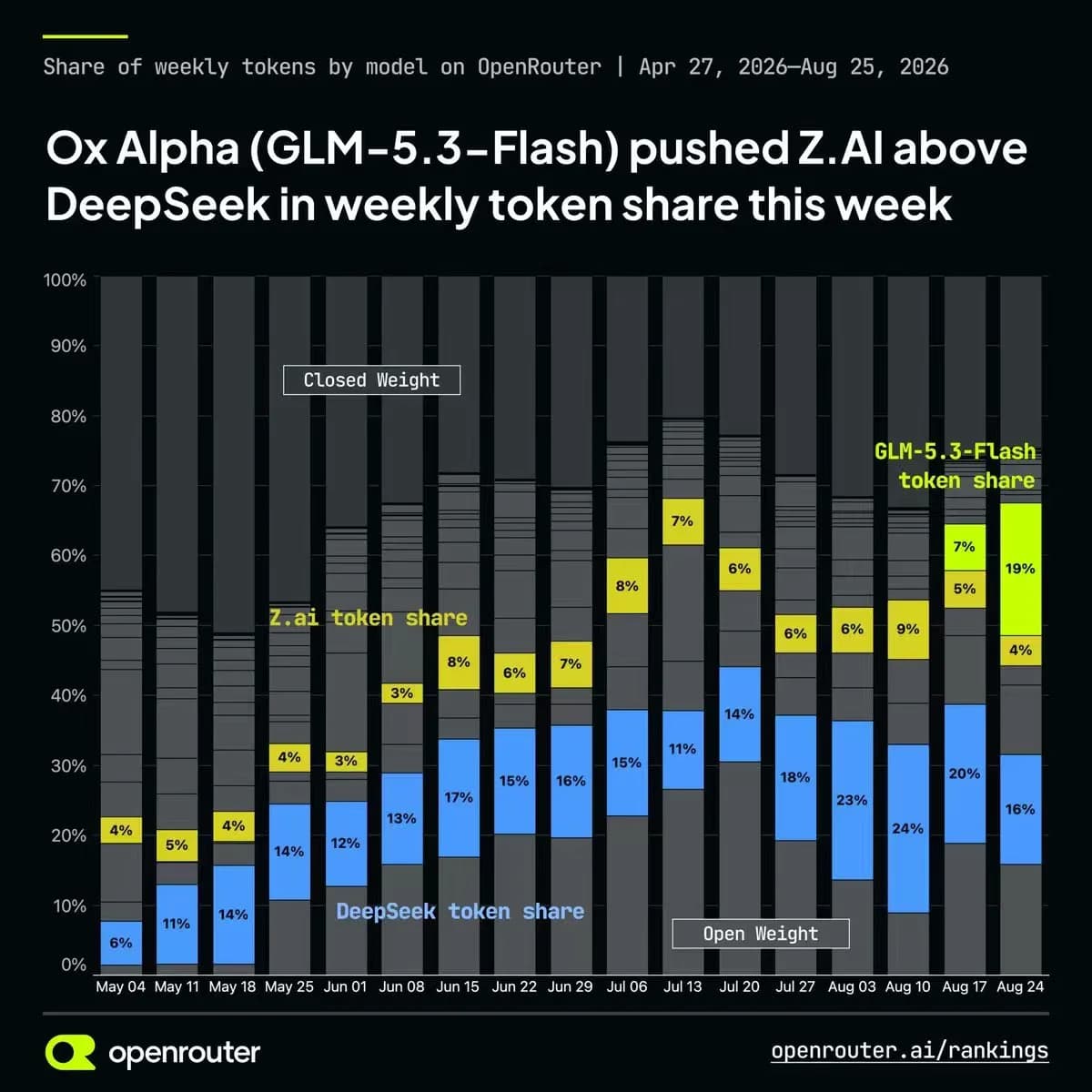
Z.ai's weekly token share on OpenRouter passing DeepSeek's, with GLM-5.3-Flash contributing 19 points. Credit: Jie Tang, OpenRouter.
A speed-tier model that reaches the frontier on cost, ships under MIT, and is served at scale on non-NVIDIA silicon changes three arguments at once — about price, about openness, and about whether export controls bind.
The caveats are real and Z.ai leaves them open. It names no chip vendor, no chip model, no cluster configuration, and publishes no throughput, utilization or power figures; nothing here has been independently audited. Serving is also not training — this is an inference claim, and the harder question of pre-training a frontier model on domestic accelerators is untouched by it. What makes the architectural half of the release checkable is the licence: MIT weights with day-one recipes for SGLang, vLLM, TokenSpeed, Transformers, KTransformers and Unsloth, so anyone can measure the KV-cache reduction themselves. What the hardware disclosure establishes, if it holds, is that the export-control moat is narrower on the inference side than on the training side, and that a Chinese lab can now absorb a week of the world's heaviest open-model traffic without an Nvidia GPU in the loop.
Z.ai launch postZ.ai developer documentationGLM-5.3-Flash on Hugging FaceZ.ai pricingArtificial Analysis: GLM-5.3-FlashSebastian Raschka's architecture notesOpenRouter model pageSouth China Morning PostImplicator.aiThe DecoderHacker News discussionZ.ai's announcementJie TangSemiAnalysisScottArya Tschand on XArtificial Analysis on XArena on XSebastian Raschka on XHesamation on XOpenRouter on X

Z.ai releases GLM-5.3 weights
GLM-5.2: Z.ai’s Open-Weight Beast for Long-Horizon Coding

GLM 5.2

GLM 5.1
Z.ai says it served GLM-5.3-Flash, OpenRouter's anonymous ox-alpha, entirely on Chinese chips
Chinese labs converge on one architecture: 3:1 linear attention and a 2,048-token budget
From o1 Pro to GLM-5.3-Flash: a 1,000x fall in token prices in 18 months