Recursive Language Models (RLM)
February 6, 2026Posted by Federico Ulfo

This is a paper from December 2025 that recently had a resurgence due to the improvement of LLMs and the proven successful implementation of sub-agents with Claude Code.
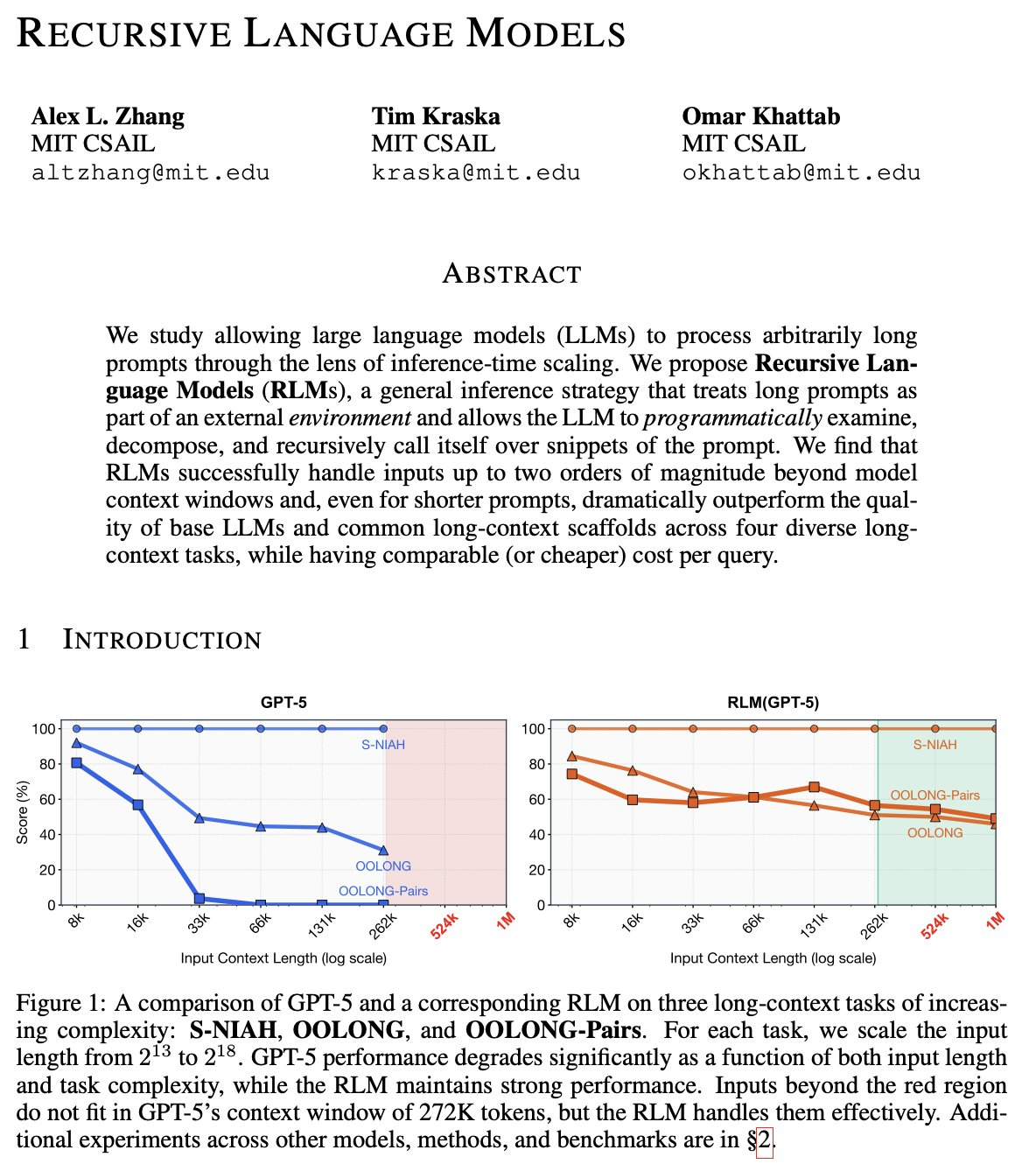
RLM are an agent architecture that overcome LLM context and reasoning limits by giving agents programmatic control over their own context via a REPL.
RLM works over a mutable context and can recursively spawn sub-agents to work on sub-tasks.
An RLM agent has:
The agent alternates between writing code, inspecting results, and delegating work recursively.
ADK adapts RLMs for production by providing low-level control over execution, memory, and orchestration via BaseAgent. Key features:
ADK preserves the core RLM idea—recursive, compute-over-context agents—while making it practical to deploy at scale.
Sources: Zhang Tweet, RLM with ADK Tweet, paper