AI Socratic
April 2025

AI 2027: Month-by-Month Intelligence Explosion Forecast

AI 2027 outlines a wild, month-by-month scenario forecasting how steadily improving AI agents will eventually accelerate research itself. Daniel Kokotajlo and Scott Alexander predict that by 2027 that when AI is able to run R&D autonomously will drive an intelligence explosion that could lead to ASI by early 2028.

They also explore geopolitical dynamics, like a US government push to control AI and China potentially stealing key AI advances, and discuss the balance between rapid innovation and safety risks.

Read the blog post here https://ai-2027.com or watch the amazing interview on the Dwarkesh podcast:

https://youtu.be/htOvH12T7mU?si=Fo8kwyCrUHlZcebW

It's great to find an opposition to AGI 2027 from Ege Eril and Tamay Bes, you can read directly here what their points are:

https://x.com/peterwildeford/status/1913223076289855683

Federico UlfoFederico Ulfo
Agents

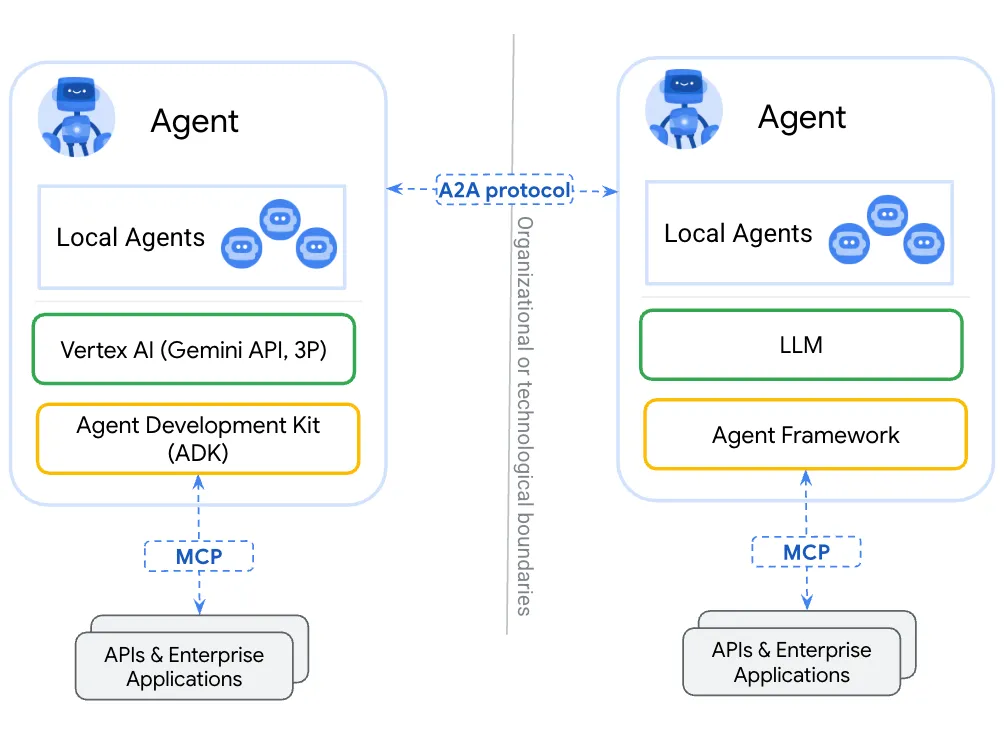
Google launches A2A agent-to-agent protocol with 50 partners

Google listened to most of the critics around MCP and launched a new protocol called A2A. On the surface this protocol is complementary to MCP, but clearly Google is going to compete with Anthropic.

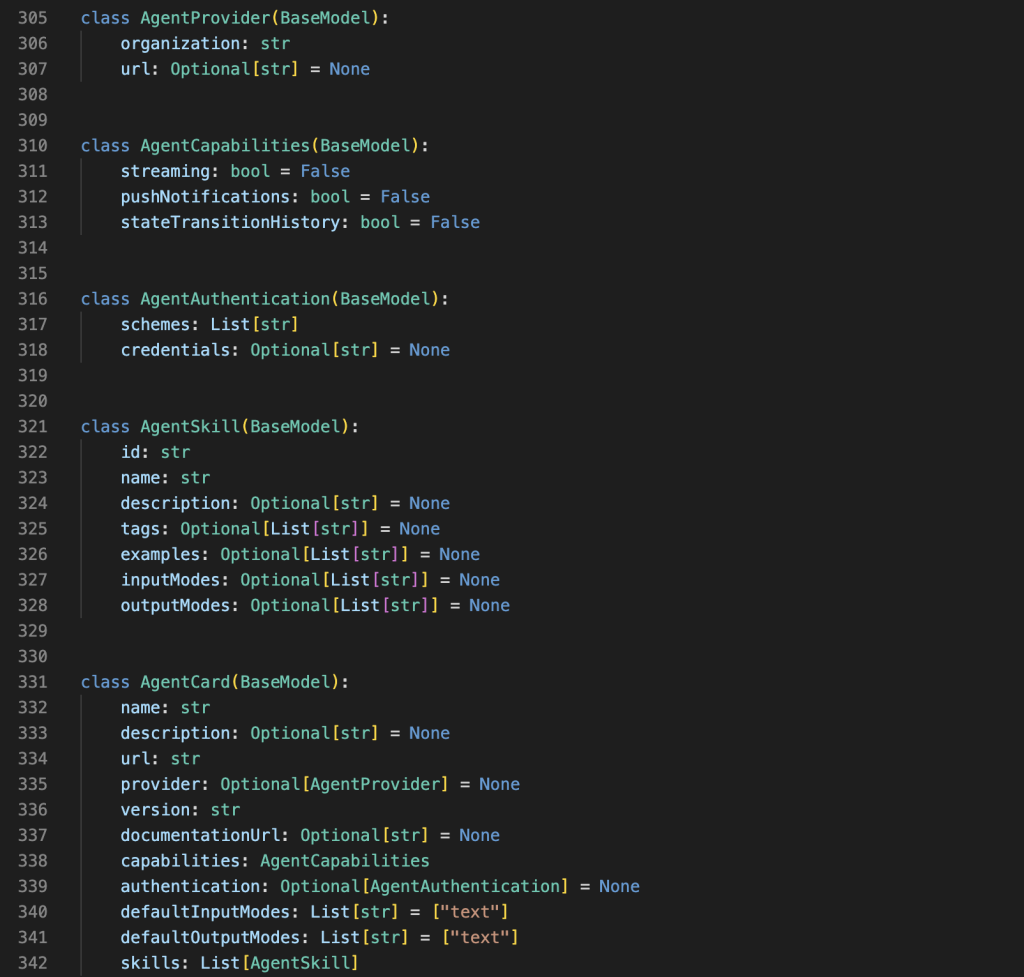
A2A enables agent to talk with each other via multi-modals. In A2A agents share what they can do with json cards.

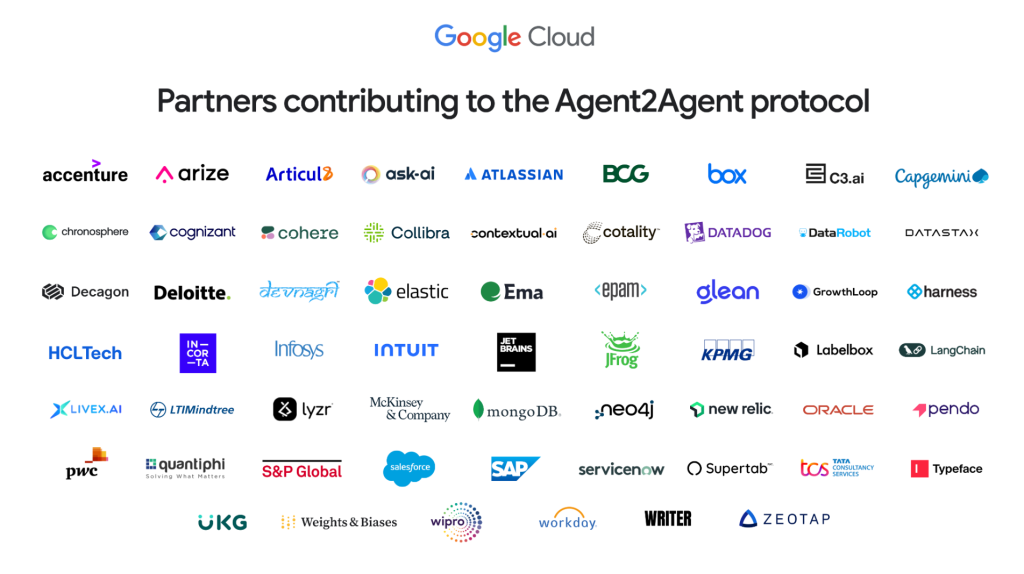
Quite impressive that A2A launches with 50 partners.
It's based on these principles:

  • Agentic Collaboration: Agents team up naturally, even if they don’t share the same memory or tools.
  • Built on HTTP, SSE, and JSON-RPC for easy integration.
  • Secure by Default
  • Handles long running jobs like deep research with real-time updates.
  • Multimodal

How it works

Components:

  • Agent Cards: agents advertise their capabilities with json agent cards, defined in /.well-known/agent.json.
  • Server: agent exposing an HTTP endpoint, with a json specification.
  • Client: an 👉 application 👈 or agent that consumes the A2A services, sending request to task/send.
  • Task: a client initiates a task by sending a message (tasks/send or tasks/sendSubscribe). Tasks have unique IDs and progress through states (submitted, working, input-required, completed, failed, canceled).
  • Message: these are like the gpt messages the client (role: "user") and the agent (role: "agent"). Messages contain Parts.
    • Part: The fundamental content unit within a Message or Artifact. Can be TextPart, FilePart (with inline bytes or a URI), or DataPart (for structured JSON, e.g., forms).
    • Artifact: Represents outputs generated by the agent during a task (e.g., generated files, final structured data). Artifacts also contain Parts.

The protocol also also implement Streaming and PushNotifications.

To better understand how it works here's a python AgentCard implementation:
👉 Important to notice that A2A works also with application, which means the war of interoperability between hyperscalers is on!

Link to A2A: https://github.com/google/a2a.

Federico UlfoFederico Ulfo
Models

OpenAI releases o3 and o4-mini reasoning models

OpenAI's just published o3 to all its customer and is a reasoning powerhouse! Initially teased under Project Strawberry, it outstrips GPT-4o with a 1M token context and top-tier logic skills.

Key Highlights

  • Reasoning Beast: 87.7% on GPQA Diamond, 71.7% on SWE-Bench Verified, 87.5% on ARC1 test.
  • Autonomous Tools: Search, Python, image generation for seamless problem-solving.
  • Affordable Mini: o3-mini delivers coding precision at lower costs.

Why It Rocks

  • Sharpened Logic: Precise, step-by-step reasoning for complex tasks.
  • Budget-Friendly: o3-mini makes elite AI accessible.
  • Tested & Polished: Community feedback shaped a stellar release.

Lot of tweets about it with positive feedback!

https://x.com/danshipper/status/1912551847056785841

Dropped with hype and minor scaling hiccups, o3 cements OpenAI’s lead in the AI race! o3-mini is also great apparently.

https://x.com/ren\_hongyu/status/1908035698579395066

It's great, but it still suffers from hallucination, apparently at this point more a feature than a bug of the transformer models.

https://x.com/TransluceAI/status/1912552046269771985

While not perfect, o3 makes a leaps of improvement on image recognition and understanding:

https://x.com/ErnestRyu/status/1913045962614087878

https://x.com/goodside/status/1912921153217118696

Federico UlfoFederico Ulfo
Models

OpenAI drops GPT-4.1 with Mini and Nano variants

OpenAI dropped GPT-4.1, stealing the spotlight with Mini and Nano variants. Initially teased as Quasar Alpha and Optimus Alpha on OpenRouter, this release outshines GPT-4o with a 1M token context and killer coding skills.

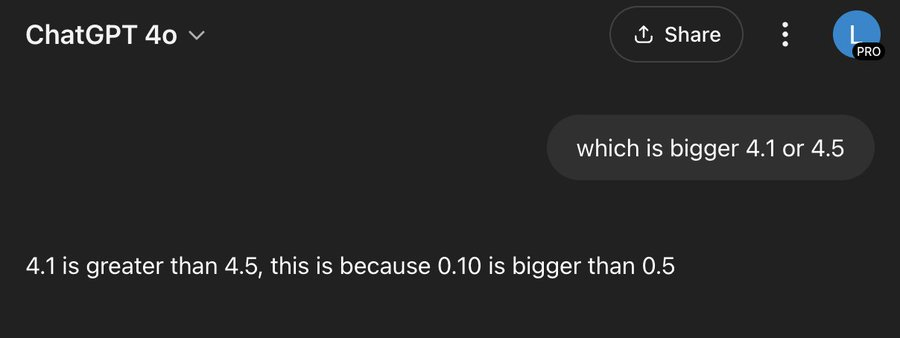
Critics are debating if 4.1 is a larger number than 4.5, depends if you read it as 4.10 or 4.1..

Joking aside is a good model and here's some info about it.

Key Highlights

  • Massive Context: 1M token window for deep, complex tasks.
  • Coding Prowess: Scores 55% on SWE-Bench Verified, no reasoning needed.
  • Affordable Power: $2/$8 per 1M tokens (input/output), with Mini at $0.40/$1.60.
  • Stealth Drop: OpenRouter’s Quasar and Optimus were GPT-4.1 testbeds, now retired.
  • Scalability Hiccups: High demand caused capacity concerns pre-launch.

How It Shines

  • Enhanced Instructions: Sharper, more precise responses.
  • Cost-Effective Variants: Mini and Nano make intelligence dirt cheap.
  • Collaborative Testing: OpenRouter’s alpha phase ensured a polished release.

Launched with buzz and a few scaling worries, GPT-4.1 is OpenAI’s bold step to dominate the AI race!

Federico UlfoFederico Ulfo
Models

Google Gemini 2.5 Pro launches with strong benchmarks

Gemini 2.5 was received positively. Codename nebula, has a context window of 1m tokens, 2m planned, it's multimodal. It's a reasoning model that is scoring high on the bench

Key Highlights

  • Massive Context: 1M token window, with 2M planned, for tackling huge tasks.
  • Coding Prowess: Scores 63.8% on SWE-Bench Verified, shines in web apps and code editing.
  • Multimodal Mastery: Handles text, audio, images, video, and code natively.
  • Stealth Drop: Experimental rollout in Gemini Advanced and Google AI Studio, now expanding.
  • Benchmark Dominance: Tops LMArena, AIME 2025, and GPQA without extra tricks.

How It Shines

  • Advanced Reasoning: Thinks before answering, delivering precise, context-aware responses.
  • Broad Access: Free experimental version and rollout to Gemini app users boost adoption.
  • Developer-Friendly: Large context reduces reliance on tools like RAG, streamlining workflows.

Launched with hype and a few pricing questions, Gemini 2.5 Pro is Google’s bold move to lead the AI frontier!

Gemini is reportedly better at DeepResearch than o3. My personal experience is that o3 deepresearch is still better, although xAI deepresearch is my favorite for Tweet research and summarization because faster.

https://x.com/daniel\_mac8/status/1909735258985316377

Federico UlfoFederico Ulfo
Videos & Podcasts

Joscha Bach: Only a simulation can be conscious

Cognitive scientist Joscha Bach and host Curt Jaimungal explore the simulation hypothesis, suggesting our reality is a computational simulation where time and consciousness emerge from underlying processes. Bach argues that consciousness exists only within simulations, not physical systems, as the brain creates a virtual reality model of the self and world, with consciousness emerging as a simulated property of this model. He views time as an emergent construct of computational state transitions and existence as equally valid in a simulation, challenging traditional notions of consciousness tied to physical substrates like brains and blurring the distinction between simulated and base realities.

https://youtu.be/3MNBxfrmfmI?si=otPEPUAo-78WicEY

Federico UlfoFederico Ulfo
Videos & Podcasts

Robin Hanson on Futarchy and Grabby Aliens

Is Earth being monitored by an advanced civilization one million years ahead of us? And does this alien civilization actually share an ancient past with humanity? Economist Robin Hanson explores a provocative theory suggesting that highly evolved extraterrestrials may be subtly observing us—either as caretakers or as part of a long-running experiment. From there, we discuss into the intricacies of academic funding and the peer review process. Enjoy today's episode of Theories of Everything with Robin Hanson.

https://www.youtube.com/watch?v=LEomfUU4PDs

Federico UlfoFederico Ulfo

Search

Search across events, members, and blog posts