
A Bernstein survey of 50 data-center procurement leaders making purchase decisions for North American projects found that double ordering — placing overlapping orders for the same equipment across multiple suppliers — "seems to be a phenomenon for ~50% or more of the respondent set." The respondents were roughly 40% hyperscalers and 60% colocation, neocloud and enterprise data-center operators. The excerpt and the accompanying chart were circulated by investor Kalani o Māui, citing Daily Chartbook issue #985.
The survey's follow-up question is the more useful one: for the equipment types where buyers place overlapping orders, how much is currently ordered above the quantity ultimately expected to be required. Forty-four respondents answered.
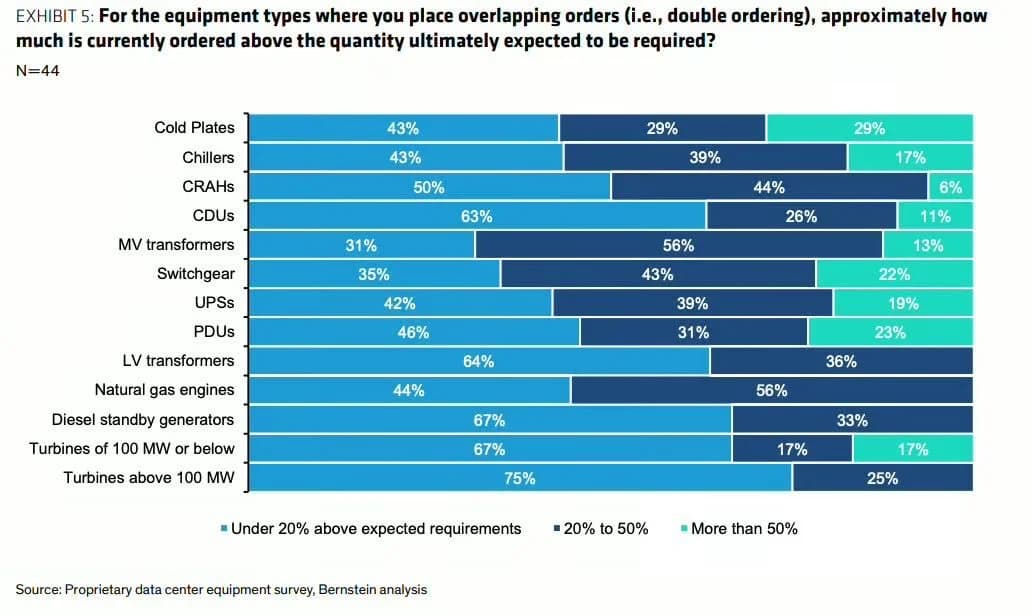
Exhibit 5 from the survey, N=44. Credit: Proprietary data center equipment survey, Bernstein analysis, via Kalani o Māui.
| Equipment | Under 20% above expected | 20–50% above | More than 50% above |
|---|---|---|---|
| Cold plates | 43% | 29% | 29% |
| Chillers | 43% | 39% | 17% |
| CRAHs | 50% | 44% | 6% |
| CDUs | 63% | 26% | 11% |
| MV transformers | 31% | 56% | 13% |
| Switchgear | 35% | 43% | 22% |
| UPSs | 42% | 39% | 19% |
| PDUs | 46% | 31% | 23% |
| LV transformers | 64% | 36% | — |
| Natural gas engines | 44% | 56% | — |
| Diesel standby generators | 67% | 33% | — |
| Turbines of 100 MW or below | 67% | 17% | 17% |
| Turbines above 100 MW | 75% | 25% | — |
The pattern runs along the supply chain's own bottlenecks. The heaviest over-ordering sits in the scarcest, longest-lead-time gear: medium-voltage transformers, where 56% of respondents order 20–50% more than they expect to need, and switchgear, where 22% order more than 50% above requirements. Cold plates — a liquid-cooling component with no long procurement history — show the largest tail, with 29% of buyers ordering more than half again what they expect to install. Big turbines, the item with the least substitutability and the most punitive slot economics, show the least padding: 75% of buyers keep the overage under 20%.
Double ordering is a rational hedge for a buyer facing multi-year lead times and a project that dies without power gear. It is a serious problem for anyone reading order books as demand. Backlogs at electrical-equipment and cooling vendors are one of the main pieces of evidence cited for the durability of the AI buildout, and this survey says a meaningful slice of that backlog is the same rack of gear counted twice. Tarun Chitra put the market-structure version bluntly: a hyperscaler executive placing orders with intent to cancel can move a supplier's apparent profit by 50% — a scale of distortion that would be a scandal in any regulated market. Nothing in the survey establishes that anyone ordered with intent to manipulate results; the respondents describe hedging, not spoofing.
It also lines up with Bernstein's published view of the pipeline, which holds that 35–40% of announced global data-center capacity is at risk of delay or cancellation, with high-voltage transformer and switchgear lead times of 80–100 weeks and interconnection queues of three to four years in major markets. If a third of announced capacity never gets built while half of buyers are ordering above plan, the cancellations arrive at suppliers twice.
Two caveats worth keeping. The sample is small — 50 respondents, 44 on the over-ordering question — and self-reported. And the underlying Bernstein note is not public: what is verifiable here is the quoted passage and the chart, published behind Daily Chartbook's paywall, not the questionnaire, field dates or respondent identities.
Daily Chartbook #985Kalani o Māui's post with the survey chartTarun ChitraBernstein on data-center delays and cancellations

Dwarkesh Patel: the AI buildout could set off a second Volcker shock

Dylan Patel: $11T of AI capex through 2029, $5T of it borrowed

Sutskever: rogue agents will go for the neoclouds next

Everything we know about AI usage comes from vendors

Dylan Patel: two labs will own most of the world's compute

Adam Becker: every exponential ends