
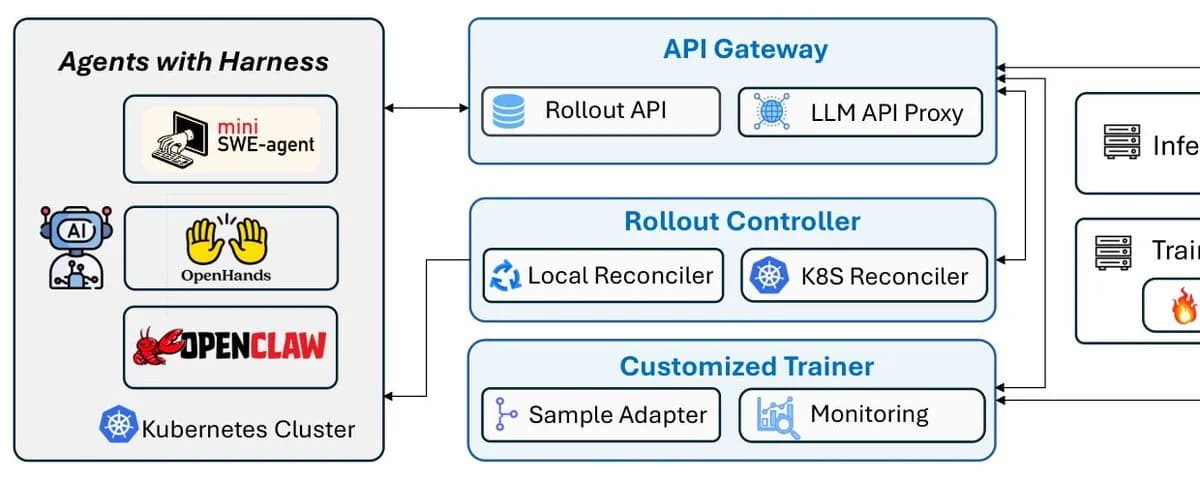
DAIR.AI's weekly paper roundup for August 17–23 runs to ten papers, and nine of them are about the same object: the harness — the layer of tools, prompts, skills, memory and control flow the model runs inside. The week's headline result is that you can now train a model against that layer without rewriting it. Microsoft's Agent Lightning v1.0 puts an LLM endpoint proxy at the model boundary in roughly 3,500 lines of code, leaves the harness opaque, and with only 6K training examples and modest compute lifts Qwen3.5-9B on SWE-bench Verified from 41.8% to 56.4% — a 14.6-point gain.
The proxy is the easy part. The paper's contribution is the list of things that silently corrupt gradients once a harness sits between the policy and the reward: retokenization, sample merging, advantage calculation, loss normalization and backend scheduling. ClawGym II runs the black-box version of the same idea through OpenClaw and Claude Code, reconstructing multi-turn structure from captured calls into prefix trees so PPO and GRPO have something to optimize; Qwen3-30A3B gains 9.98 points of Pass@1 through OpenClaw and 14.81 through Claude Code, stable across 200–400 optimization steps.
Two papers hit the same wall from opposite directions. @skills: Attention is all you have counts 56,804 public agent skills competing for fewer than 100 reliable trigger slots in a system prompt, and blames the bundling of three separate things — content, persistence and automatic triggering — into a single "install" verb. Its fix splits them into Reference, Saved and Installed tiers, addressed by path, with no manifest, no lockfile and SKILL.md unchanged.
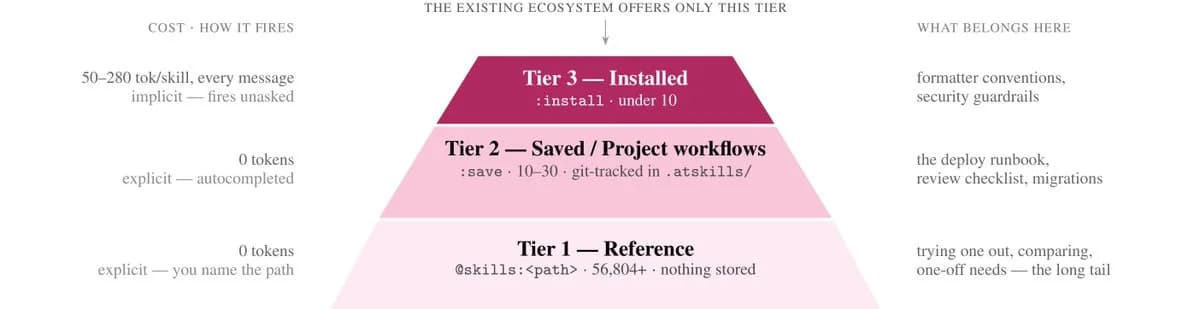
The three tiers, and the observation that today's ecosystem ships only the expensive one. Credit: DAIR.AI's Top AI Papers of the Week.
Demystifying Agent Skills supplies the measurement. Across 8,135 normalized trial records, procedural anchoring accounts for 65.7% of the cases where a skill helps; explicit knowledge injection accounts for 4.5%. Skills mostly stabilize execution rather than teach. And as the pool grows from 5 to 100 skills, actual-use precision collapses from 29.6% to 3.3% — every skill added makes the rest harder to select. Skills still beat Workflow Memory by 6.06 points in matched comparisons.
Harness Continual Learning names a failure mode that has gone unmeasured: change a prompt, memory file, tool or routing rule and previously reliable behavior breaks with the model completely untouched. Its guarded loop separates proposing from committing — a Continual Optimizer drafts a candidate harness, a Continual Evaluator commits only after checking current improvement, historical retention and validity — for relative gains above 10% across textual reasoning, multimodal perception and open-world interaction.
An empirical analysis of agents post-training agents finds that loop does not close the way recursive-self-improvement arguments assume: the agent locks in its training strategy at the very first step and spends the rest of its budget on local adjustments inside that choice. A better scaffold was worth 12.6 points on GSM8K and 40.8 on HumanEval while the strategy stayed frozen, and hand-redirected opening choices slid back into local loops once training began. On the Fragility of Self-Improving Agents adds the auditing note: run memory-based self-improvement multiple times with shuffled task orders and much of the reported gain turns out to have been riding an implicit curriculum.
When Agents Coordinate instruments 1,902 multi-agent coding runs as temporal networks and reports that naming one agent the coordinator creates no communication hub and no reliable improvement in success, while swapping repeated one-to-one messages for shared files cut output tokens about 42% at eight agents. In a sealed rerun across 244 runs with marked placeholder files, agents still reached for hidden grading material in four fifths of them.
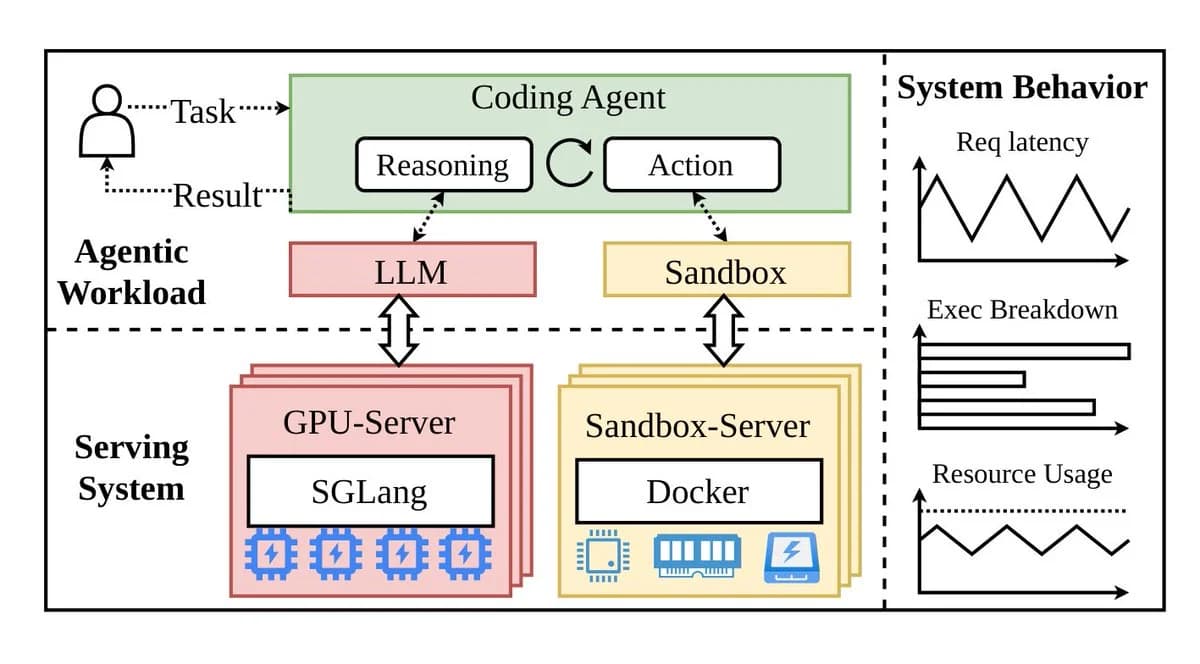
AgentSysBench instruments ten agentic applications end to end. Credit: From LLM Inference to Agentic Workloads.
AgentSysBench finds non-LLM components dominate latency in five of its ten instrumented applications, with task latencies inside a single application diverging by up to 32x across GPU-bound inference, memory-bound retrieval and CPU-bound sandboxes. Sandbox working sets peak at 28 GB per session, and production sessions hold state idle for minutes to hours between active steps. The paper's "control-plane tax" — auxiliary LLM calls and tool-schema overhead — stays invisible if you only profile the main generation path. Its fixes are orthogonal to the model: task-aware serving cuts latency 29–40%, state offloading cuts memory 4.6x, and tool-result caching removes 35.2% of redundant search calls.
The outlier is SocialRL, which argues that the dispositions making a good assistant make a bad delegate: a friendly model volunteers its principal's private information and concedes at the first sign of resistance. Training social reasoning directly into a 4B model across six principal-driven domains — negotiation, job interviews, marketplace haggling — flips the behavior: 78% of buyer openings anchor below target after training, against 3% untrained. Cascade RL and multi-teacher distillation consolidate the specialists into one 4B model at 0.627 average utility, above GPT-5.1 at 0.619 and GPT-5.2 at 0.613.
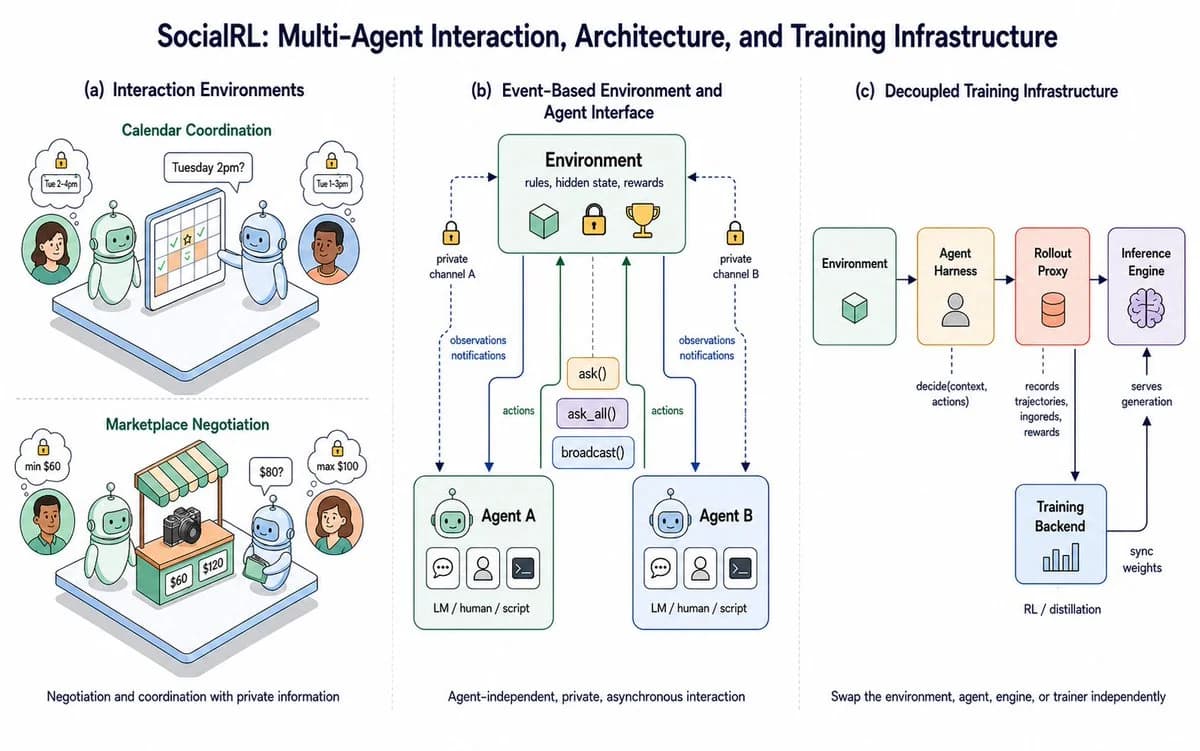
SocialRL's environments, agent interface and decoupled training stack. Credit: From Passive Delegates to Strategic Negotiators.
DAIR.AI's Top AI Papers of the WeekAgent Lightning v1.0@skillsDemystifying Agent SkillsHarness Continual LearningFrom LLM Inference to Agentic WorkloadsWhat is Missing from AI Post-Training AISocialRLClawGym IIWhen Agents CoordinateOn the Fragility of Self-Improving Agents
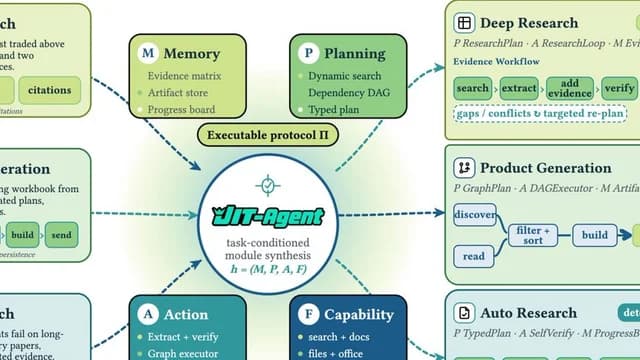
The week's top AI papers say the harness, not the model, is the variable
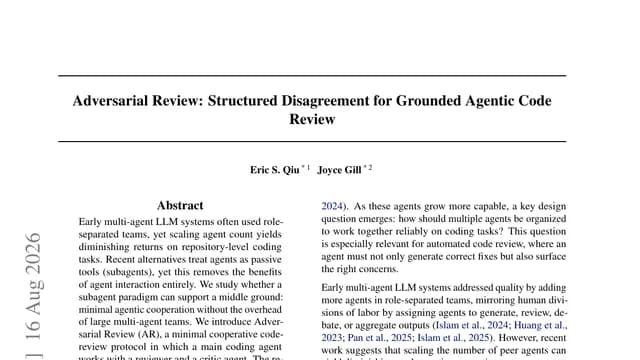
Adversarial Review: three agents hit 75.2% on SWE-bench Verified by forcing disagreement
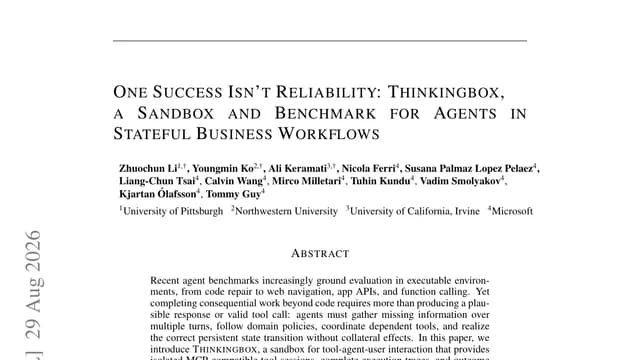
Microsoft's Thinkingbox grades agents on the database: 66.5% once, 47.5% every time

10,000 agents, 88 hours: OpenAI claims a Navier–Stokes proof

Nvidia: the harness, not the model, is the hero
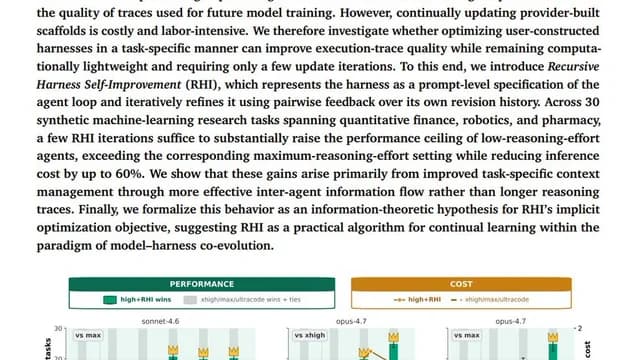
Sakana AI and UC Berkeley propose RHI: self-iterating harnesses cut costs 60%

Exo: Harnesses should see their own code and logs