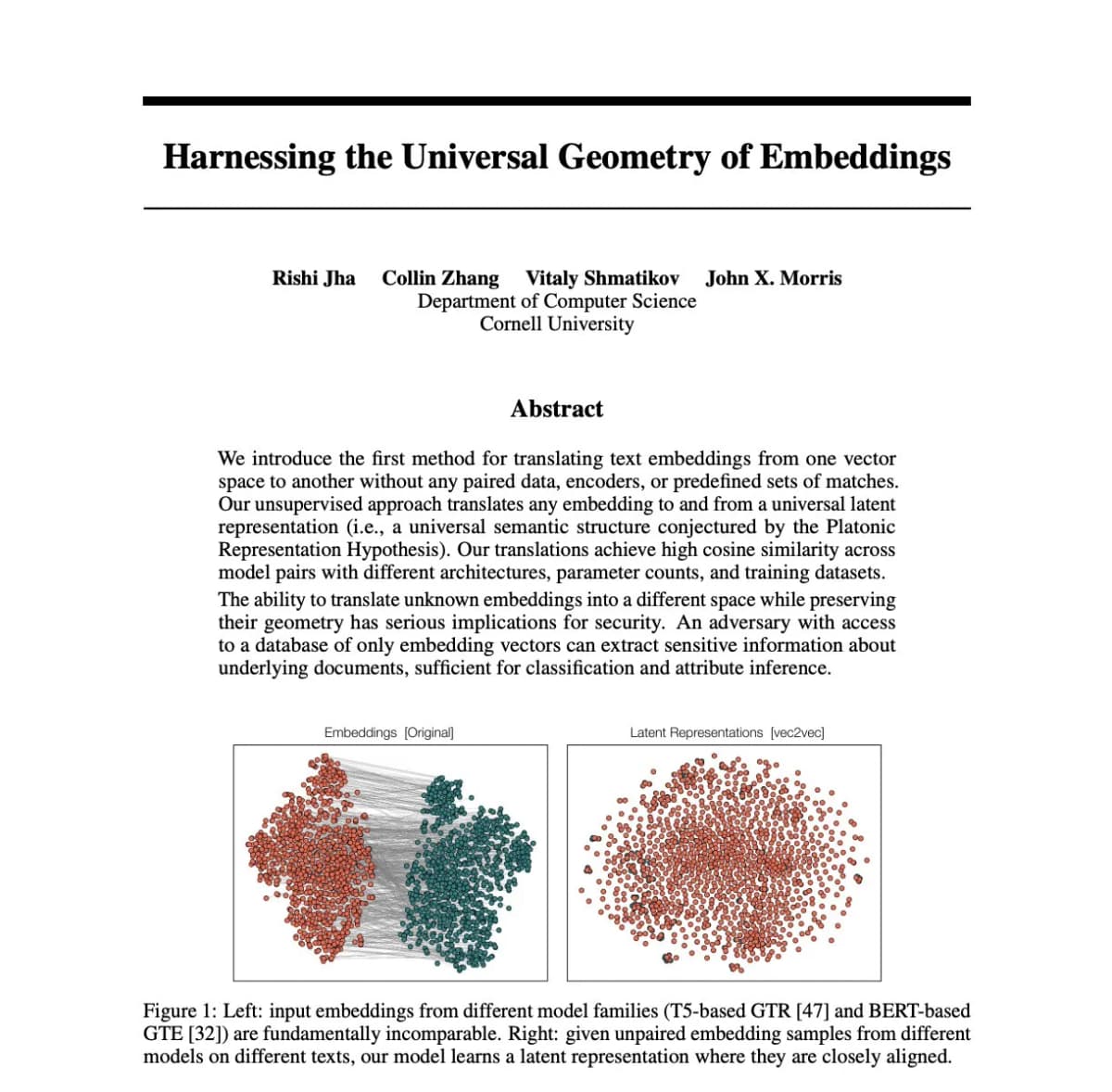
A viral X thread claiming "every LLM on earth is converging on the exact same universal geometry of meaning" is pointing at a real result, and overstating it. The underlying work is Harnessing the Universal Geometry of Embeddings by Rishi Jha, Collin Zhang, Vitaly Shmatikov and John X. Morris of Cornell's computer science department — a NeurIPS 2025 poster, first posted to arXiv in May 2025 and revised through January 2026. Their method, vec2vec, is the first to translate text embeddings from one model's vector space into another's with no paired data, no access to either encoder, and no predefined set of candidate matches.
The claim is narrower than the thread suggests: the models studied are text embedding models — GTR, GTE, E5, Stella, Granite and CLIP, spanning five transformer backbones and 109M to 278M parameters, with a 4B Qwen encoder tested on a single pair in an appendix. Claude, GPT, Llama and Gemini were not part of the experiments.
The setup is an attacker's: you hold a dump of embedding vectors from a compromised vector database, produced by an encoder you cannot query and whose architecture and training data you do not know. You do have some other encoder you can query freely.
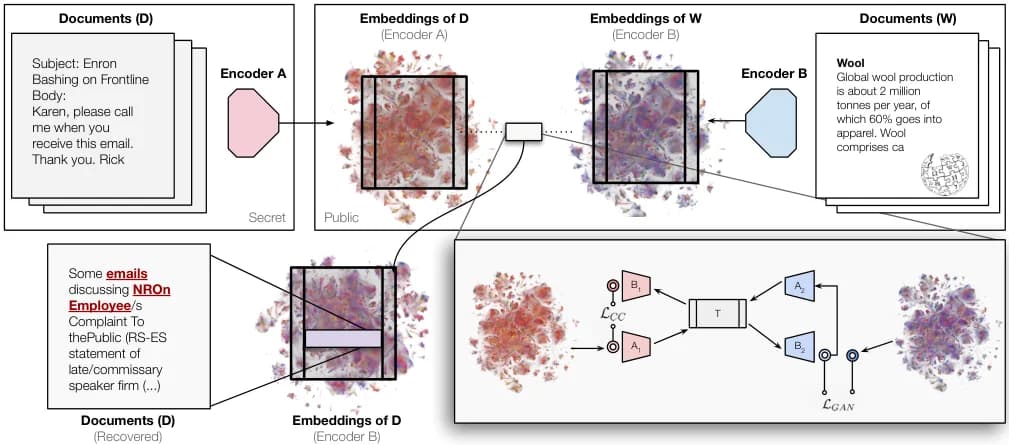
Figure 2: vec2vec translates a stolen database into a known model's space using latent structure alone. Credit: Jha, Zhang, Shmatikov and Morris.
Architecturally, vec2vec is small: per-space input adapters map embeddings into a shared latent representation, a shared backbone processes it, and per-space output adapters map back out — all MLPs with residual connections, layer normalization and SiLU, no CNNs, since embeddings have no spatial structure. Training borrows from unsupervised image translation: adversarial losses at both the latent and output level, plus cycle consistency, reconstruction, and a vector-space-preservation term that forces pairwise distances to survive the trip. Each translator was trained on 1M 64-token sequences from Natural Questions, with the two models' embeddings drawn from disjoint text sets.
On a 65,536-text NQ evaluation chunked into batches of 8,192, translations reach cosine similarity up to 0.92 against the ground-truth target vectors (the paper cites 0.96 for its best model pair) and top-1 accuracy up to 100% — meaning the correct target is the nearest neighbour among 8,192 candidates. The naïve baseline of feeding the raw vector through unchanged scores near-zero cosine and mean rank around 4,080 out of 8,192, i.e. random. Oracle-aided optimal transport, which is given the candidate set and so has an unfair advantage, still gets 0.00 top-1 on cross-backbone pairs.
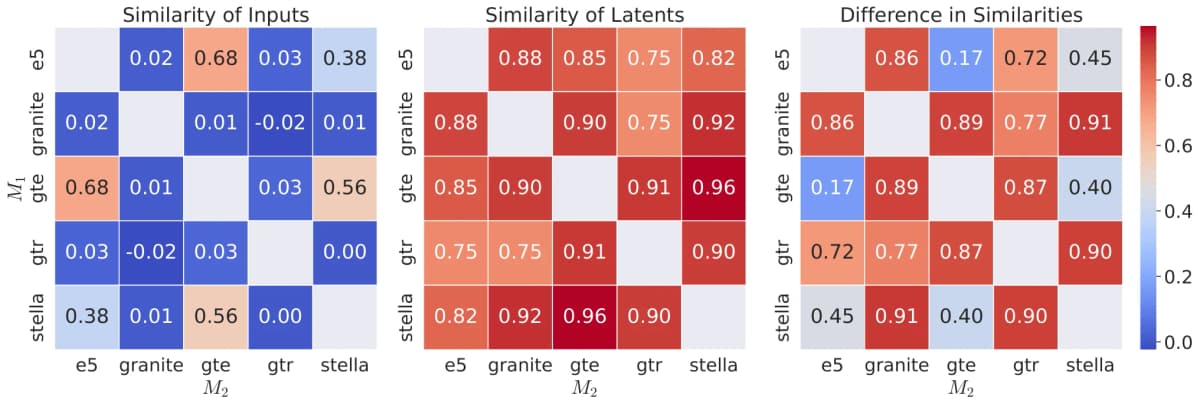
Figure 4: raw embeddings from two models (left) are incomparable; their vec2vec latents (middle) have near-identical pairwise geometry. Credit: Jha, Zhang, Shmatikov and Morris.
Translators trained on Wikipedia-derived questions hold up out of distribution, on 800 tweets and on 8,192 pseudo-re-identified MIMIC-III patient records labelled with 2,673 MedCAT disease descriptions. The authors treat the preservation of concepts like "alveolar periostitis," which never appears in training, as evidence the latent space really is a general representation rather than a memorized mapping. Ablations are brutal: drop the vector-space-preservation loss, the cycle-consistency loss or the latent discriminator and top-1 accuracy falls to zero. Data requirements are modest — 50,000 embeddings get close to the 1M result.
This is where the thread's "vector databases are wide open" needs qualifying. The paper's own framing is that extraction is "sufficient for classification and attribute inference." Zero-shot attribute inference on translated vectors beats the naïve baseline consistently and sometimes beats the ideal same-space oracle. Running an off-the-shelf zero-shot inversion model on translations recovered information from as many as 80% of emails in a 50-email Enron subset and 67% of tweets, for some model pairs, as scored by a GPT-4o judge — enough to surface names, dates, financial details and outages. The authors call these inversions imperfect and leave purpose-built inverters for translated embeddings to future work. Stored embeddings are not encrypted text, but they are not opaque either.
The Platonic Representation Hypothesis argued that large models converge on a shared representation. vec2vec upgrades that from an observation to something operational — the authors call it the Strong Platonic Representation Hypothesis: the universal structure can be learned and used to move between spaces without any correspondence. If it holds as models scale, re-embedding a corpus to switch providers becomes a translation problem, and any embedding store has to be treated as roughly as sensitive as the documents behind it. The code is open on GitHub, and a follow-up, mini-vec2vec by Guy Dar, replaces the unstable GAN training with a fitted linear transformation that it reports as orders of magnitude cheaper while matching or exceeding the original results.
arXiv abstractfull paper (HTML v4)project pageNeurIPS 2025 postermini-vec2vecthe original X thread