
Five researchers at Microsoft Research India — Mihir Agarwal, Viraj Agrawal, Sabyasachi Basu, Ankit Garg and Kirankumar Shiragur — have published the first explicit construction showing that single-vector embeddings can need exponentially more dimensions than multi-vector embeddings to get a ranking right. Alongside the proof they release ANDOR, a 50,000-document shopping benchmark built from the same logical structure, on which a small late-interaction model beats OpenAI's largest embedding model by 16× at Recall@2 zero-shot.
The question has been open in an awkward way. Late-interaction models like ColBERT — which keep one vector per token and score with the Chamfer/MaxSim metric — consistently beat dense single-vector encoders in practice, and vector databases from Vespa to Qdrant to LanceDB have added native multi-vector support on that evidence. But nobody had shown the advantage was representational rather than an artifact of training. The LIMIT benchmark exposed a large gap, and follow-up work from the same lab then showed much of that gap could be recovered by task-specific fine-tuning.
The paper's Theorem 1 fixes a family of Boolean relevance matrices built from Razborov and Sherstov's pattern-matrix machinery, with the Minsky–Papert AND-of-OR function inside. For that family, any unit-norm single-vector representation that ranks every relevant document above every irrelevant one needs dimension 2^Ω(m), while a multi-vector representation does it exactly with O(m⁶) size per query and document and a separation margin of Θ(m⁻²).
The important word is ranking. Earlier separations, notably Rajesh Jayaram's, were about approximating Chamfer similarity scores pointwise — a strictly stronger demand than getting the order right. The authors close that loop from the other side too: Theorem 2 shows Jayaram's own hard instance admits a single-vector representation of size Θ(N) that preserves the retrieval ordering. Score-approximation hardness, in other words, does not imply ordering hardness; this paper supplies the ordering result that was missing.
ANDOR turns the construction into something a retrieval engineer would recognise. It models 20 product categories (colour, material, fit, occasion, season…) with 20 attribute values each. A query names several mandatory categories and lists acceptable values within each; a document is relevant only if it matches at least one accepted value in every queried category — AND across categories, OR within them. The corpus holds 50,000 product descriptions with 2,000 designated test positives and 38,780 shared hard negatives that miss by exactly one, two or three categories, so partial matching cannot fake a win. Each test suite has 1,000 queries with exactly two relevant documents apiece.
Seven models were evaluated: GTE ModernColBERT v1 and Jina Embeddings v4 in late-interaction mode on the multi-vector side; Jina v4's 2048-dim head, Qwen3 Embedding 0.6B, Snowflake Arctic Embed L v2, Cohere Embed v4 and OpenAI text-embedding-3-large on the single-vector side.
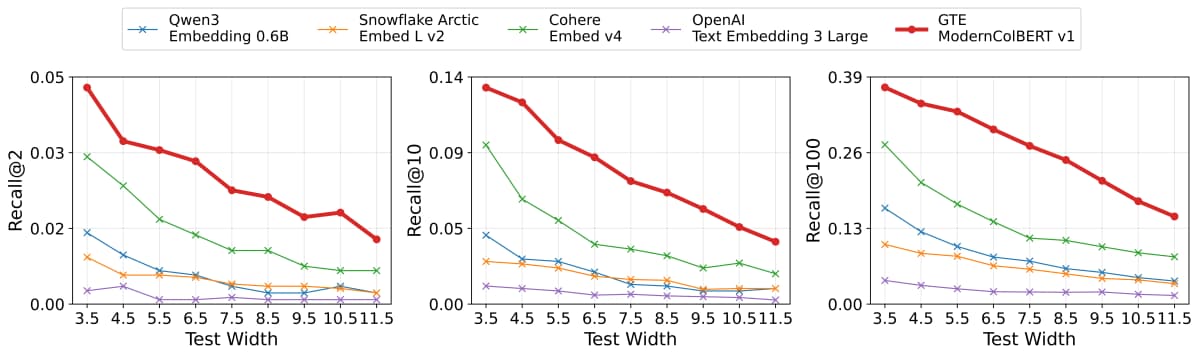
Zero-shot recall across nine ANDOR test widths. Every model degrades as queries get wider; the multi-vector lead does not close. Credit: Agarwal et al., arXiv:2608.21494.
Zero-shot, GTE ModernColBERT's relative gains over the single-vector baselines are lopsided:
| Single-vector baseline | Recall@2 | Recall@10 | Recall@100 |
|---|---|---|---|
| Cohere Embed v4 | 80.6% | 93.8% | 87.0% |
| Qwen3 Embedding 0.6B | 352.2% | 346.8% | 223.8% |
| Snowflake Arctic Embed L v2 | 432.3% | 396.9% | 321.9% |
| OpenAI text-embedding-3-large | 1662.1% | 1204.5% | 1025.0% |
| Mean gain | 631.8% | 510.5% | 414.4% |
Fine-tuning — 6,250 steps per run, 32 queries per batch, each scored against 2 positives and 30 negatives weighted toward level-1 hard negatives — helps everyone and closes none of it. Averaged over the full train–test grid, ColBERT keeps a 99.4% margin at Recall@2 and 57.8% at Recall@100 over the fine-tuned single-vector baselines.
The cleanest evidence comes from Jina Embeddings v4, which exposes a single-vector and a multi-vector head from one backbone. Fine-tuning both jointly holds architecture, data and parameter count fixed and varies only the representation.
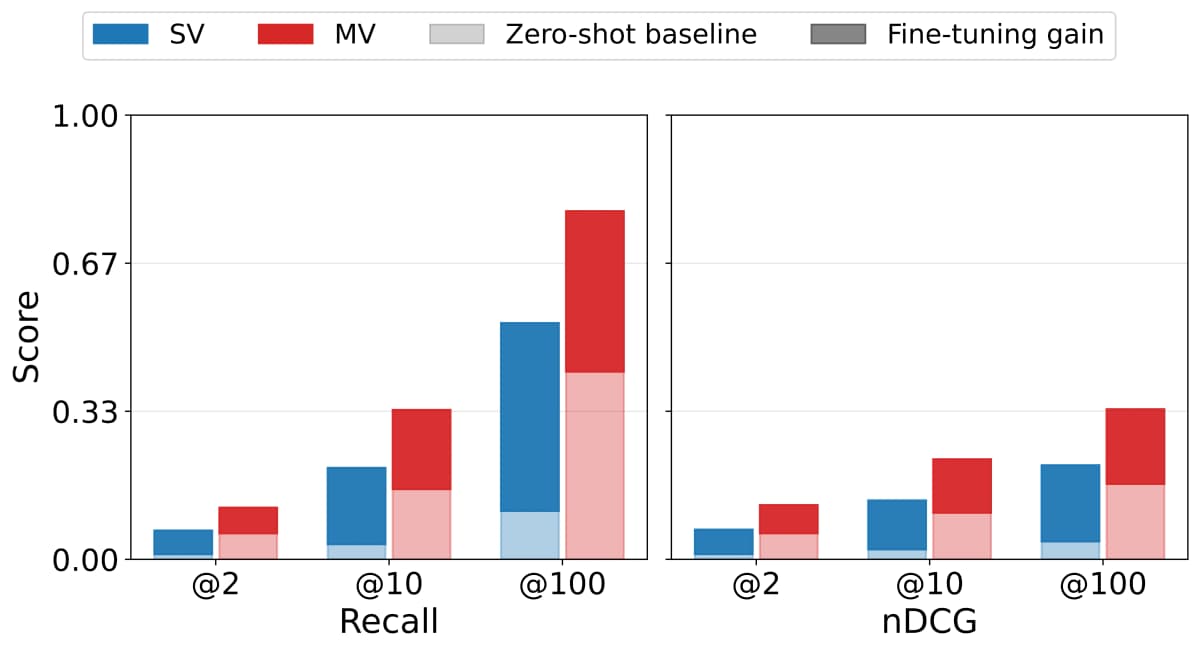
Jina v4's two heads after joint fine-tuning at training width 5.5, evaluated at test width 3.5. Credit: Agarwal et al., arXiv:2608.21494.
The fine-tuned single-vector head roughly catches up to where zero-shot late interaction already was, and stops. The multi-vector head stays ahead at every test width, by 104.8% at Recall@2, 83.8% at Recall@10 and 61.5% at Recall@100. The authors call this their strongest evidence that the gap is representational rather than a training or hyperparameter artifact.
Compositional, faceted queries are not a corner case — they are what e-commerce search, filtered RAG and agentic retrieval look like when the user has more than one requirement. This paper gives the first formal reason to expect a single dense vector to fail on them no matter how many dimensions you buy, and hands the field a benchmark where fine-tuning does not paper over the difference. The authors say the data and evaluation code will be released shortly.
Two caveats the authors raise themselves. ANDOR is a semantic instantiation of the construction, not the pattern matrix from the proof — the empirical gap is consistent with the theory but is not the theorem. And because each ANDOR test query has only two positives, prior work guarantees that a five-dimensional single-vector embedding realising the correct ordering exists; it just cannot be learned from semantic content alone, which is the setting every real system operates in. The lower bound is a worst-case statement, so it does not establish that production retrieval workloads sit anywhere near the hard family. The paper also notes that AI tools supplied initial direction and coding agents built the dataset and evaluation pipeline, with proofs and review done by the authors.
Retrieval Needs Multivectors: An Exponential Separation (arXiv:2608.21494)full HTML versionJayaram, Multi-Vector Embeddings are Provably More ExpressiveWeller et al., On the Theoretical Limitations of Embedding-Based Retrieval (LIMIT)S et al., On Strengths and Limitations of Single-Vector Embeddings

