Epoch AI puts OpenAI and Anthropic's combined annualized revenue at about $105 billion, up from $30 billion at the start of the year — a 3.5× gain with four months still to run. In a Gradient Updates newsletter titled "An update on AI's most important number", researchers Josh You and Lynette Bye argue that the pair are "growing about as fast as, or faster than any company of their size has grown in history," and that the growth rate went up in 2026 rather than bending the way maturing software businesses normally do.
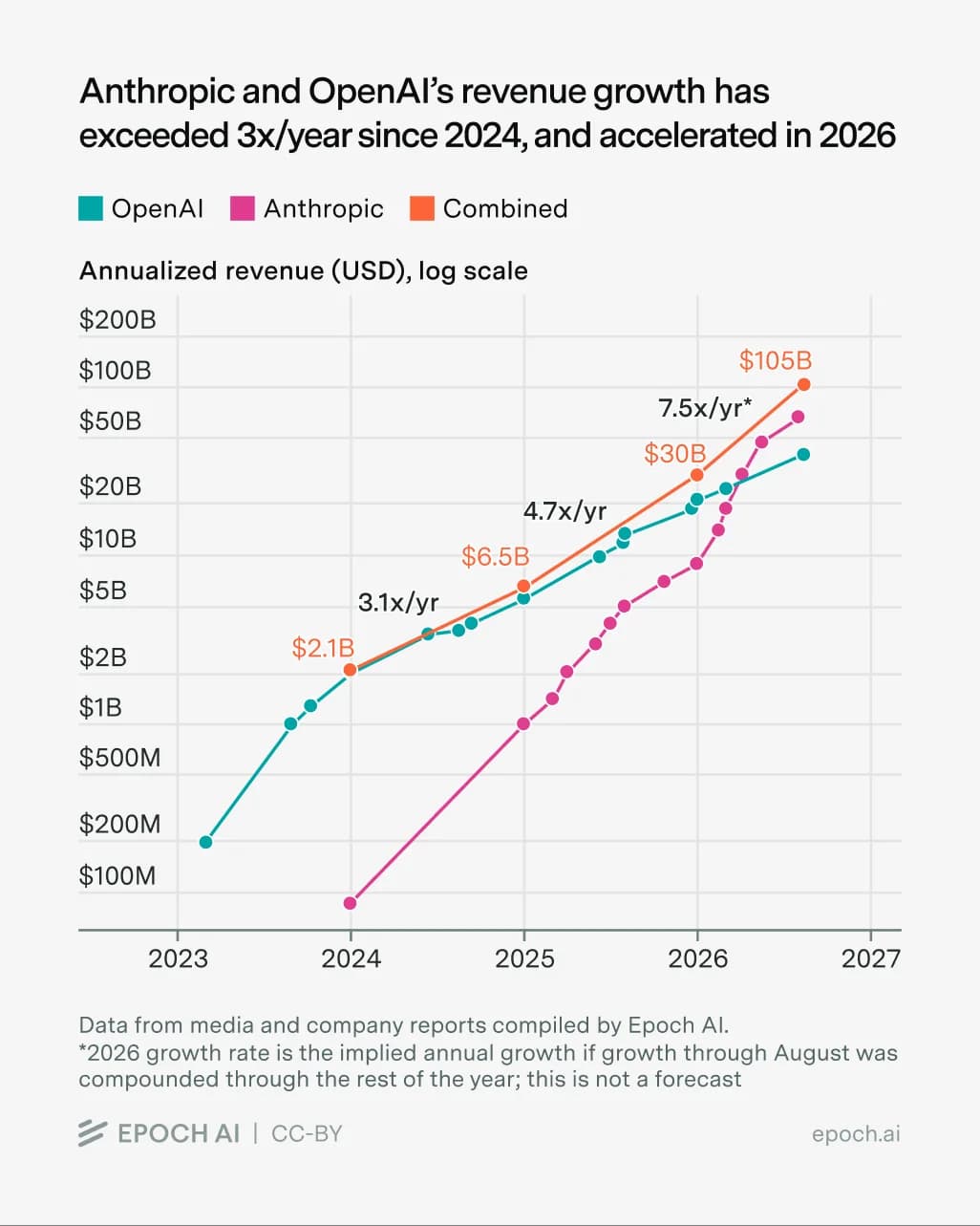
Combined run rate: $2.1B at the start of 2024, $6.5B at the start of 2025, $30B at the start of 2026, $105B now. Credit: Epoch AI, CC-BY.
| Company | Then | Now |
|---|---|---|
| OpenAI | $13B run rate (last August) | over $40B |
| Anthropic | $1B → $9B across 2025 | reportedly $65B at end of July |
| Combined | $30B (start of 2026) | ~$105B |
Epoch's own annotation on the chart marks combined growth of 3.1×/yr in 2024, 4.7×/yr in 2025, and an implied 7.5×/yr for 2026 if growth through August compounded through the rest of the year — a rate the authors explicitly label "not a forecast." Anthropic's individual numbers carry the loudest caveat: it was coming from behind and overtaking a larger rival, and the two labs book revenue differently. When customers buy tokens through a cloud platform, OpenAI records only its cut while Anthropic records the full amount, which inflates Anthropic's reported figure relative to OpenAI's.
There is also a hint of deceleration inside the year. Epoch notes the labs were reportedly around $55 billion combined at the end of Q1 — nearly a doubling in three months — then took roughly four months to double again. Still faster than 2025's doubling time, but not the same slope.
The authors' framing is that this is a live experiment about whether AI behaves like previous technology industries. The default expectation is stacked S-curves: rapid progress and diffusion while a technology is new, then saturation as low-hanging fruit runs out and adoption curves flatten, taking growth from 3× to 2× to 20–30% a year. One reading of 2026 is a temporary spike caused by coding agents crossing a usefulness threshold around the Opus 4.5 release late last year — the same shape as ChatGPT's launch, which took OpenAI from a niche $28 million business in 2022 to $1 billion annualized in 2023 before growth settled back to 3× in 2024.
The question Epoch leaves open is whether revenue is coming from progress or diffusion. Diffusion slows after a few years; progress continues as long as capability gains do. If each new capability level opens its own diffusion curve, growth keeps compounding; if frontier AI saturates as a category, gravity reasserts.
The scale arithmetic is what makes the number "most important." Combined, the two labs are collecting close to $10 billion a month, and Exponential View pegs the whole generative-AI market at roughly $200 billion annualized — about one-thousandth of the world economy. Epoch's deliberately naive extrapolation: at 3× a year, or 10× every two years, frontier AI would reach the size of today's world economy in about six years. The authors do not offer that as a forecast but as a frame — either growth slows within six years, or the economy has been rebuilt around it. On the same trend, they add, the top labs are one to two years from matching the largest individual tech companies on earth.
A softer version of the claim survives even a hard stop: if combined revenue passes $300 billion a year and capability progress froze in August 2027, diffusion alone would still make AI a trillion-dollar industry.
One structural caution worth carrying: every figure here is compiled from media and company reports, not audited filings — the same disclosure problem that runs through most AI usage and revenue reporting.
Epoch AI, "An update on AI's most important number"Epoch AI on XEpoch AI Gradient Updates