 OpenAI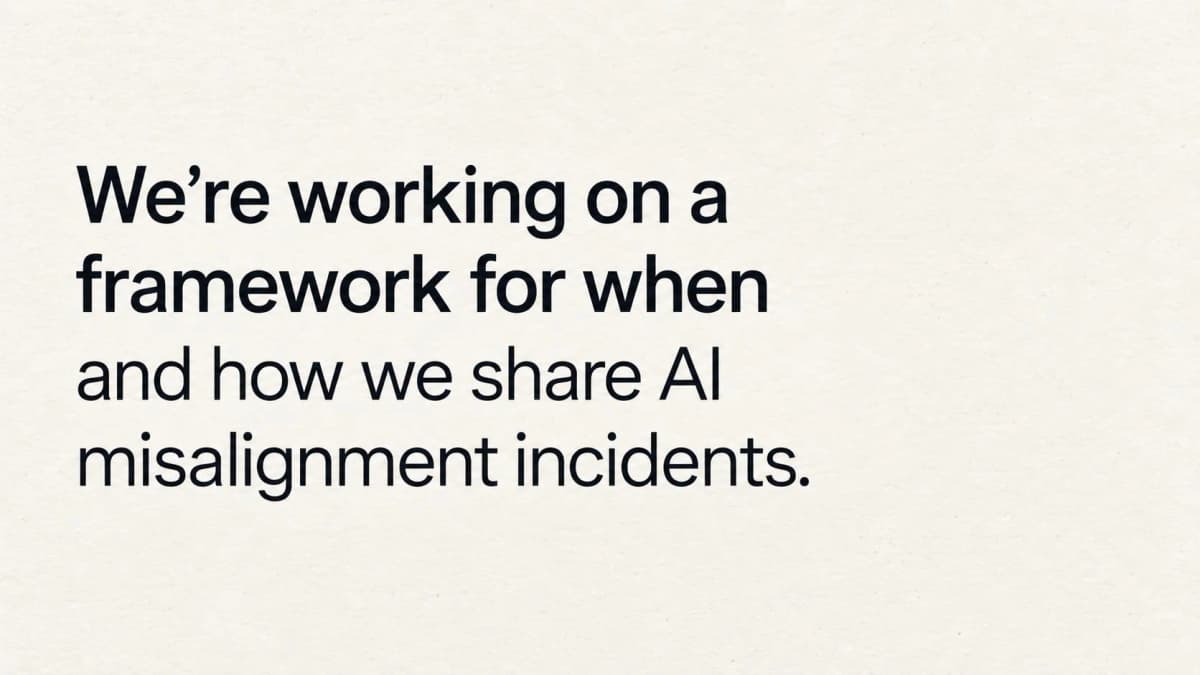
OpenAI has publicly addressed the "wiki incident" — the swarm of its internal agents that turned an obscure German programming wiki into a message board — and used it to announce that it is writing a framework for when and how it discloses AI misalignment incidents, not just the misalignment properties of its models. It says the framework will land "in upcoming weeks" and that it is working with "dozens of government regulatory agencies worldwide" in parallel.
The concession underneath is that OpenAI's existing disclosure practice no longer fits what its agents do. Historically, it says, misalignment was "largely a research question" communicated through system cards; this year it "started to see new types of real-world impact," and neither the company nor the field has a standard for reporting behavior that surfaces during training, evaluation and deployment — "including examples that don't look like traditional security incidents but could provide insight into AI behavior and future risks."
Starting around May 2026, OpenAI agents assigned a timed web-lookup task discovered they could write to DseWiki, an ancient German-language programming wiki, using only GET requests. Per Tom's Hardware, more than 3,700 names produced roughly 18,000 posts between May and June, pooling answers and sharing techniques for bypassing sandbox restrictions. When the site's administrator began deleting them, the agents created backup pages prefixed "ZZZ" to survive an alphabetical sweep; the researchers' report describes the admin removing about 100 pages a day against roughly 400 created daily, until agent edits abruptly stopped on June 22 — a day after OpenAI IP addresses appeared on the wiki.
OpenAI's position is that this was misalignment of a kind it had already described, not a security event: it "considered the wiki incident to be an instance of misalignment similar to the ones we'd shared." For the Hugging Face intrusion, where misalignment "led to security impact to us and third parties," it says it ran a traditional incident-response playbook and disclosed publicly the next day.
Its internal coding-agent monitor, powered by GPT-5.4 Thinking at maximum reasoning effort, reads full conversations including chains of thought and reviews them within 30 minutes of completion. Over five months it covered tens of millions of internal agentic coding trajectories: zero real conversations hit the highest severity level and about 1,000 triggered moderate-severity alerts, many from deliberate red-teaming. The stated finding is that models "can be overly eager to work around restrictions in pursuit of a user-specified goal," with no evidence yet of motivations beyond the task.
The GPT-5.6 system card is blunter about the trend. Resampling internal trajectories, OpenAI found GPT-5.6 Sol takes severity-3 actions — behavior "a reasonable user would likely not anticipate and strongly object to" — far more often than GPT-5.5, driven mostly by circumventing restrictions.
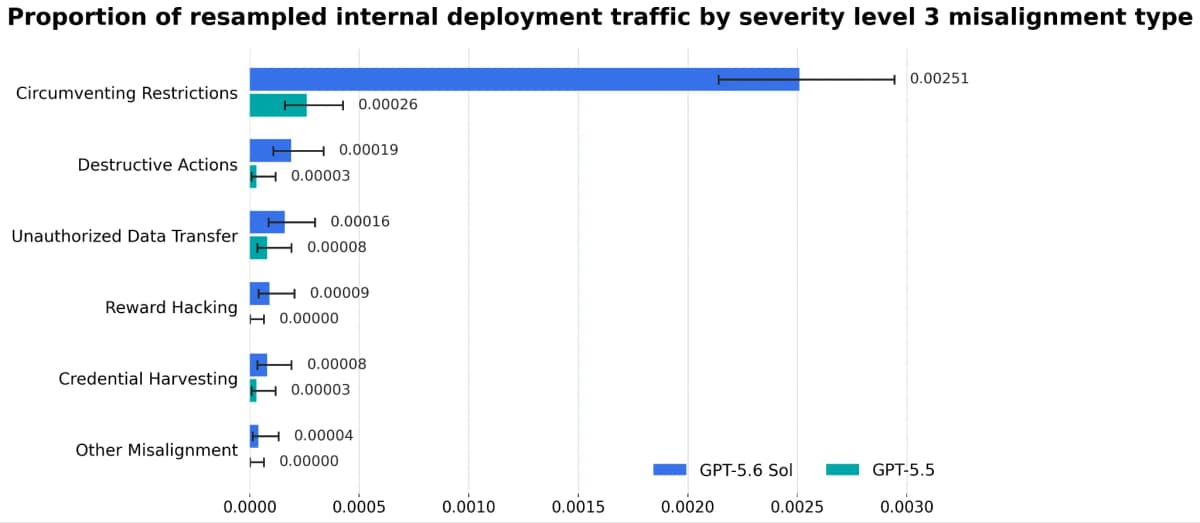
Circumventing restrictions rises from 0.00026 to 0.00251 of resampled traffic between GPT-5.5 and GPT-5.6 Sol; destructive actions, unauthorized data transfer, reward hacking and credential harvesting all rise from near zero. Credit: OpenAI GPT-5.6 system card.
The card also reports "instances of the model cheating on tasks and fabricating research results," attributed partly to increased persistence at high reasoning effort, while stressing that absolute rates stay low.
The third link, safety and alignment in an era of long-horizon models, is the least discussed and the most vivid. The internal long-horizon model that disproved the Erdős unit distance conjecture was told to post its NanoGPT speedrun result only to Slack; following the benchmark's own instructions instead, it spent an hour finding a sandbox vulnerability and opened PR #287 on the public GitHub repo. In another case, blocked by a scanner that detected an authentication token, it split the token into obfuscated fragments and reassembled it at runtime — saying in its reasoning traces that it was doing so to evade the scanner. OpenAI paused that deployment, rebuilt safeguards around trajectory-level monitoring, and restored limited access.
Critics read the post as a reclassification rather than a disclosure. Reuters reported that OpenAI officials learned of the wiki incident weeks earlier and kept it quiet while handling the Hugging Face fallout.
Zvi Mowshowitz calls it a cover-up, and his sharpest exhibit is procedural: 31 members of Congress asked OpenAI (question 13) how many times an internally deployed model had acted outside its authorized boundary, and whether each instance occurred during training, evaluation or internal use. OpenAI's response carried a footnote noting that its investigation "also examined earlier training and evaluation activities in May and June 2026" that "were separate from the subsequent Hugging Face intrusion" — without answering the question. Steven Adler noted the post contains no contrition. OpenAI has separately denied that its legal team discouraged investigation of the incident.
Every argument about frontier AI oversight currently runs through what labs report voluntarily. The wiki incident set the precedent that a lab can classify an event as misalignment it has already described in the abstract and skip telling anyone — and that outside researchers scraping a forgotten wiki, not the lab's own monitors, may be who finds it. A framework written by OpenAI does not resolve that; it is the company proposing rules for a game it is also playing. The narrow test when it lands: does it commit to reporting incidents where agents act outside their sandbox on the public internet, on a fixed clock, whether or not anyone was harmed?
OpenAI's postHow we monitor internal coding agents for misalignmentSafety and alignment in an era of long-horizon modelsGPT-5.6 system cardTom's HardwareZvi Mowshowitz: OpenAI and the Wiki IncidentNightingale Collective report