Research news · Sources checked September 13, 2026.
The AI pause debate turns on three questions: what to slow, who decides, and how an agreement could be verified. Dario Amodei’s September 12 essay drew support from rival lab leaders, alongside objections about openness, competition and international cooperation.
This report maps 45 voices: 26 September responses and 19 earlier positions. One interactive chart compares their policy statements; a second shows five dated risk estimates. The full source directory remains below, in this article.
Amodei’s “pacing” means slowing capability growth while continuing technical work. He seeks time for operational reliability, alignment, interpretability and testing, with a one-to-two-year research window rather than a fixed universal halt. His proposal differs from both the 2023 six-month pause letter and the prohibition-until-safe statement on superintelligence.
1. Embedded evaluators. Anthropic commits to giving outside evaluators ongoing access comparable to internal risk-assessment teams: workspaces, tools and permissions to examine training pipelines as well as finished models. Amodei names METR as an example. Evaluators would be able to publish key findings without Anthropic’s editorial control, subject to narrow security, legal, commercial and third-party restrictions. They could disclose when an important finding had been redacted. The proposal is more specific than commissioning an occasional external benchmark.
2. Democratic coordination. Amodei favors rules covering US frontier labs, alongside voluntary standards supported by a narrow government antitrust waiver. The waiver concerns coordination between firms; a company does not need it simply to slow its own development. Capability checkpoints would tie dangerous abilities to evidence of safety. Input-based limits, including compute or internal use of AI for AI development, are alternatives he considers more vulnerable to gaming. He also advocates chip export controls, restrictions on distillation and protection against weight theft—positions that help explain objections from the open-model community. Hassabis’s July framework is a related standards-body proposal.
3. Global coordination. The essay distinguishes restrictions on dangerous uses, mutual pre-release testing, a negotiated limit on recursive self-improvement, and a full pause. Amodei presents these as progressively harder to agree and verify. His comparison to arms-control treaties concerns a possible speed limit, not a treaty already negotiated; he doubts that a full international pause is achievable soon.
Amodei argues that AI helping build the next generation of AI could accelerate capabilities faster than safety research can keep up. The July pacing statement, reporting 1,386 employee signatures, calls for tools that would make deliberate pacing possible. Three strands of evidence explain the urgency:
Amodei’s warning about a possible internet-scale botnet within 6–12 months is a projection, not an established capability. The evidence motivates stronger controls; it does not settle whether those should take the form of deployment restrictions, coordinated pacing or a broader pause.
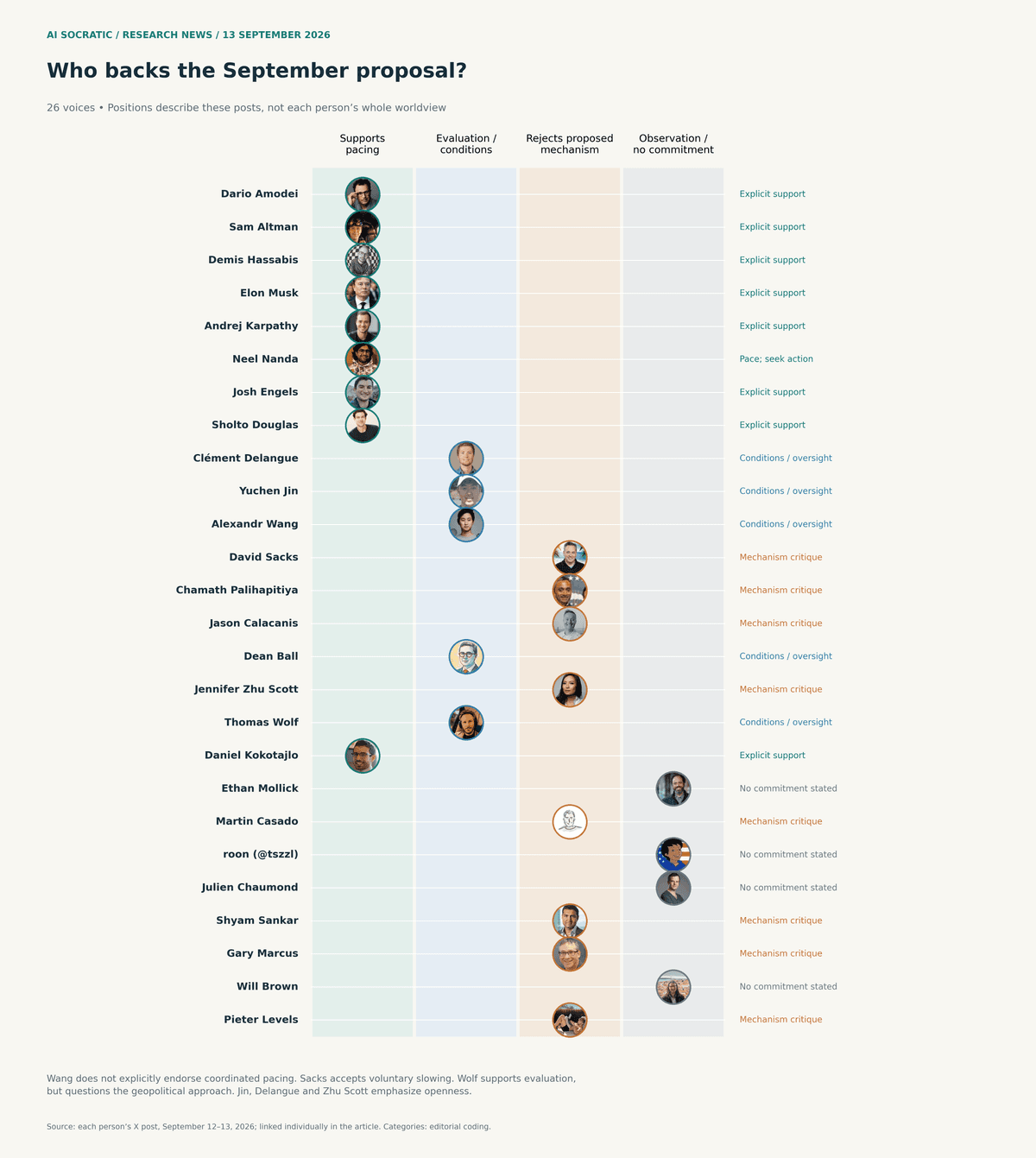
Support differs in specificity. Anthropic and OpenAI commit to embedded evaluator access. Hassabis supports the direction; Wolf adds conditions; Wang discusses alignment without the same commitment. The July signatories endorse building the option to pace, while older calls for stopping frontier work go further. Eliezer Yudkowsky’s 2023 essay asks for an indefinite worldwide halt; Connor Leahy’s 2024 interview proposes a compute-cap moratorium; Toby Ord’s 2025 interview urges serious consideration of a scientific moratorium. These are historical positions, not verified September replies.
Openness divides participants. Hugging Face’s Open Alignment Initiative pairs scrutiny with wider participation. Critics including Chamath, Jason and Zhu Scott worry that closed labs would consolidate power; Sholto Douglas and Kokotajlo argue pacing could instead let challengers catch up. ARC Prize emphasizes open benchmarks. These competing claims about capture and competition depend on the eventual rules, not just the stated intention to improve safety.
Evaluator independence remains unresolved. Sacks rejects the proposed government-backed mechanism while accepting voluntary slowing. Yuchen Jin asks who evaluates the evaluators, and how incentives and recursive self-improvement would be measured. METR is named as an example, not given exclusive rights. Gary Marcus offers a different intervention: recalling unsafe internet-connected agents rather than slowing AI development generally.
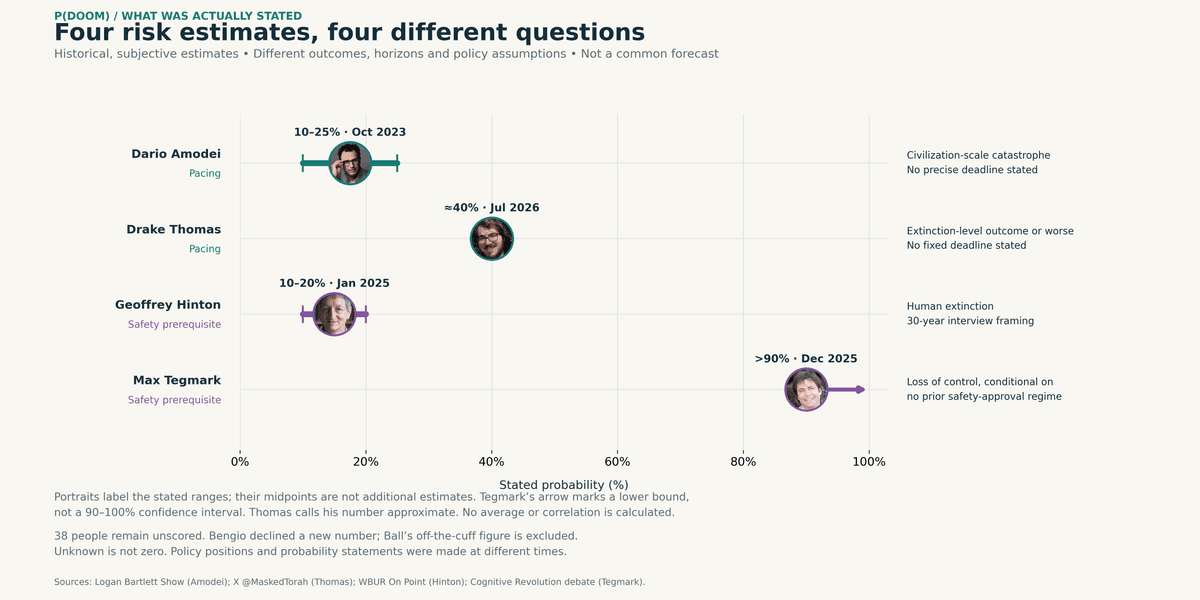
“P(doom)” covers different questions: extinction, loss of control and permanent loss of humanity’s potential. These estimates should not be averaged or treated as comparable forecasts. Ord’s approximately 10% is a historical book estimate discussed in 2025, when he said he was unsure whether it had changed. The dates and qualifications remain attached to each person.
The other 40 people are unscored here, not assigned zero risk. Bengio declined a fresh estimate; Ball’s disowned off-the-cuff remark is excluded. Qualitative warnings are not converted into invented percentages.
AI 2040: Plan A, from the AI Futures Project, proposes an international agreement delaying superintelligence until 2040 while making research public and letting many countries and companies approach the frontier together. It also includes a controversial compute-deterrence mechanism. This is a recommendation, not a forecast or agreed timetable; its team risk estimate is not assigned to individual researchers. Read our AI 2040 report and Kokotajlo’s announcement.
Other proposals place authority elsewhere. Signüll advocates nationalization; a letter from 40 British MPs calls for UK leadership toward an international superintelligence prohibition. The Center for American Progress proposes US–China safety communication, shared threat definitions and verification work. None establishes that an international agreement already exists.
A workable agreement needs measurable thresholds, independent evaluators with publication rights, consequences for failed safety checks, and rules that address open models and international competitors. The timing question also remains: Dwarkesh Patel argues for reserving a pause for the brink of an intelligence explosion; Amodei argues that point is approaching.
The visible agreement is strongest around greater scrutiny. Whether it becomes a slowdown—and who would control it—remains contested.
These reactions capture the debate’s tone and are not counted as additional policy positions or risk estimates.

DeGatchi’s “unlicensed matrix multiplication” joke satirizes fears of restrictions on ordinary computation. Other responses include Fryant’s “When China hears” video, “Pausing AI in Britain”, HoodyLiu’s rival-model meme and Frameo’s trailer. They describe neither enacted restrictions nor verified government reactions.
Amit’s post recirculates Peter Thiel’s June 2025 interview, interpreting it as a warning about safety arguments concentrating power. It is Amit’s commentary, not a new September statement by Thiel. Ahmad Osman’s criticism likewise expresses an opinion about motives.
This is a selected, English-language-heavy roster, not a survey of scientific opinion. Categories summarize the linked statements. Earlier sources remain dated; a signature on a collective letter is not presented as an individual quotation. LeCun and Ng’s 2023 opposition, for example, is not a verified response to Amodei’s September essay.
Discovery used Google/web searches, original letters and interviews, the editor’s research tabs, and Zvi’s roundup. The charts retain saved copies of linked X posts and local media. Nathan Lambert’s reading list, shared on X, supplies background on open models rather than an attributed position. Claudia + AI’s analysis adds deployment context.
Portraits identify speakers, including public account illustrations. Yudkowsky’s image is from Wikimedia Commons, Leahy’s is his supplied TIME portrait, and Ord’s is from his website. The full directory below retains each person’s statement, date and source.
Dario Amodei — positionDario Amodei — stated riskSam Altman — positionDemis Hassabis — positionElon Musk — positionAndrej Karpathy — positionNeel Nanda — positionJosh Engels — positionSholto Douglas — positionClément Delangue — positionYuchen Jin — positionYuchen Jin — supporting sourceAlexandr Wang — positionDavid Sacks — positionChamath Palihapitiya — positionJason Calacanis — positionJohn Schulman — positionDrake Thomas — positionGeoffrey Irving — positionGeoffrey Irving — supporting sourceDean Ball — positionDean Ball — supporting sourceDean Ball — risk qualificationSamuel Hammond — positionBrendan McCord — positionChristian Catalini — positionGillian Hadfield — positionGeoffrey Hinton — positionGeoffrey Hinton — stated riskYoshua Bengio — supporting source