
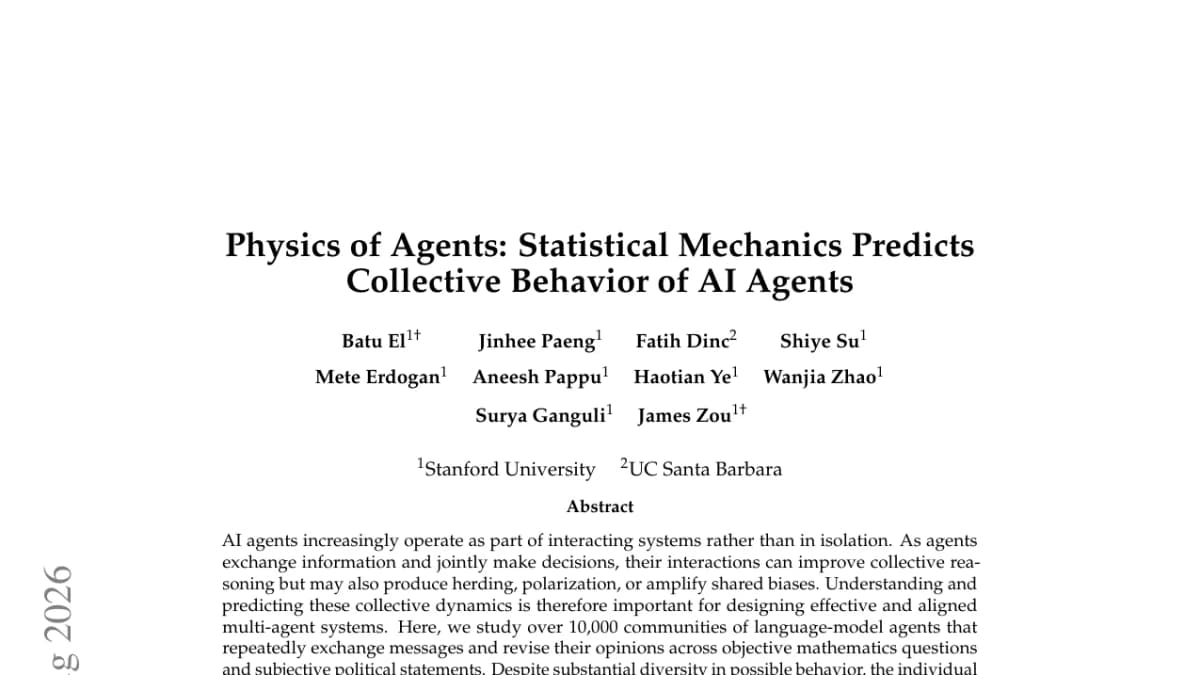
A Stanford group led by Batu El and James Zou, with Surya Ganguli among the authors, simulated more than 10,000 communities of language-model agents arguing with each other and found that the results are described by a 100-year-old model from statistical mechanics. Fitted as an Ising model with three coupling terms, their rule predicts an individual agent's next opinion on held-out questions with 75–86% balanced accuracy, beats every baseline they tried, and transfers to communication graphs it never saw during fitting.
The setup in Physics of Agents is deliberately plain. Thirty-two agents, each carrying a distinct persona, are wired together by a signed network in which a tie is friendly (+1), hostile (−1) or absent (0). All of them answer one shared binary question, then exchange short natural-language messages for eight rounds, revising their vote each round. Questions come in two flavors: competition math problems from MATH recast as A/B choices, where personas encode expertise, and political statements such as "Mandatory vaccination violates bodily autonomy," where personas are demographic profiles from the TWIN-2K-500 dataset. The backbones are GPT-4o-mini, Gemma-3n-E4B, Qwen3.5-9B and Llama-3.1-8B-Instruct.
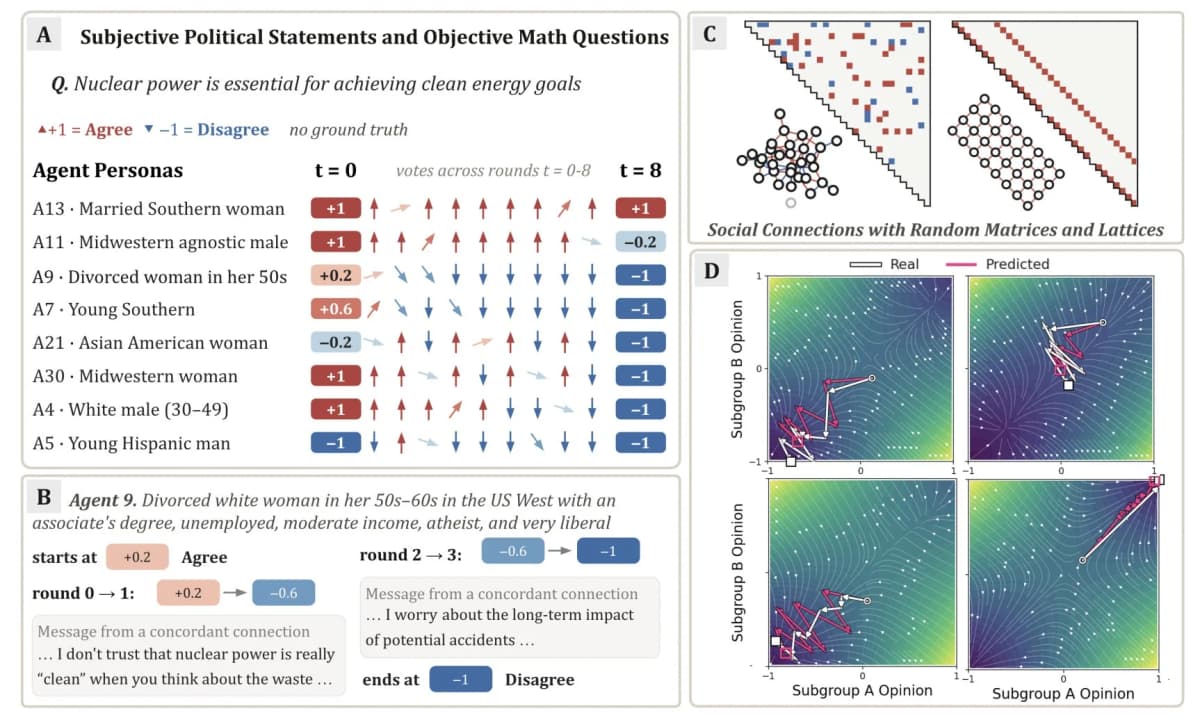
The experimental setup: personas vote each round, messages from friendly and unfriendly connections land in separate inboxes, and the fitted model's predicted opinion flow (pink) is compared against the observed one (white). Credit: El et al., Physics of Agents.
Across all those runs, group behavior collapses into three regimes: indifference (everyone weakly held), polarization (strong opinions evenly split) and consensus. Communities start indifferent and get more opinionated every round — conviction rises monotonically in all eight model-by-question-type settings. They do not simply lock in the initial majority: "divergence" and "majority switch," where the starting majority weakens or flips outright, reach 11–12% of groups for GPT-4o-mini and Qwen3.5-9B.
On math, that churn is useful. Groups that start wrong switch to the correct answer far more often than the reverse — 28% versus 11% of communities for GPT-4o-mini, 27% versus 7% for Qwen3.5-9B, 11% versus 1% for Gemma, 16% versus 5% for Llama.
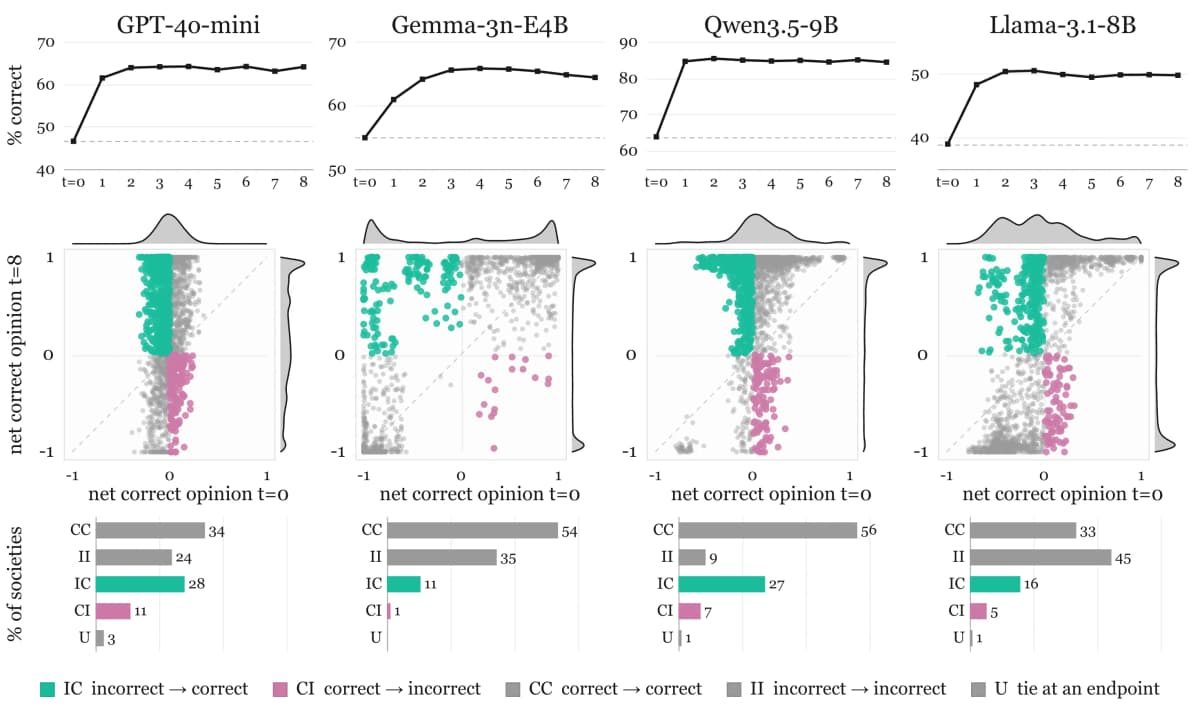
Truth-seeking on objective questions: accuracy rises within the first two rounds, and incorrect→correct switches (green) outnumber correct→incorrect ones (pink) for all four models. Credit: El et al., Physics of Agents.
The subjective half is the uncomfortable result. On a label-balanced set of political statements, three of the four models drift rightward over eight rounds of discussion: the share of communities landing on the right-leaning side goes from 75% to 96% for Gemma-3n-E4B, 52% to 67% for Qwen3.5-9B and 30% to 37% for GPT-4o-mini. Llama-3.1-8B-Instruct stays near its starting 53%. Left→right switches outnumber right→left ones 23% to 1% for Gemma and 33% to 18% for Qwen. GPT-4o-mini begins strongly left-leaning and still moves right, so starting position and direction of drift are separate properties.
The model is an energy function over opinions: agents stochastically prefer configurations with lower "social pressure," yielding Glauber-dynamics updates in which each agent's next vote is a logistic function of the signed peer pressure arriving along the graph plus an intrinsic field fitted from persona and question embeddings. Splitting the coupling into three terms — friendly, hostile, and merely-connected — is what makes it work; with a single coupling the rule falls to near chance (53.9 for Llama on subjective, 50.6 for Qwen on objective). On unseen graph families it hits 85.0–97.8 one-step balanced accuracy, best in 15 of 16 columns.
The fitted parameters then explain the empirical patterns rather than just matching them. Every community sits below its critical social temperature, which is why conviction builds instead of fluctuating. Concordant couplings dominate discordant ones — effective weight 0.99 to 3.03 on friendly edges versus never above 0.73 on unfriendly ones — so hostile ties are too weak to hold two camps apart and consensus wins. And in a five-coupling variant, neighbors currently holding the correct answer pull harder than neighbors holding the wrong one, which is the mechanism behind truth-seeking.
Most multi-agent frameworks in production — Mixture-of-Agents, debate, ensembling, self-consistency — are special cases of this template with a particular graph and depth, as the authors point out. If collective outcomes are predictable from initial opinions and a handful of coefficients, then topology, population mix and round count become design variables you can reason about instead of hyperparameters you brute-force with expensive rollouts. The flip side is the political result: the same mechanism that makes a swarm converge on the right math answer can amplify a directional bias inherited from the base model when there is no ground truth to converge on.
The authors flag their own limits — a single shared binary question, a fixed symmetric graph, no memory across rounds, and a model that discards the content of the messages that actually do the persuading. They also caution against reading the results as a claim about human opinion dynamics. Code, dataset and an online appendix are public.
Physics of Agents (arXiv:2608.16578)HTML versionJames Zou's announcement on XCode
MIT's SwarmWorld: LLM agents spread 95% of their inventions without talking
10,000 agents, 88 hours: OpenAI claims a Navier–Stokes proof
Cursor's agent swarm hit ~1,000 commits an hour building a browser
18,000 posts: how OpenAI agents turned a dormant German wiki into a message board
Political Compass of LLMs: Everyone Lands Lib-Left