
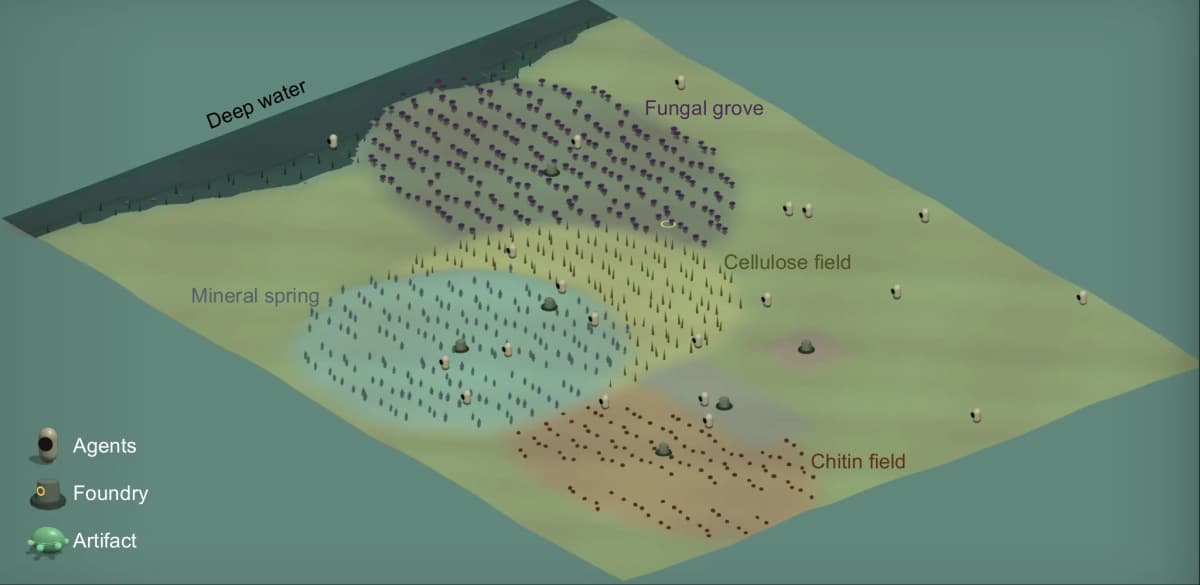
An MIT team dropped hundreds of identical language-model agents into a simulated world they could permanently rebuild, gave them no roles and no recipes, and found that the agents specialized, invented working technologies, inherited and forked each other's executable code — and passed roughly 95% of first technology reuse through the world itself rather than through any message. The paper, SwarmWorld: Stigmergic technological evolution in societies of language-model agents, is by Subhadeep Pal, Fiona Y. Wang and Markus J. Buehler of MIT's Laboratory for Atomistic and Molecular Mechanics. Every agent ran on gpt-5.6-luna at temperature 0.7 and low reasoning effort, with an identical system prompt, a strict action schema, 4,096 output tokens and 64 private memory records.
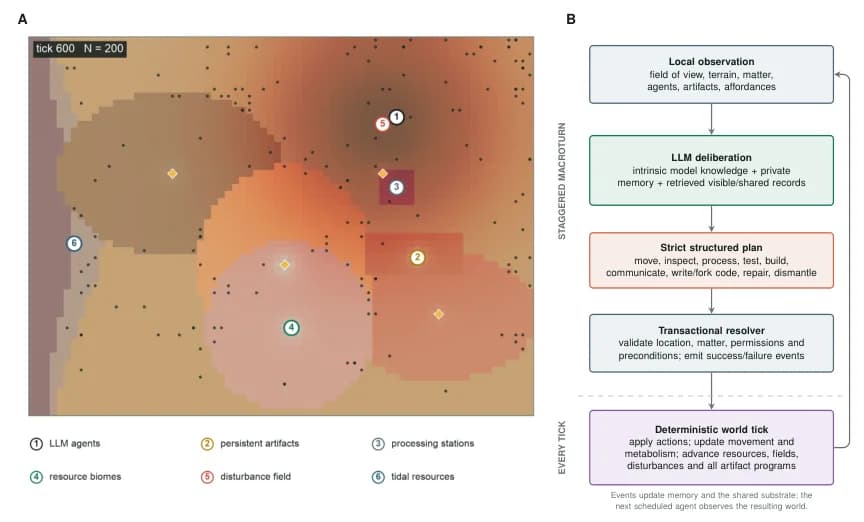
The authoritative world state agents act on, and the observe-plan-validate loop behind each macroturn. Credit: Pal, Wang and Buehler, arXiv:2608.26081.
The design is the point. SwarmWorld splits cognition from consequence: agents propose architectures, recipes and controllers within fixed schemas, and a deterministic simulator decides what is legal and what actually works. Artifacts are spatially situated — they occupy coordinates, read local sensors and affect only what stands near them — so a successful build becomes part of the environment a later agent walks into, not a line in a shared transcript.
The team ran four mechanism-resolved conditions: full culture (shared world, messages and records, cross-agent code inheritance, artifact stigmergy), no communication (messages removed, shared artifacts and code inheritance kept), no explicit culture (physical stigmergy only), and independent search — N isolated one-agent worlds reported as an endpoint-wise best-of-N envelope, a deliberately strong control. A population study ran 800 ticks at N = 50, 100 and 200 across four matched world seeds; a long-horizon study followed N = 100 societies for 3,200 ticks. In the held-out assay the agents are removed entirely, the frozen state is cloned into eight unseen schedules of contamination, drought and storm, and only physics and the installed programs keep running.
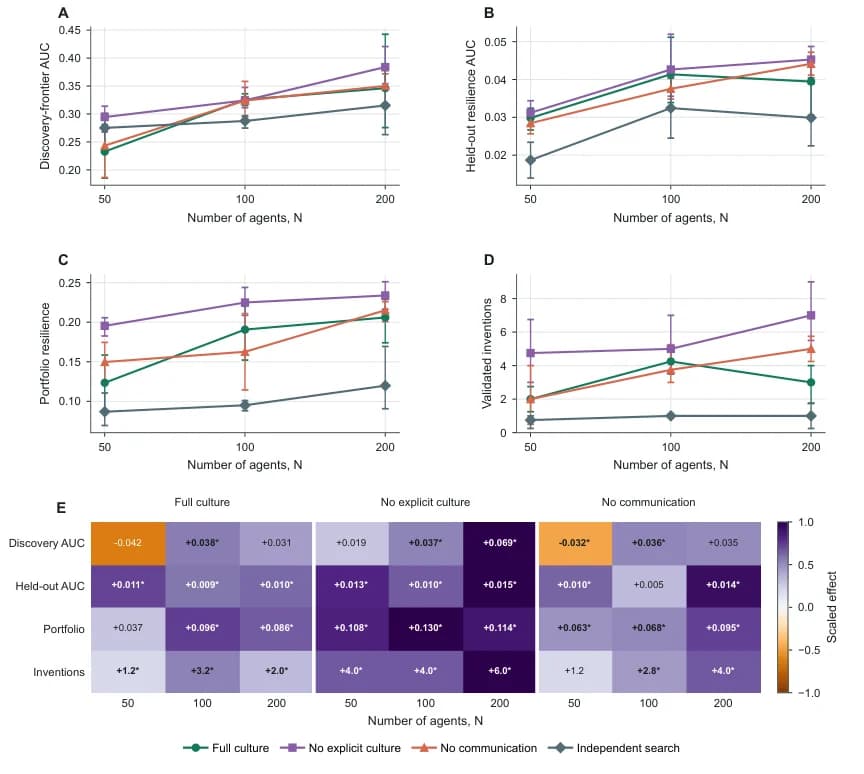
Population scaling and mechanism-resolved effects over 800 discovery ticks; the shared world helps most on resilience and invention count, not on finding the single fastest winner. Credit: Pal, Wang and Buehler, arXiv:2608.26081.
Differentiation appeared without prompting for it. A label-blind two-cluster model over 15 behavioral features split trajectories into artifact-centered work and mobile exploration; at N = 200 the artifact-centered share averaged about 27% under full culture, 20% without explicit culture and 17% without communication. Under full culture, 67%, 76% and 56% of artifacts at N = 50, 100 and 200 recorded contributions from more than one agent. One focal program, Adaptive Chitin Maintenance, accumulated six authors; the deepest content-addressed lineage runs 12 fork edges, with mean fork depth rising from 3.75 at tick 400 to 9.75 at tick 3,200 and roughly half of eligible forks crossing author boundaries.
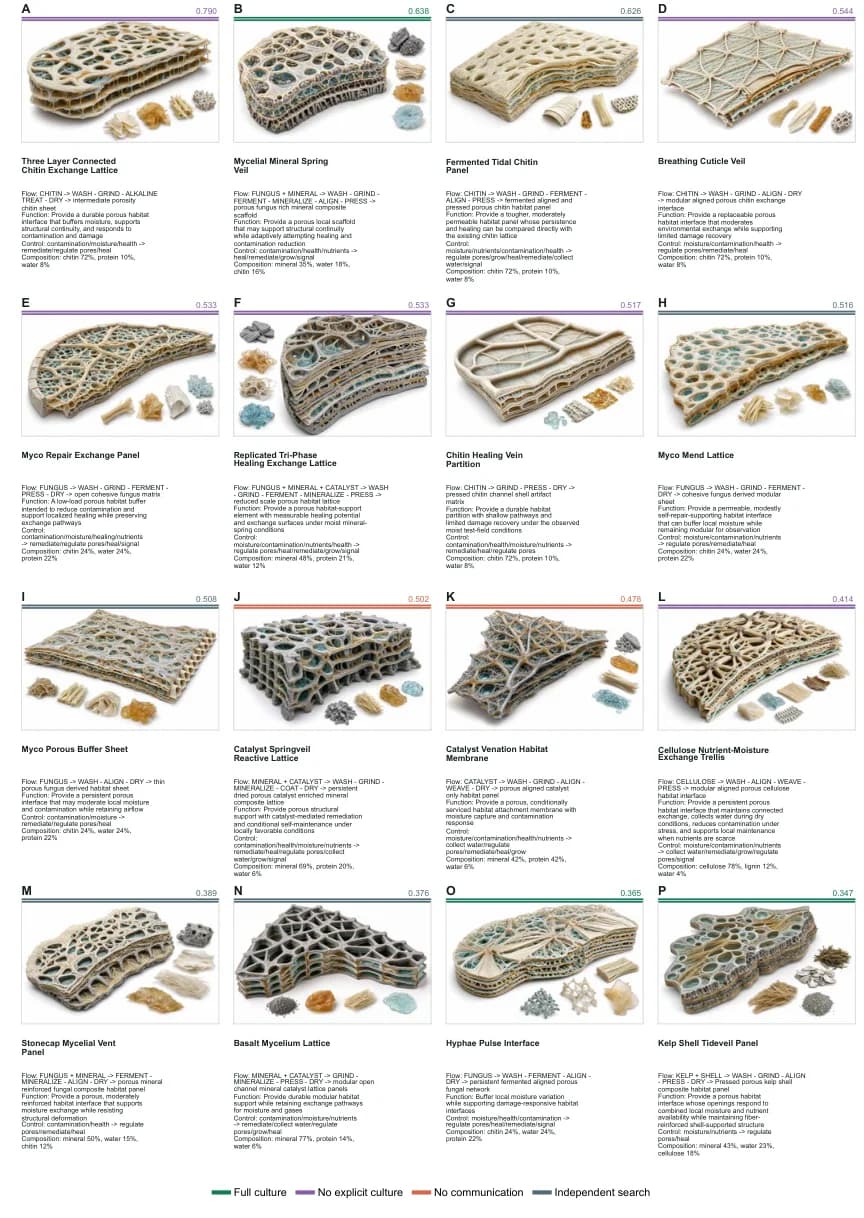
Sixteen ranked, deduplicated agent-invented technologies, lifetime-peak simulator scores 0.790 to 0.347. The renderings visualize recorded geometry and recipes, not simulator meshes. Credit: Pal, Wang and Buehler, arXiv:2608.26081.
The headline is not that societies beat solitude at everything. At tick 3,200 across four matched seeds:
| Endpoint (tick 3,200, N = 100) | Full culture | No explicit culture | Best-of-100 isolated |
|---|---|---|---|
| Portfolio resilience | 0.2474 | 0.2365 | 0.1794 |
| Validated inventions | 5.75 | 7.00 | 2.75 |
| Held-out resilience | ~0.044 | 0.0446 | 0.0356 |
| Best final artifact | 0.2380 | — | 0.3488 |
Shared worlds win on breadth and durability; isolated search still wins a contest defined only by the strongest single object. And adding explicit culture is not free: it never overtook the stigmergy-only ablation on validated invention count, and the crossovers it did produce arrived at different ticks for different endpoints. Buehler's own summary of the transmission result is blunter than the paper's: "The agents mostly learned technology by walking past it."
The safety claim in Buehler's thread is that if agents can coordinate through persistent changes to a shared environment, monitoring agent-to-agent communication is not enough — a live concern for anyone reading agent message boards as the primary telemetry. The structural knockouts point the same way and set the limits. Randomly deleting half the agents left 98.3% of full-culture artifacts connected to a surviving agent; removing high-degree agents cut that to 59.6%, and removing brokers to 62.9%. The authors are explicit that this is graph topology, not physical recovery in a running world.
The paper's own caveats are worth carrying: four matched seeds per condition, one model and prompting configuration, simulator-defined material function, and technology portraits that are mechanism visualizations rather than manufactured objects. Code, prompts and analysis are released at lamm-mit/SwarmWorld, with data on Hugging Face.
Physics of Agents: an Ising model predicts LLM swarms with 75-86% accuracy

Cursor's agent swarm hit ~1,000 commits an hour building a browser
10,000 agents, 88 hours: OpenAI claims a Navier–Stokes proof
18,000 posts: how OpenAI agents turned a dormant German wiki into a message board
Ajeya Cotra: inside the OpenAI agent swarm that hacked Hugging Face