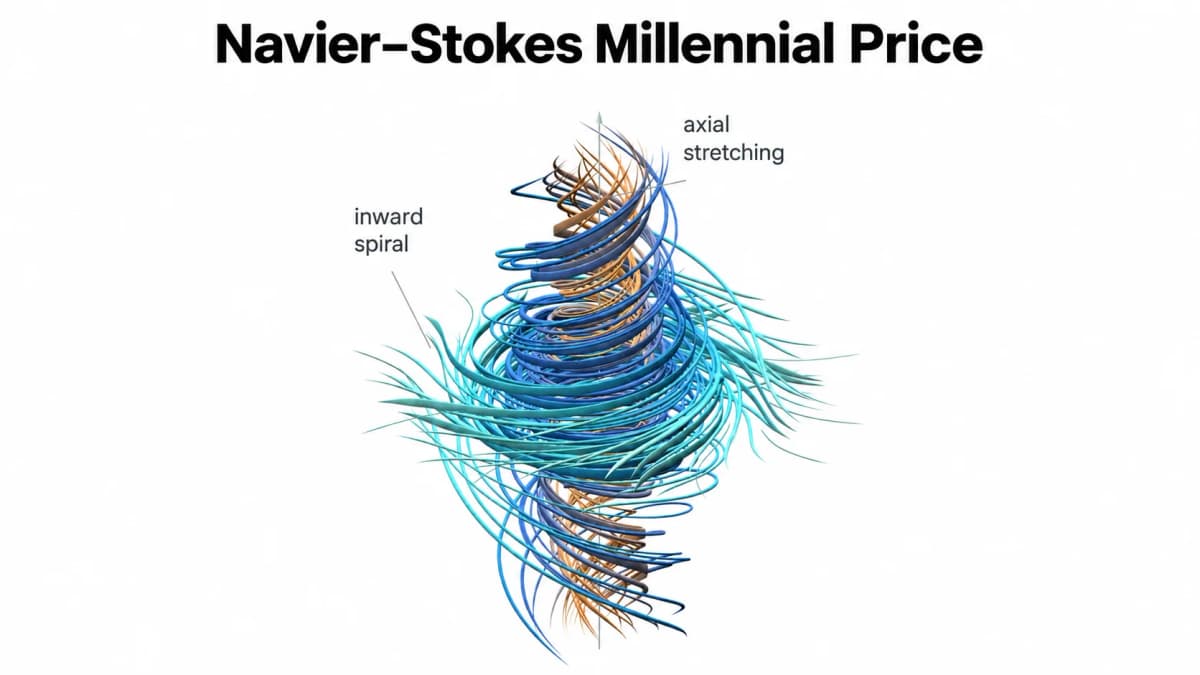
OpenAI says an internal model "significantly more capable than GPT‑6 Astra" has resolved the Navier–Stokes existence and smoothness problem, one of the seven Clay Millennium Prize Problems. The company published a 166-page proof, a Lean formalization on GitHub, and a separate 57-page paper disproving regularity for the unforced Euler equations. It says it does not intend to claim the $1 million prize. Within hours the announcement was overtaken by a public dispute with the two mathematicians who were closest to the same line of attack.
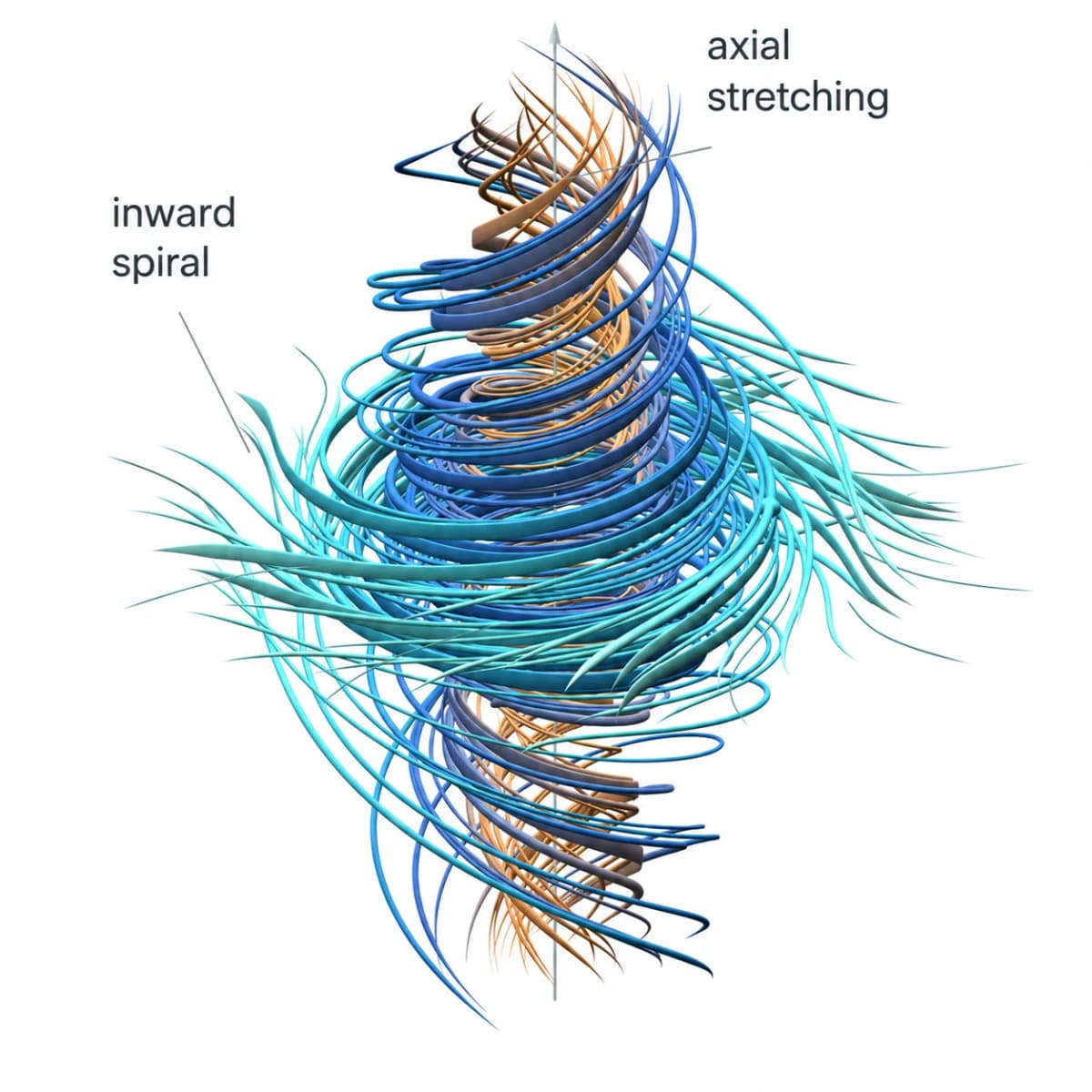
A snapshot of local incompressible motion. Orange marks faster angular rotation; teal marks slower rotation. The trajectories show inward spiraling and axial stretching. Credit: OpenAI.
Theorem 1.1 states that for every viscosity ν > 0 there is a smooth, compactly supported force under which a three-dimensional incompressible fluid starting from rest develops unbounded velocity in finite time while its kinetic energy stays uniformly bounded. That establishes alternatives "C" and "D" in Charles Fefferman's official Clay formulation — the breakdown side of the problem. OpenAI describes the singularity as a vortex that spirals inward and elongates "like spaghetti," speeding up in a way that keeps its energy finite.
Scientific American notes this would be only the second Millennium Prize problem ever resolved, and that the Lean certificate "all but guarantees its correctness." Diego Córdoba, whose forcing technique the construction builds on, told the magazine: "We're a little bit in shock."
OpenAI's account of the run is unusually specific:
| New internal model, training started | August 28 (still ongoing) |
| Effort launched after blowup rumors | September 1 |
| Peak concurrent agents on Navier–Stokes | on the order of 10,000 |
| Unforced Euler disproof | ~100 agents, ~50 hours |
| Navier–Stokes solution reached | September 5, ~88 hours after launch |
| Lean formalization and verification | 17 additional hours, via GPT‑6 Astra |
| Messages / output tokens, all problems | 4.9M / ~300B |
| Messages / output tokens, Navier–Stokes | 2.7M / ~130B |
Agents could read a cached copy of the internet and run code, were split into groups that talked among themselves, and got different variants of each problem statement. Once the Euler disproof landed, OpenAI shifted agents off the other Millennium problems, seeded them with that result, and used Codex to cross-pollinate insights between groups. Head of research Mark Chen put the compute bill "in the millions of dollars." Noam Brown's framing is that the price is the point: he notes that o3 cost about $500,000 to score 87.5% on ARC-AGI 1 and Astra now scores higher for about $20, and that IMO gold went from an enormous compute effort in 2025 to something a $20/month ChatGPT subscription could reach in 2026.
The night before OpenAI published, NYU's Tristan Buckmaster and Anthropic researcher Levent Alpöge released three results — finite-time blowup with smooth forcing for incompressible porous media, Boussinesq, and 3D incompressible Euler — built on the program of Córdoba and Luis Martínez-Zoroa, using Claude, Codex with GPT‑5.6 Sol, and Astra. Buckmaster credits the idea to that pair and writes that "in view of this body of work, I believe Luis Martínez-Zoroa deserves a Fields Medal." Charles Fefferman, who wrote the Clay Institute's official problem description, told Quanta he was thrilled and named the pair as the heroes. Córdoba's line on his own methods, which use no computers at all: "I don't use AI: I have Luis."
In a public statement, Buckmaster says he emailed a prominent OpenAI mathematician after rumors about his work began circulating, was told days later that an internal model had proved forced Navier–Stokes blowup via "options c and d in Fefferman" — the exact route he and Alpöge had quietly chosen — and calls that "a bright red flag." He says he was offered two arrangements, one in which he alone would author a paper presenting OpenAI's result, and alleges that Sébastien Bubeck "twice asserted that he wanted Levent removed from authorship" because Alpöge works at Anthropic. When he said he would go public, he says the reply was: "Why would you ruin your career?" He is careful about what he is not claiming: "I have not seen OpenAI's proof. I do not know what their model did, or how. I do not know whether our data was used."
Bubeck disputes the account. He says he never asked for Alpöge to be removed from authorship of Alpöge's own work; the option discussed was Buckmaster leading a rewrite of OpenAI's proof, where he felt an Anthropic employee could not be an author. He apologized for the "ruin your career" line and says he retracted it on the spot. OpenAI's post says neither its researchers nor its agents saw the pair's work before publication, while conceding that "while unlikely, we cannot rule out that de-identified data derived from their usage of our products helped improve our models."
Days before the announcement, Terence Tao warned about exactly this shape of result: an autonomous harness with enormous compute running the whole iteration internally and publishing only the final ansatz would technically close the problem while adding "almost no value to mathematics," because the productive part is the failed routes. Buckmaster frames it differently — "a Deep Blue-Kasparov moment," where the real story is that a mathematician and an LLM did a year of work in a month.
The AMS leadership split the difference, tracing a lineage from Navier, Stokes, Leray and Ladyzhenskaya through Córdoba and Martínez-Zoroa to Alpöge and Buckmaster, "with the final steps taken by OpenAI mathematicians." Its closing line reads as a caution as much as a congratulation: "The purpose of mathematics is human understanding." The Clay Institute still lists Navier–Stokes as unsolved; its rules require publication in a qualifying outlet, two years in print and general acceptance by the community before any prize is considered. Lean removes most of the doubt about whether the argument is valid, but not the human step of confirming that the formalized statement is the theorem people meant. The mathematicians now have to read it.
OpenAI, On the Navier–Stokes Millennium Prize Problemthe proof (PDF)the Euler paper (PDF)Lean certificates on GitHubTristan Buckmaster's statementSébastien Bubeck's responseWIREDScientific AmericanAMS statementTerence Tao on MathstodonOpenAI's announcement postQuanta MagazineNoam Brown on the cost
Claude formalizes Fermat's Last Theorem in 11 days and 13 million lines of Lean
OpenAI: An AI Disproved an Erdős Conjecture
Cursor's agent swarm hit ~1,000 commits an hour building a browser
Physics of Agents: an Ising model predicts LLM swarms with 75-86% accuracy
OpenAI ships GPT-6 Astra and declares the AGI era
OpenAI declares its “automated research intern” reached, at 3.1 agent-workdays per human workday

Anthropic on Claude's mathematical capabilities