The standard worry about AI and inequality is that output explodes while labor's share of income collapses, leaving workers poorer in a much richer economy and requiring massive redistribution to fix. George Mason economist Alex Tabarrok has a new paper arguing that the arithmetic does not support it. "Labor income is GDP multiplied by labor's share of GDP," he writes on Marginal Revolution. "What matters is the product."
The paper, How Much Redistribution Will AI Require?, derives a one-line accounting rule for the transfer needed to keep aggregate real labor income per capita on its no-AI path. With G the ratio of AI-path to no-AI GDP per capita, λ₀ the benchmark labor share and s the AI-path labor share, the required transfer as a share of AI-path GDP is max(0, λ₀/G − s). It is national-income accounting, so it holds regardless of which growth model produced the forecasts.
Tabarrok's benchmark: without AI, real GDP per capita grows 2 percent a year and labor receives 60 percent of GDP. Ten years out, the break-even labor share — the point below which a transfer becomes necessary — falls as AI-path growth rises.
| Annual AI-path growth | GDP vs. no-AI path | Break-even labor share |
|---|---|---|
| 2.5% | 1.050 | 57.1% |
| 5.0% | 1.336 | 44.9% |
| 10.0% | 2.128 | 28.2% |
At 5 percent growth, GDP per capita ends up about 34 percent above the no-AI path and labor can take 45 percent of it while aggregate labor income still matches the benchmark. At 10 percent growth — the range Satya Nadella and Dario Amodei use as their test for an AI industrial revolution — GDP more than doubles relative to baseline and the share can fall to 28 percent with no shortfall at all.
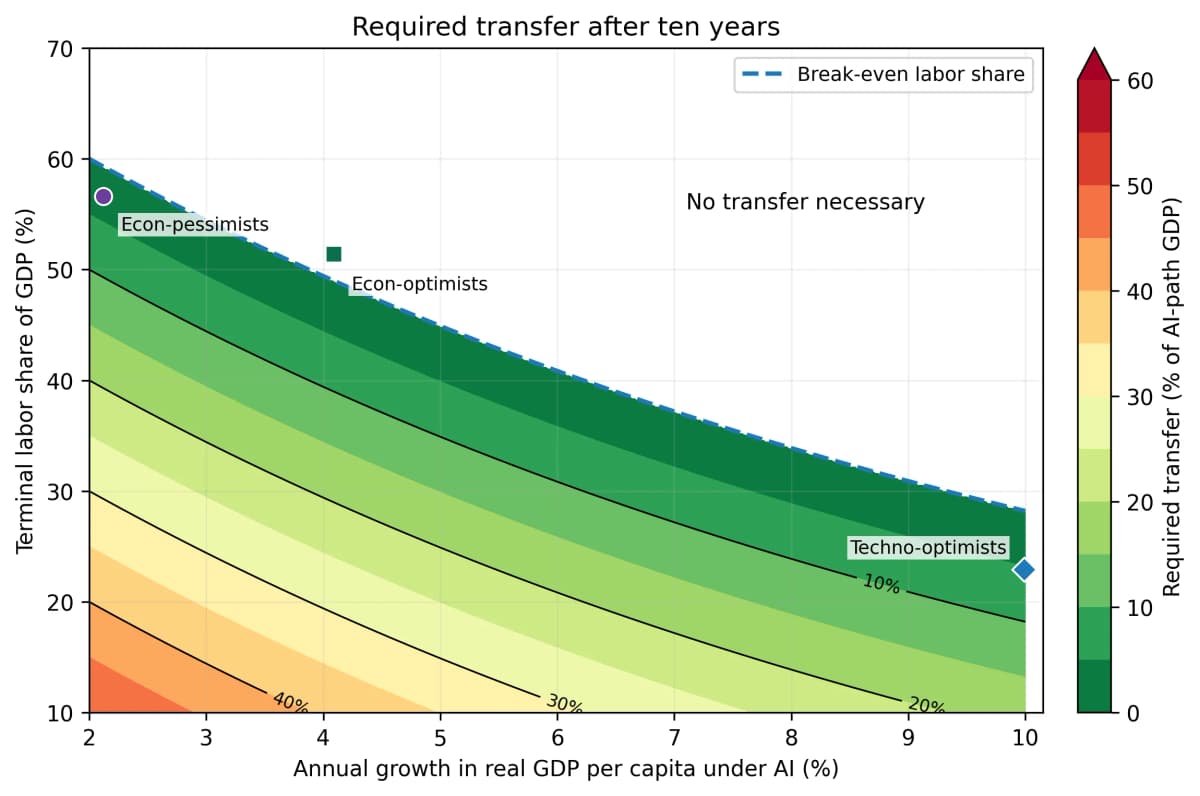
Required transfer as a share of AI-path GDP after ten years. The white region above the dashed break-even line needs no transfer. Credit: Alex Tabarrok, Marginal Revolution.
The paper maps three positions from the literature onto that space using a three-parameter translator: displacement d, GDP created per displaced dollar q, and labor's share of the new output β.
| Stylized view | Growth | Labor share | Required transfer |
|---|---|---|---|
| Econ-pessimist (Acemoglu) | 2.1% | 56.6% | 2.7% of GDP |
| Econ-optimist (Cowen, Bryan, Tabarrok) | 4.1% | 51.4% | 0.0% |
| Techno-optimist (Amodei) | 10.0% | 22.9% | 5.3% of GDP |
The third row is the one Tabarrok calls most surprising: something close to a techno-capitalist dystopia in factor shares — labor taking less than a quarter of GDP — still leaves a manageable compensation bill, because the pie has doubled. The decisive quantity in his translator is βq, new labor income per dollar of displaced labor income. If it is at least 1, labor gains with no transfer at all; below 1, the accounting rule measures the gap.
The fiscal implication is that the transfer need not be a net tax increase. The US already taxes labor heavily — federal payroll taxes alone run about 6 percent of GDP — so a required transfer of a few percent could in principle be financed by shifting the base rather than raising revenue: cut or zero out wage taxes, replace them with a broad consumption tax that also reaches spending out of capital income and accumulated wealth, and add cash transfers for people with little or no labor income. Under equation (1) the result is an aggregate Pareto improvement: labor recipients hold their benchmark income, capital recipients still come out ahead of the no-AI world.
The caveats are Tabarrok's own. These are illustrative year-10 scenario calculations, not forecasts, and every number scales linearly with the assumed 60 percent benchmark. Keeping aggregate labor income whole says nothing about any individual worker: he expects "enormous churn," heavy losses in particular occupations and painful transitions regardless. He also notes labor's share may dip early — when task displacement runs ahead of machine productivity — and recover later. And the entire argument is contingent on the growth actually arriving: if AI delivers ordinary growth while sharply cutting labor's share, the required transfer moves into the 20–40 percent-of-GDP range and redistribution gets very hard.
How much redistribution will AI require? (Marginal Revolution)Tabarrok, "How Much Redistribution Will AI Require?" (PDF)