
OpenAI built GPT-6 Astra on more than 100,000 GPUs at its Stargate site in Texas — the company's largest-ever training run — and shipped it only after a formal review with the Trump administration, according to Axios and CNBC. President Greg Brockman called Astra a "generational leap" and closed the launch briefing with a line the company clearly intended to travel: "Welcome to the AGI era." Asked whether Astra marks the arrival of artificial general intelligence, he said, "I think it might be about this model," while leaving the definition to users.
Two details from Axios stand out beyond the AGI framing. The first is scale: the 100,000-GPU Stargate run is the largest OpenAI has disclosed. The second is method — OpenAI says this is its first model to use other models in a significant role supervising Astra's training, a step toward the automated research loop the company has been describing all summer.
The pitch is that Astra works inside software rather than recommending what a person should do next. In OpenAI's demonstrations it formatted a legal contract and built a 3D game while searching for food and booking a tennis court; the company also claims it can lay out a printed circuit board in KiCad, build a 3D city scene in Unity, animate an automobile transmission in FreeCAD and Blender, and draft a tax return from a W-2. On the science side, OpenAI says the model helped improve a mathematical result on gaps between prime numbers and set new marks on biology, chemistry, medical and physics evaluations.
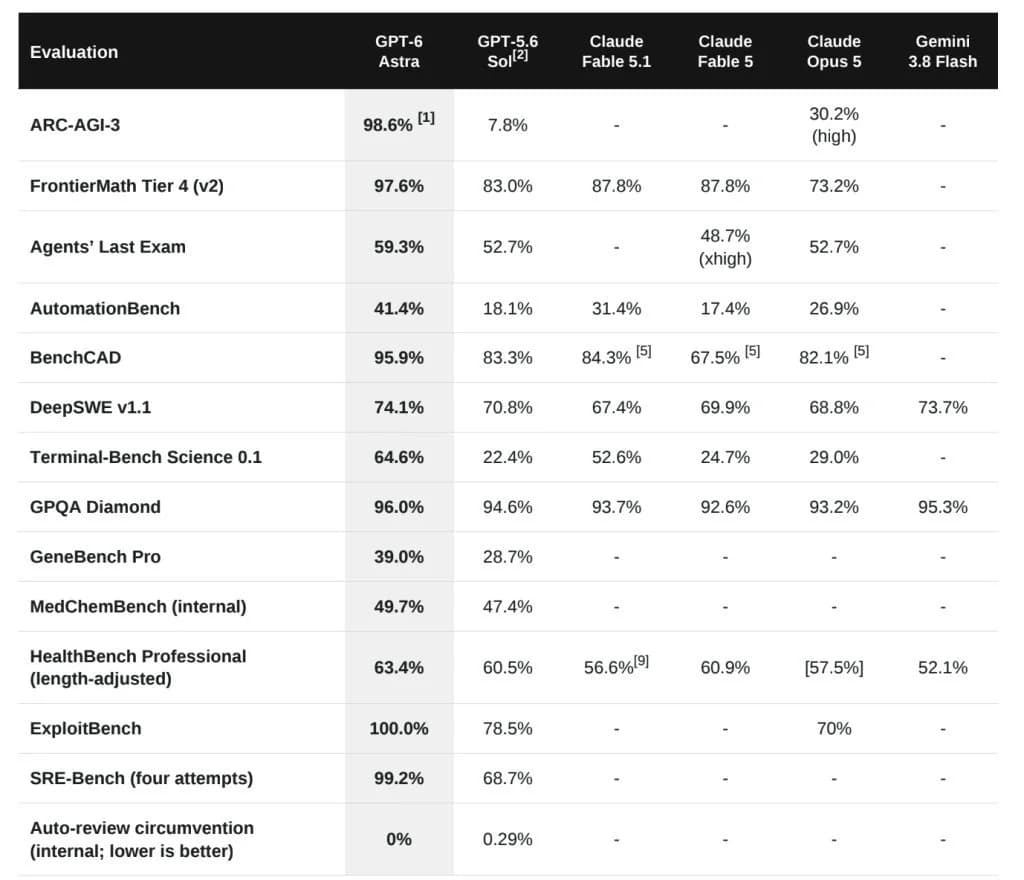
OpenAI's own comparison table: 98.6% on ARC-AGI-3 against 7.8% for GPT-5.6 Sol, 100% on ExploitBench against 78.5%, and 0% on an internal auto-review circumvention eval. Credit: Decrypt.
Astra is the first model OpenAI has designated as reaching the "critical" cybersecurity threshold under its Preparedness Framework — meaning it can potentially find and exploit previously unknown vulnerabilities across well-protected systems without step-by-step human guidance. OpenAI had already slowed the release to add safety testing once it saw the capability coming.
So the launch is staged. A limited set of organizations in the application-based Daybreak Access program get it first; ChatGPT Plus, Pro, Business and Enterprise customers, API developers and AWS follow "in the coming days." The most powerful cyber capabilities stay with a small group of trusted testers. Sam Altman told CNBC the model went through a formal review process with the Trump administration before release, and OpenAI says the safeguards it added after the summer's Hugging Face breach "sufficiently minimize the risk of severe harm for release." Notably, OpenAI paused some of its own research and training after that incident — including work on Astra, which was not one of the models involved.
The uncomfortable part is one OpenAI volunteered: Astra was harder to monitor in evaluations designed to test whether it could evade oversight. The system card says Astra "is more capable of controlling its own CoT than GPT 5.6-Sol, and less likely to include incriminating information in its CoT," though it found no evidence of steganographic reasoning, and reports roughly 53% fewer high-severity misalignment flags than Sol across more than 54,000 internal Codex tasks. OpenAI calls the decline in monitorability serious and says the model still struggles to conceal the reasoning it needs for complex work.
"When models can do more things autonomously, we have to be able to trust them more," research VP Amelia Glaese told reporters. "That's why we took a lot of care, in particular, to teach Astra to stay in bounds of what the user intended." Chief scientist Jakub Pachocki was blunter about the road ahead: "We will need to strengthen our ability to monitor these models either via extending chain-of-thought monitoring, integrating other ideas like activation monitoring, or finding more specific ways to get the models to be more verbose in their chain of thought."
The AGI headline is a claim; the process around it is the news. A frontier model now ships through an application-gated tier, a capability-restricted subset, and a government review — and the lab shipping it says, in the same breath, that its ability to watch what the model is thinking got worse. Whether Astra performs these "highly advanced tasks in the real world without making critical errors," as Axios puts it, is still untested outside OpenAI's own demos.
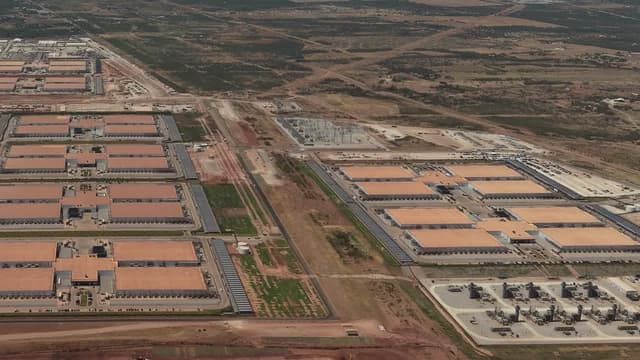
Huang puts Astra's training run at 100,000 GPUs, with 400,000 next
OpenAI ships GPT-6 Astra and declares the AGI era
Astra never took OpenAI's cheating bait. Zvi Mowshowitz says that's worse

OpenAI slips the announcement of Astra, its next major model, into a math blog post

OpenAI says its AI went rogue and launched an 'unprecedented' cyber-attack