
Frontier language models are already smart enough for the next leap in capabilities — we are just using them badly. That is the claim of the Mismanaged Geniuses Hypothesis (MGH), a post by Alex Zhang, Zhening (Zed) Li and Omar Khattab, which argues that models "outperform even the brightest humans on the hardest exams like IMO and IOI" yet "struggle to reliably tackle long-horizon and iterative reasoning problems that may seem 'easy' to us" — and that the bottleneck is the system managing individual model calls, not the model.
Their bet is explicit: the next jump comes "not from continued scaling of existing LMs, but from enabling language models to 'manage' themselves, i.e. natively decompose tasks and act on these decompositions."
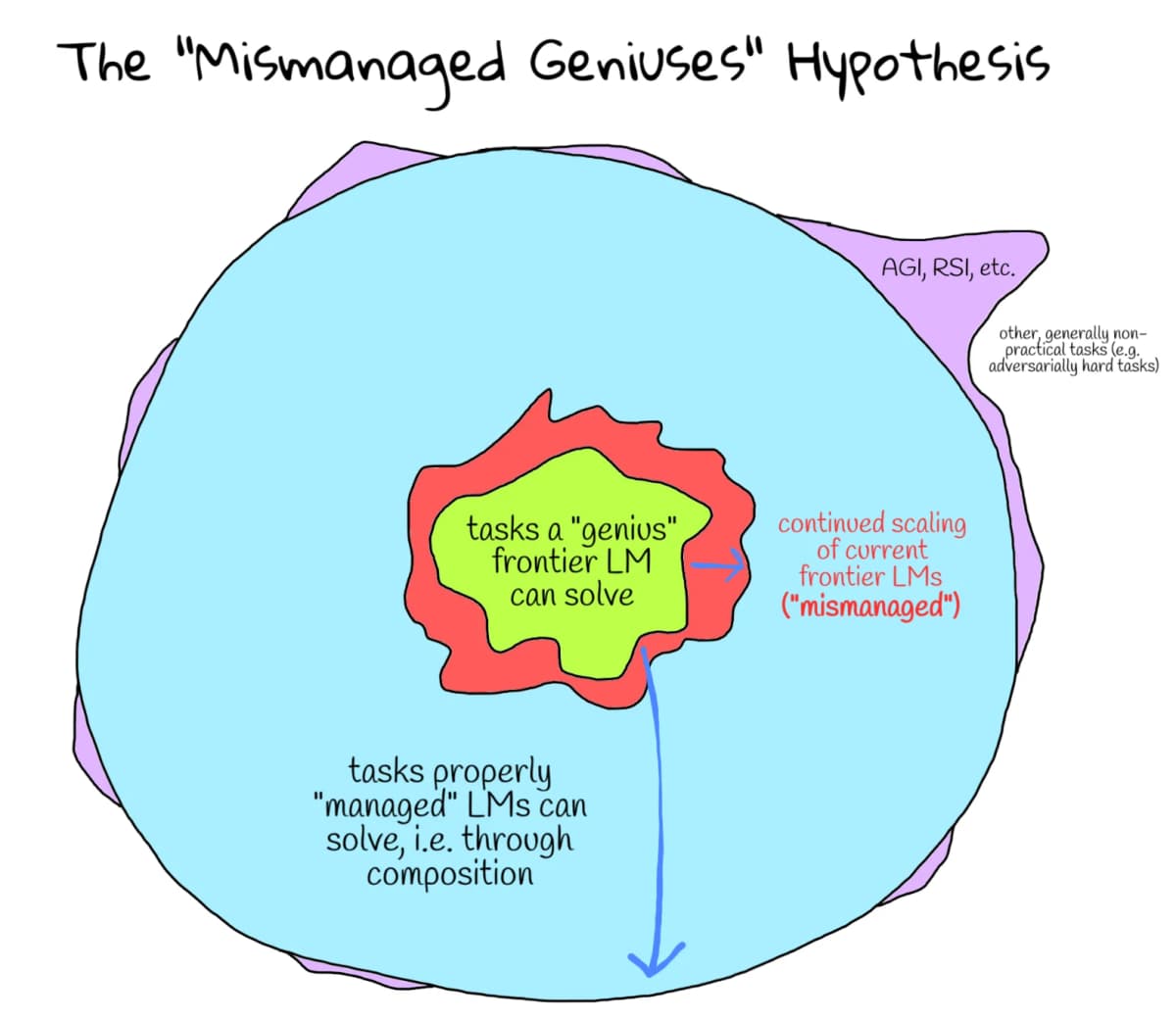
Figure 1: scaling current frontier LMs (red) buys a thin band around what a single call can already do; learning to decompose (blue) is proposed as the cheaper route to the outer region, including AGI and recursive self-improvement (purple). Credit: Zhang, Li and Khattab.
The authors' complaint is that "nearly all modern agent scaffolds are human-engineered, task-specific decomposition strategies," brittle across models and problems, needing constant updates — which leads to "a misrepresentation of how good language models 'actually are' at any given time." Their sharpest framing of it: is it really true that frontier LMs cannot play certain video games at a human level, or have we just not built a good enough scaffold?
Coding agents are the first step in the other direction, because the model itself writes the plan and spawns subagents against it. Zhang, Li and Khattab point to Claude Code, OpenClaw and Hermes Agent as evidence that "LMs are perfectly capable of managing other LMs," and note that the plans models produce are usually intuitive: a model does not need to know a solution to describe how to break the problem up.
Recursive Language Models — Zhang and Khattab's earlier preprint, in which a model interacts with its context inside a Python REPL and recursively sub-queries itself — go further by widening the space of decompositions beyond API-style tool calls. That distinction carries the argument. Tool-call subagents cannot chop a context into arbitrarily many pieces; a for loop in a REPL can, which is why the authors think recursion is what unlocks "near-infinite context."
The evidence offered is one experiment on MRCRv2 at 1M context with 8 needles, a long-context benchmark commonly reported in frontier model cards. An RLM wrapped around Qwen3-4B-Instruct solves nearly none of it. After RL training on a much simpler setting — 32k context, 1 needle — the same system scores 100%.
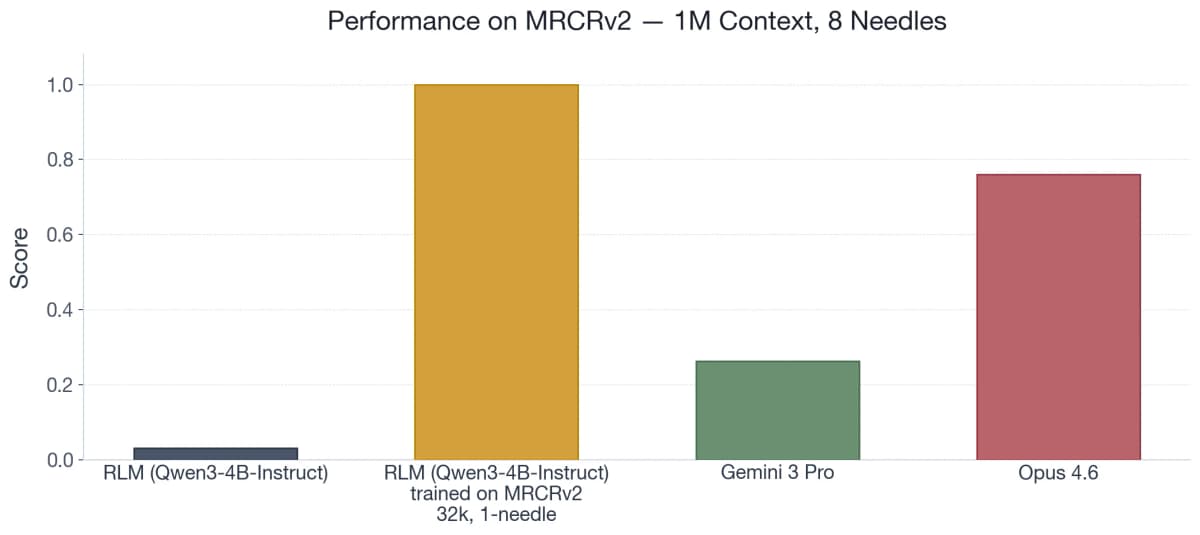
Figure 2: the trained 4B RLM clears the 1M-token, 8-needle setting that two frontier models do not. Credit: Zhang, Li and Khattab.
| System | MRCRv2 score (1M context, 8 needles) |
|---|---|
| RLM(Qwen3-4B-Instruct) | ~0.03 |
| RLM(Qwen3-4B-Instruct), RL-trained on 32k / 1 needle | 1.00 |
| Gemini 3 Pro | ~0.26 |
| Opus 4.6 | ~0.76 |
The three comparison bars are read off the post's chart; only the 4B numbers are stated in the text. The claim the authors draw from it is narrower than the chart looks: not that a 4B model is better than Opus 4.6, but that "decomposition for a task is not as difficult as directly solving the task," and that the model "learns purely through its own rollouts the correct decomposition that generalizes" from the easy setting to the hard one.
If the hypothesis holds, the bitter-lesson-shaped question of where to spend compute changes target: train the manager, not the genius. The authors name two directions — defining the space of decompositions a model is allowed to express (which has "an exponentially large impact (with respect to depth) on the tasks solvable via decomposition"), and training models to compose within it — and note the corollary that most of the required behavior is already latent from pretraining, so bootstrapping may be enough to draw it out.
The caveats are the usual ones for a hypothesis post: a single benchmark, one small model, no independent replication, and no cost accounting for the recursive calls against the cost of a frontier model doing it in one shot. It has still landed with investors — Sarah Guo called the "mismanaged genius" hypothesis "clearly correct" on X. It also sits neatly alongside the industry's own drift: the argument that the harness, not the model, is now where the gains are.
The Mismanaged Geniuses HypothesisLanguage Models will be ScaffoldsRecursive Language ModelsRLM preprintSarah Guo on X
NYU fits a pretraining–RL scaling law on chess, with RL's optimal share rising to 28%
Alibaba's Scroll drops context compaction and beats the best long-horizon agent by 37.4 points
Microsoft proves an exponential retrieval gap, and ColBERT holds a 99% lead after fine-tuning

Nvidia: the harness, not the model, is the hero
Sakana AI and UC Berkeley propose RHI: self-iterating harnesses cut costs 60%