

OpenRouter has published the numbers behind a natural experiment in inference pricing. Between July 27 and August 14 it ran a 50% discount on OpenAI's GPT-5.6 Terra and Luna, and daily token volume on the two models rose 5.6x and 13.8x respectively against their pre-period averages. Sol, the third GPT-5.6 model, stayed at list price over the same window and moved 1.11x — a clean control that makes the discount, not general platform growth, the obvious cause.
The discounts got deeper mid-flight. On July 30 OpenAI cut its own list prices — Luna by 80% and Terra by 20% — on top of OpenRouter's 50%, so from that date the effective discounts were 90% on Luna and 60% on Terra. All three models had launched only on July 9.
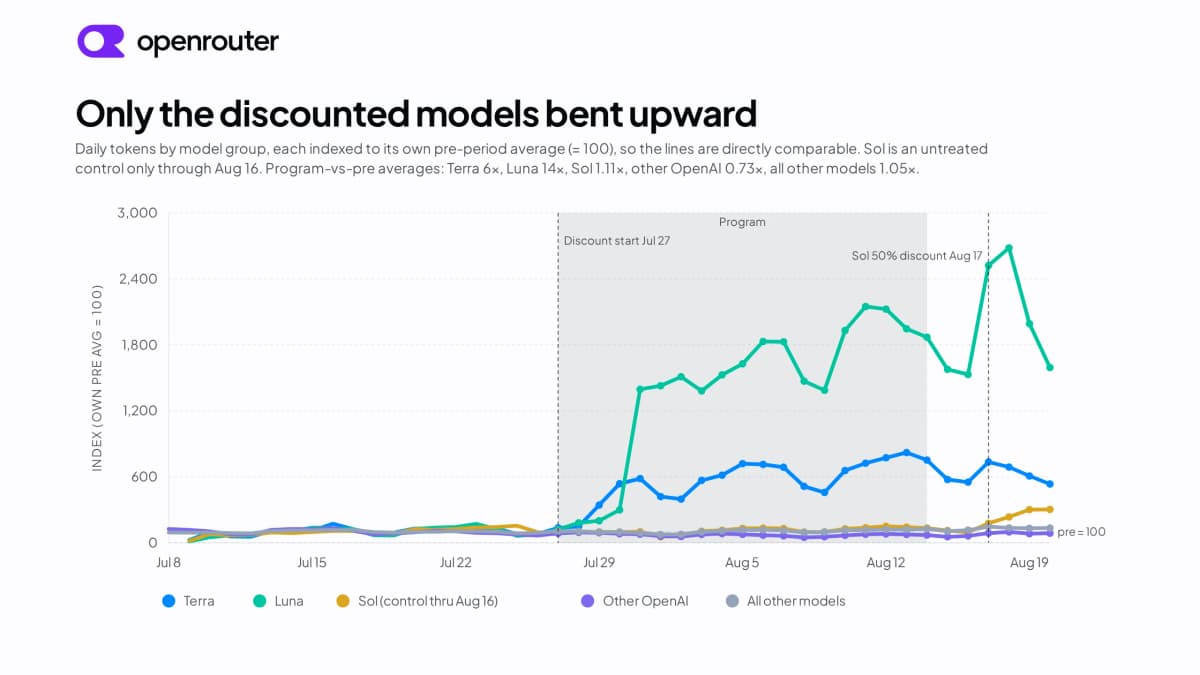
Only the discounted models bent upward. Program-vs-pre averages: Terra 6x, Luna 14x, Sol 1.11x, other OpenAI 0.73x, all other models 1.05x. Credit: OpenRouter.
The more interesting result is where the volume came from. Terra and Luna went from 0.7% to 7.8% of all OpenRouter tokens between the pre-period and the program — a gain of 7.1 share points. Competitors gave up 5.3 points and other OpenAI models gave up 1.9, so roughly three quarters of the gain came from outside the OpenAI family rather than cannibalising it. Across the whole family, token share grew from 7.1% to 12.4%, cresting above 15% on individual days.
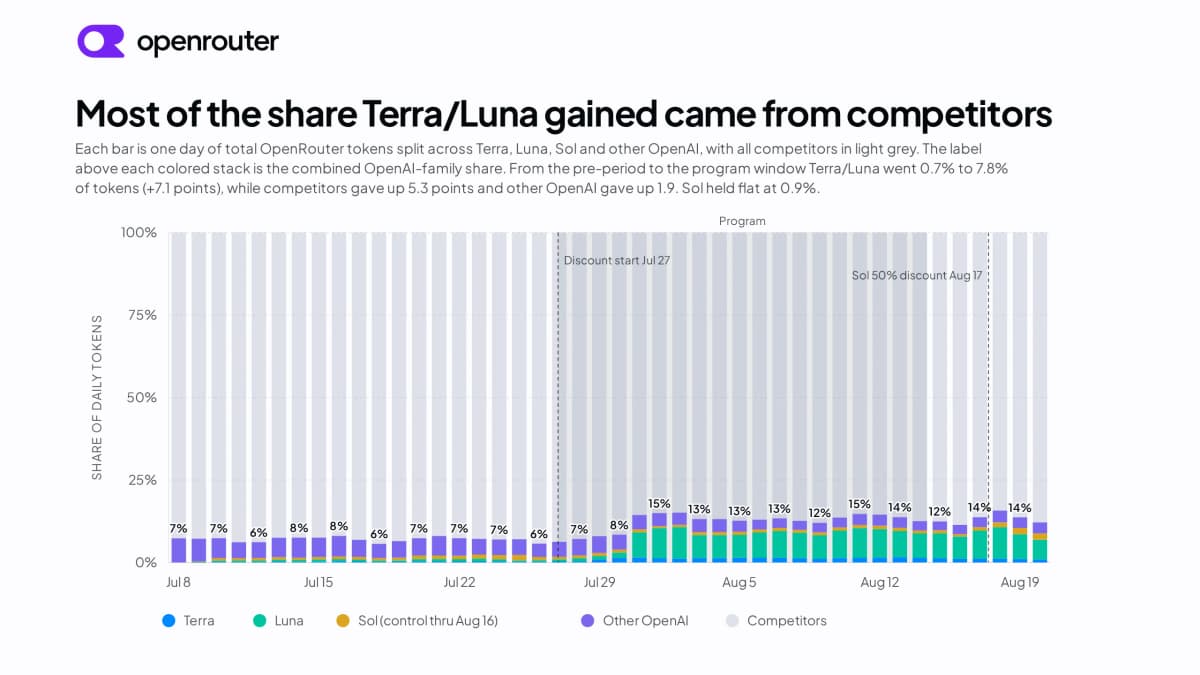
Terra/Luna went from 0.7% to 7.8% of daily tokens; competitors gave up 5.3 points. Credit: OpenRouter.
Tokens rose across most major model authors in the window — Anthropic was the exception, which did not grow over this timeframe. OpenAI's own volume roughly doubled on average and, OpenRouter says, has held at that higher level since the program ended.
Of the 105,955 customers who used Terra or Luna during the program, 32.1% kept some usage in the days after the discounts expired and 17.9% ran at or above their program pace. That is a headcount, not a token-weighted figure — and aggregate Terra/Luna volume in the post-period ran at 1.38x the discount-period daily average, which means the accounts that stayed are far larger than the median program user.
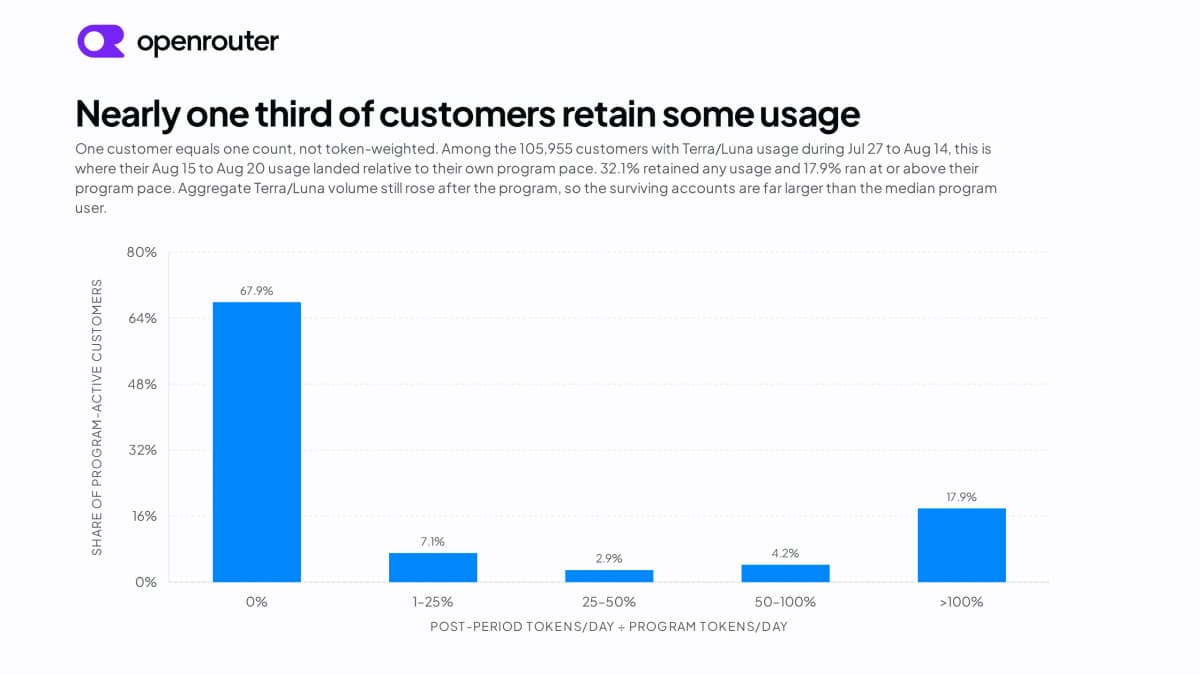
Nearly one third of program-active customers retained some usage after the discounts ended. Credit: OpenRouter.
OpenRouter flags its own caveats: the post-period is only six days (August 15–20) against a 19-day program, August 20 may be a partial day, and banned, deleted, internal and churned accounts are excluded. Sol is a valid control only through August 16, because Sol got its own 50% discount on August 17 — and immediately reproduced the Terra/Luna pattern, after averaging 79.1B tokens/day during the program versus 71.2B/day before it.
OpenRouter frames this as Jevons Paradox — cheaper use of a resource raising total consumption rather than lowering it — and on its own marketplace the framing holds up unusually well, because a same-family, same-week control model sat right next to the treated ones. For anyone pricing an API, the operational reading is narrower than the meme: a deep, time-boxed discount bought a 7.1-point share swing mostly taken from other labs, and about a third of the trial users were still there a week later. What the post does not report is money — no revenue, gross margin or serving-cost figures accompany the token counts, so "usage exploded" is not the same claim as "the promotion paid for itself."
OpenRouter, "GPT 5.6 Discounts & Jevons Paradox"OpenRouter's post on X

OpenAI cuts GPT-5.6 Luna price by 80%
An 11x price spread for the same open-weight model on OpenRouter
From o1 Pro to GLM-5.3-Flash: a 1,000x fall in token prices in 18 months

OpenAI tunes GPT-5.6 Sol, opens Luna to free users

OpenAI Launches GPT-5.6 Family: Sol, Terra, and Luna in Limited Preview

Stripe to buy OpenRouter for $7B