Thinking to Recall: How Reasoning Unlocks Parametric Knowledge in LLMs
 Federico Ulfo
 Federico Ulfo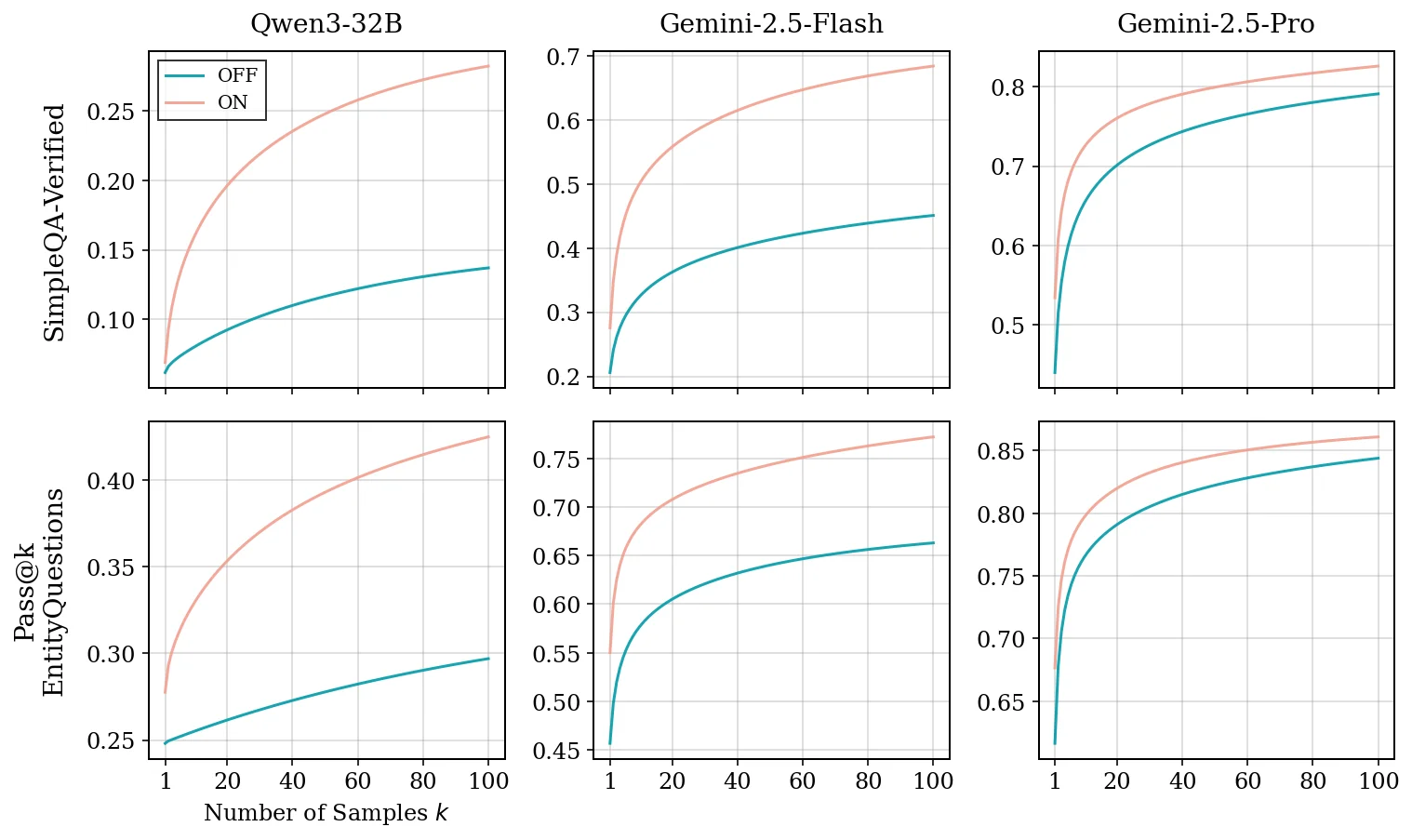
Google Research has a neat result: letting a model "think" can help it answer simple factual questions, not just hard reasoning problems.
In Thinking to Recall, the authors test Gemini 2.5 Flash/Pro and Qwen3-32B on closed-book QA. With reasoning turned on, the models recover facts that are nearly unreachable when reasoning is off — even for single-hop questions that need no step-by-step logic.
The effect comes from two mechanisms.
First, the extra generated tokens act like a computational buffer. Even meaningless filler like repeated "Let me think" improves recall somewhat (lifting SimpleQA accuracy from 20.6% to 26.2%), though it plateaus below real reasoning.
Second, real reasoning traces create factual priming. The model surfaces nearby facts that make the target fact easier to retrieve — to answer "Who was the 10th King of Nepal?", it may first list the earlier kings, priming the final answer.
There's a failure mode: if those intermediate facts are hallucinated, accuracy drops sharply. The paper shows that selecting reasoning traces with verifiable intermediate facts improves final-answer accuracy.
The takeaway: chain-of-thought isn't only for solving multi-step problems — it can also unlock latent factual knowledge, and more grounded intermediate reasoning may be one path to models that recall more reliably and hallucinate less.
Paper: Thinking to Recall: How Reasoning Unlocks Parametric Knowledge in LLMs (Google Research, arXiv:2603.09906).

Founder, Engineer
New York City