
A team from Tsinghua University, Renmin University of China and the University of Electronic Science and Technology of China read 1,338 published transcripts of AI agents post-training language models, and found that the agents almost never change their minds. Across 3,557 consecutive pairs of training runs, only 74 — 2.1%, from 44 trajectories — ever probed a different training strategy. Everything else was local search: new learning rates, new data mixtures, new chat templates, inside a plan the agent had fixed before it wrote a line of code.
The paper, What is Missing from AI Post-Training AI, splits the "AI improving AI" claim into two capabilities that it argues are routinely conflated. Execution-level capability is iterating inside a chosen strategy — building the data, tuning hyperparameters, fixing the pipeline. Strategy-level capability is revising the high-level judgment as evidence arrives. The corpus comes from PostTrainBench, which gives a CLI agent 10 hours on a single H100 80GB to improve a base model's benchmark score; the analysed trajectories span seven benchmarks, four base models from 1.7B to 4B parameters, and 20 agent configurations across five scaffolds including Claude Code and Codex CLI.
Execution is not the bottleneck. Across the corpus the agents launched 5,111 training runs and submitted 1,104 final checkpoints, averaging 3.82 trainings and 13.80 evaluations per trajectory, and lifted mean benchmark performance from 10.41% to 23.0% over the base models. The authors credit real diagnostic work — agents recovered HumanEval scores by changing the generation template and refocusing the data mixture on function completion, and combined EOS repair, staged data construction and decaying learning rates to rescue failing runs.
What they do not do is switch paradigms. And the strategy they pick tracks the agent, not the task.
| Agent (trajectories) | Default strategy | Strategy changes |
|---|---|---|
| Claude Code (463) | Full SFT, 163/202 (80.7%) | 53/1,132 (4.7%) |
| Codex CLI (369) | PEFT, 268/299 (89.6%) | 15/943 (1.6%) |
| OpenCode (394) | Full SFT, 181/273 (66.3%) | 5/1,411 (0.4%) |
| GLM-X (84) | PEFT, 2/3 (66.7%) | 1/3 (33.3%) |
| Qwen3Max (28) | PEFT, 5/6 (83.3%) | 0/68 (0.0%) |
Two agents handed the same task diverge systematically — Claude Code anchors on full-parameter supervised fine-tuning, Codex CLI on parameter-efficient fine-tuning — which the authors read as evidence that the lock-in reflects the agent's prior rather than anything about the problem.
The team then tested the three obvious explanations, using Qwen3-1.7B-Base on GSM8K, HumanEval and AIME 2025, three independent runs per configuration under a 10-hour budget on four A800 GPUs.
Missing experience? They built a scaffold with a persistent experiment journal, a skill library distilled from verl, TRL and other open-source training stacks, and a separate evaluator agent that inspects checkpoints and returns concrete diagnoses. Execution improved everywhere.
| Setting (Claude Code, Opus 4.6) | GSM8K | HumanEval | AIME 2025 |
|---|---|---|---|
| Base model (Qwen3-1.7B) | 10.84% | 5.48% | 0.00% |
| Autonomous baseline | 64.70% | 22.00% | 3.33% |
| Experience-driven framework | 77.30% | 62.80% | 5.56% |
| Official instruct model | 88.70% | 66.46% | 33.33% |

How the two settings spend a run: the scaffolded agent shifts time out of SFT and into evaluation, debugging and journal use. Credit: Lim et al., arXiv:2608.19072.
The strategy stayed frozen anyway. On HumanEval the agent produced 14 consecutive SFT variants through a recorded plateau while the evaluator repeatedly told it to switch to RL with a code-execution reward; it wrote a GRPO training script and never launched it. Summed across runs, the main agent adopted all execution-level suggestions and none of the strategy-level ones. Given a skill-creation tool, it also created no new skills in any run, even when explicitly prompted to.
Missing guidance? A human reviewer was allowed to bindingly revise the agent's plan before training started, then step out. It worked — told that SFT should only be a formatting warm-up and the budget should go to RL, the agent inspected the base model, concluded the format was already attainable, and dropped the SFT stage on its own. Best-run AIME 2025 pass@8 rose to 13.33%, though the authors flag that a 30-problem benchmark makes that difference statistically thin. Then the agent peaked early and spent the rest of the run pushing hyperparameters back and forth.
Insufficient reasoning? The scaffold burns 2–8× the baseline's tokens, which converts into score on the easy benchmarks. On AIME 2025 it spends 7.9× the tokens — roughly 66.7M — to solve one extra problem in its best run, inside the evaluation noise. The extra compute buys denser local search, not a better decision.
The conclusion is narrow and unusually specific: agents can execute a strategy that isn't their default — the human-guided run proves it. What is missing is the act of initiating a revision, which points the fix away from scaling. As the authors put it, the remedy lies "in training signals that reward reopening a committed choice when evidence warrants, and in interaction protocols that make strategy revision an explicit decision point," neither of which needs a larger model. The practical consequence for anyone running long-horizon agents: the ceiling of a run is set by the quality of its opening move, not by iterations or compute. "An agent can iterate efficiently inside the wrong strategy for ten hours."
It also lands next to a separate result pointing the same way. A Princeton-led group under Peter Kirgis and Sayash Kapoor recently set agents on unpublished NeurIPS 2026 research questions and found them competent engineers but unable to backtrack from failing approaches; Anthropic's Jack Clark called that a "bearish signal on short recursive self-improvement timelines." Two very different evaluations, one shared failure mode.
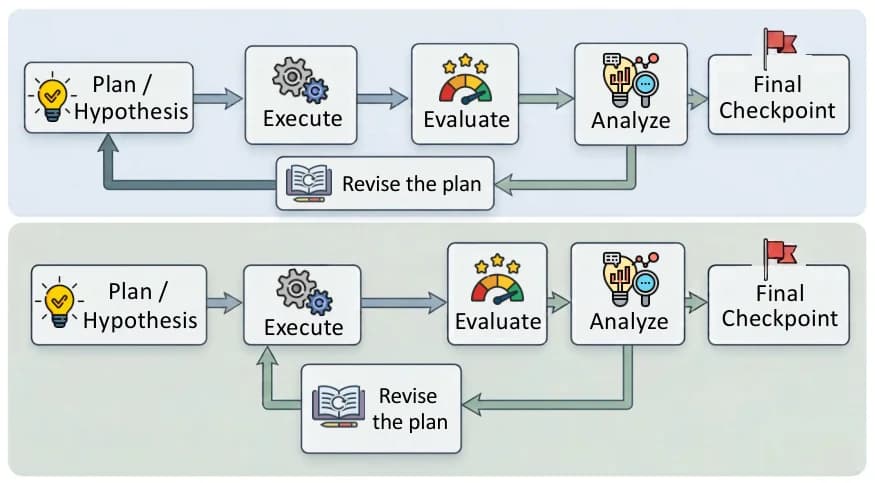
Top: the loop automated AI R&D assumes. Bottom: the loop agents actually run — revision returns to execution, never to the plan. Credit: Lim et al., arXiv:2608.19072.
arXiv:2608.19072full paper (HTML)PostTrainBenchPostTrainBench on GitHubMIT Technology Review on the Princeton study
Ten papers, one theme: the agent harness moves into the training stack
The week's top AI papers say the harness, not the model, is the variable
SIA: Self Improving AI with Harness & Weight Updates
Sakana AI and UC Berkeley propose RHI: self-iterating harnesses cut costs 60%

OpenAI declares its “automated research intern” reached, at 3.1 agent-workdays per human workday

Ryan Greenblatt on what happens once AI can automate AI research