
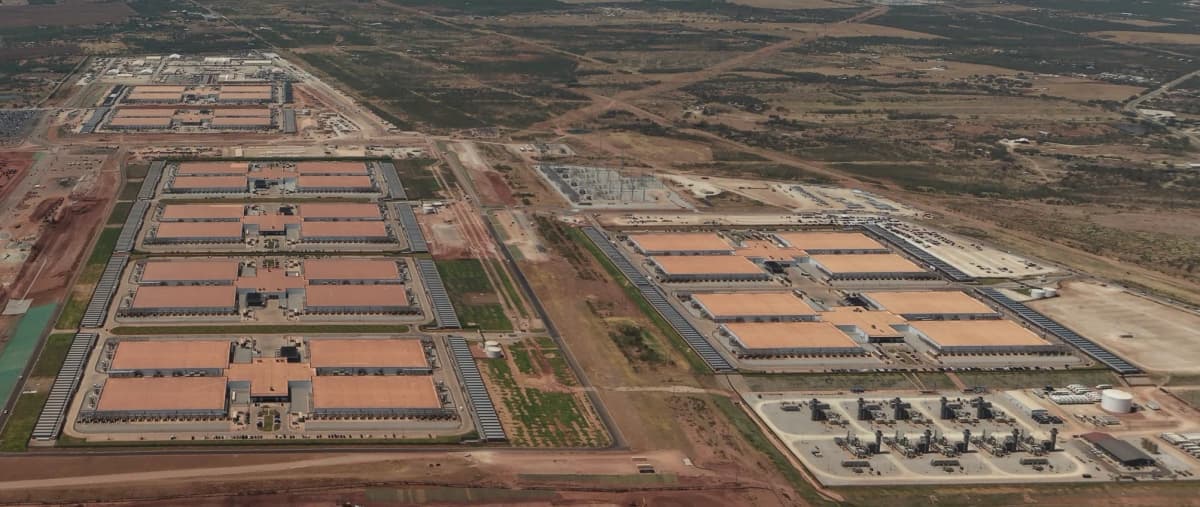
Jensen Huang has attached the first hardware figure to OpenAI's newest model: GPT-6 Astra was trained on "~100K+ NVIDIA Grace Blackwell NVLink72," with 400,000 GPUs coming online next. The Nvidia CEO added the line the site's readers will argue about for longer — "From ChatGPT to o1 to Astra in 4 years. AGI has arrived. Congratulations @OpenAI team" — in a reply to Crusoe CEO Chase Lochmiller, who had posted an aerial of the Stargate site in Abilene, Texas with the caption "I guess this makes Abilene the birthplace of AGI!"
OpenAI has not published a compute disclosure for Astra, so Huang's post is currently the most specific public account of the run — and it is corroborated from inside the lab.
Huang's phrasing is genuinely ambiguous: "100K+ Grace Blackwell NVLink72" could mean 100,000 GPUs or 100,000 NVL72 racks, and the second reading would put the count in the millions. President Greg Brockman settles it. Speaking to Stratechery, he said Astra was "the first run that we've trained on more than 100,000 GPUs, which is an easy number to throw around, but just think about the scale of that." The Decoder reports the pretraining ran at the Stargate facility in Texas, and quotes OpenAI researcher Aidan Clark calling it the company's largest training run ever — with the Sol-to-Astra jump larger than the jump to Sol, partly because earlier models helped monitor the training.
Analytics Insight reports that Huang first posted a figure of 300,000 systems, deleted it, and replaced it with the smaller number. That detail is single-sourced; the surviving post is the one quoted above.
Neither Nvidia nor OpenAI has said what the next cluster is for or when it lands, so the arithmetic below is third-party estimation, not disclosure. Wccftech works it out two ways:
| Estimate | Basis | Result |
|---|---|---|
| Astra's training run | 100,000 GPUs × 90–120 days × $2.50–$3.50 per GPU-hour | $540M – $1.01B |
| A 400,000-GPU run | ~5,556 GB200 NVL72 racks × ~140kW × 1.5 PUE | ~1.2GW |
Those are order-of-magnitude figures built on assumed rental rates and rack power, and the cost line in particular assumes OpenAI paid something like a market GPU-hour price at its own Stargate site rather than an internal one. The power number is the more useful of the two: a single training cluster in the gigawatt class is the scale at which grid interconnects, not chips, become the constraint.
The Astra launch was a benchmark story; this is the infrastructure receipt behind it, and it lands with an obvious asterisk. Huang sells the hardware, is declaring the arrival of AGI on it, and used the post to advertise a cluster four times larger — a sequence TechRadar read as a next-gen GPU pitch as much as a technical claim. Researchers quoted by Analytics Insight make the same objection: AGI has no fixed definition, OpenAI's own is "outperform humans at most economically valuable work," and no independent evaluation has tested Astra against it. Anthropic's Fable 5.1 still leads Astra on SWE-Bench Pro, the Artificial Analysis Intelligence and Coding Agent indices, and ProofBench v1.1.
Brockman himself is more careful than his hardware supplier: "People do have their own definition of AGI, it's almost this blurry thing… Maybe it was the previous model, maybe it's Astra, maybe it's the next model, but somewhere in there, I think we're going to cross most people's AGI threshold."
What is not in dispute is the trend line the numbers describe. A 100,000-GPU pretraining run is now a thing that has happened once, publicly, and the company that sold the chips is already quoting the next figure with a four in front of it.
Jensen Huang on XChase Lochmiller on XBrockman quote via The TranscriptStratechery interview with Greg BrockmanThe DecoderPC GamerWccftechAnalytics Insight
OpenAI trained GPT-6 Astra on 100,000+ GPUs and cleared it with the White House first
OpenAI ships GPT-6 Astra and declares the AGI era
GPT-6 Astra takes 10 of 16 RuneBench records, at $15 a task

Dylan Patel: two labs will own most of the world's compute

OpenAI declares its “automated research intern” reached, at 3.1 agent-workdays per human workday