

Linear CEO Karri Saarinen says the company's own bug autofix loop has fixed 300+ bugs in the last 30 days, and posted the configuration behind it. The screenshot fills in the number the tweet leaves out: the loop, called "autofix bugs" and owned by Linear engineer Igor Sechyn, ran 817 times over the same 30 days.
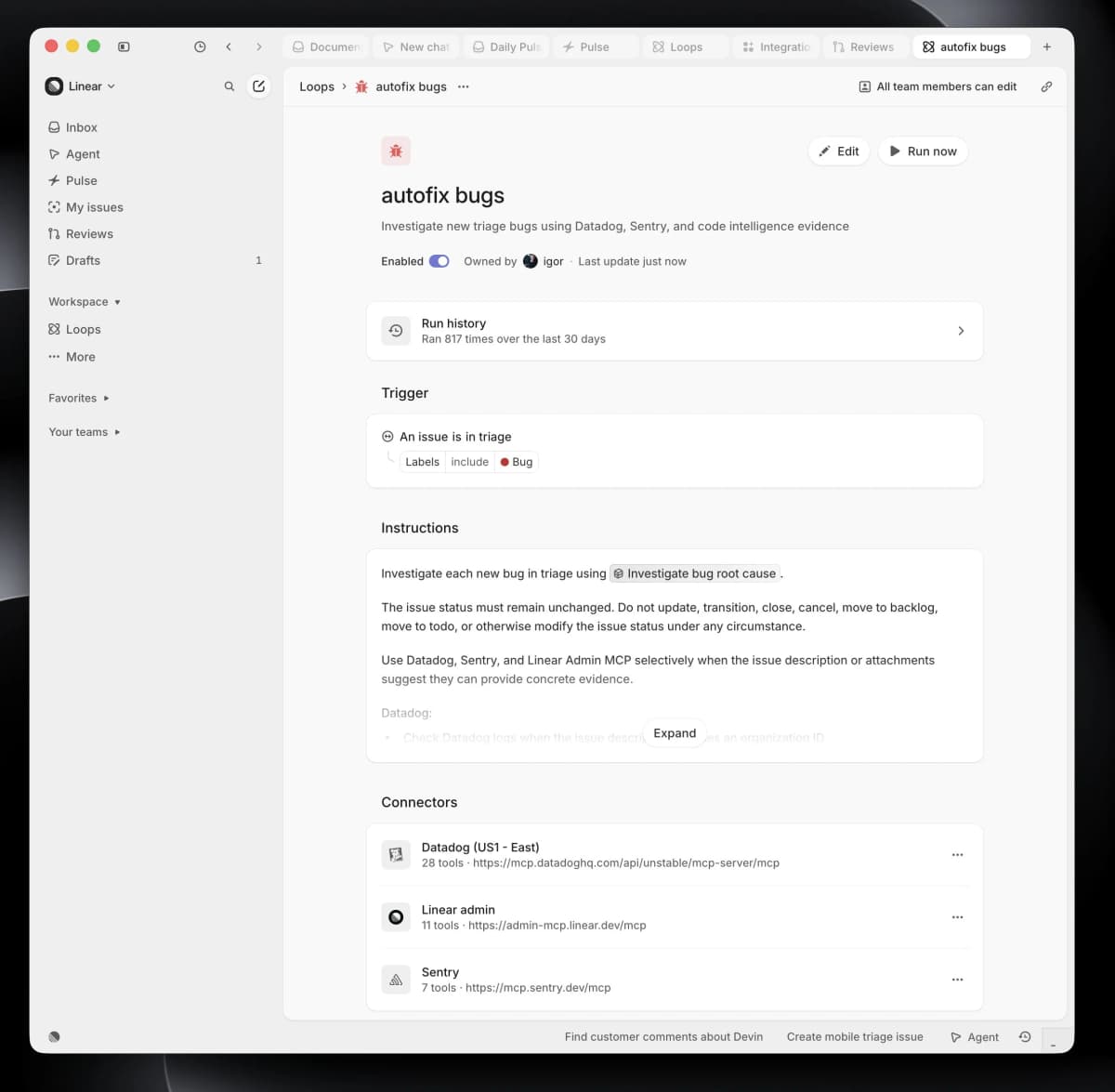
The "autofix bugs" loop in Linear: a triage trigger, three MCP connectors, and 817 runs in 30 days. Credit: Karri Saarinen on X.
The trigger is narrow: an issue enters triage with the Bug label. The instructions tell the agent to investigate each one with an "Investigate bug root cause" skill, and then draw a hard line around the ticket itself — "The issue status must remain unchanged. Do not update, transition, close, cancel, move to backlog, move to todo, or otherwise modify the issue status under any circumstance." Evidence gathering is deliberately conditional: "Use Datadog, Sentry, and Linear Admin MCP selectively when the issue description or attachments suggest they can provide concrete evidence."
Three MCP connectors are attached — Datadog (US1-East, 28 tools), Linear admin (11 tools, admin-mcp.linear.dev) and Sentry (7 tools). Per Saarinen, an investigated issue is then handed to Linear's coding agent to fix.
This runs on Loops, Linear's scheduled-or-triggered agent runs, available on Business and Enterprise plans and billed against AI credits. Loops carry their own permission set, gating web access, Code Intelligence and the ability to start a coding session separately, plus a run history for auditing what each execution did.
Sechyn wrote the workflow up before the number existed, and his account is more measured than the headline. The first attempt pointed the agent at every incoming bug: "That didn't work very well because there wasn't enough context to one-shot the fix, so we had to narrow the ask and feed it the right instructions and tools."
What survived the narrowing is two bug shapes:
| Bug class | How it's detected | First-pass success |
|---|---|---|
| Dead feature flags | Datadog monitor files an issue once a flag returns the same result 100% of the time | Agent "one-shots it nearly every time" |
| Failing background tasks | Monitor files an issue when a task's failure rate climbs above 0.2% | "Lands the correct fix about a third of the time" |
Linear also added gates that make the agent demonstrate it understands the problem before it is allowed to attempt a fix, to cut down on off-target PRs and wasted tokens. When it can't fix something, it still leaves the investigation behind for whoever picks the issue up.
This is a rare look at the plumbing rather than the pitch. The loop is not a general-purpose "fix my bugs" agent: it is two well-shaped bug classes, detected by thresholds a human chose, investigated with observability MCPs, with the agent explicitly forbidden from touching workflow state. The interesting number may be 817 runs against 300+ fixes — a bit over a third, if each run corresponds to one triaged bug — which lines up with Sechyn's per-class rates rather than contradicting them.
It is also Linear dogfooding what it sells. The company shipped coding sessions, automated triage and Diffs on June 11, and Saarinen said at launch that almost 700 PRs had been merged by the agent in the preceding month, citing Ramp's internally built Inspect as writing more than 60% of the PRs that team merges.
The caveats are the usual ones for a founder metric. "Fixed" is undefined, and Linear's own description of the loop ends at a pull request tagged for an engineer to review — so the 300+ presumably counts fixes a human merged, not autonomous deploys. There is no figure for PRs opened and rejected, regressions, or bugs the loop investigated and gave up on.
Karri Saarinen on XTeaching an agent to auto-fix bugs (Igor Sechyn, Linear)Now Linear writes the code, too (Karri Saarinen, Linear)Linear docs: LoopsSentry: auto-create and triage issues in Linear

OpenAI's Defense Factory: agents wrote 100% of the patches in its security sprint
Lauren Tan: 20 GrokBot agents, ~1,000 PRs a month, 600 refactors to get there
Seven anti-slop skills for coding agents: one linter, six cleanup prompts

OpenAI declares its “automated research intern” reached, at 3.1 agent-workdays per human workday

Coding agents are learning to talk to each other