Dwarkesh Patel argues recursive self-improvement has already started
In a 44-minute video essay, Dwarkesh Patel argues that recursive self-improvement has started. Earlier this year he would have put superintelligence "at least the better part of a decade" away. After three months of debates on and off his podcast, his median for AIs that match the very best human AI researchers is 2028, with 2027 possible and at least a 25% chance it takes until after 2032.
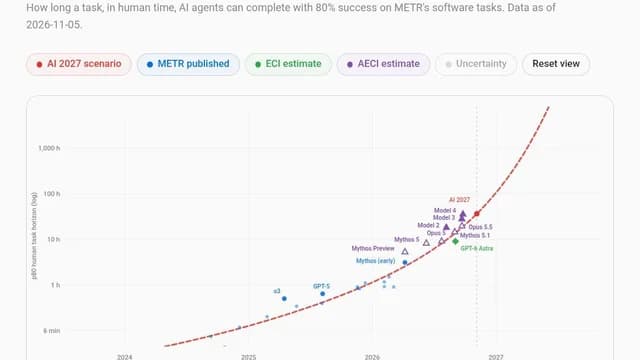
His evidence that AI already speeds up AI research: METR, after three months embedded at Anthropic, concluded the lab's progress on well-scoped tasks runs at twice last year's rate, mostly because of its own use of AI. An OpenAI post said its heaviest internal users went from about $1,000 to over $7,000 a day of coding agents over the summer, and Anthropic said Claude now leads 26% of its AI R&D work, up from under 1% in February. He treats math as the preview: models that could not add four-digit numbers in 2023 took International Math Olympiad gold in 2025 and, he says, solved a Millennium Prize problem in 88 hours a month ago. AI research, he argues, is even more verifiable than math: held-out loss, speedruns and benchmarks give agents a score to climb.
Patel gives even odds to two outcomes: a software-only singularity within months, or a "spark" that packs three to six years of progress into one calendar year and then stalls until more compute is built. He answers four objections (continual learning, research taste, data, experiment compute), calls the bottlenecks serious and the later parts of the argument speculative.