
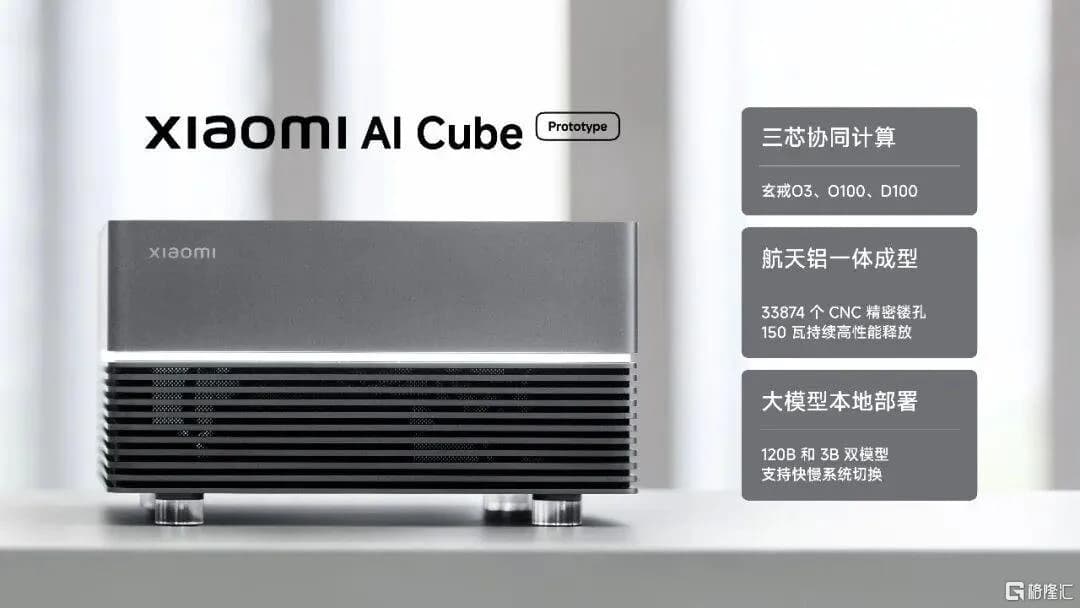
Xiaomi used its Xring chip briefing in Beijing to show the AI Cube Prototype, a desk-sized machine that runs large language models locally on three of its own chips: the Xring O3 flagship SoC, the Xring O100 AI accelerator and the Xring D100 automotive AI processor. The box is an aerospace-aluminum unibody with 33,874 CNC-machined cooling perforations, rated for 150W sustained power, and Xiaomi demonstrated it deploying a 120B model alongside a 3B model with fast/slow system switching.
The spec sheet went viral on X, where the local-AI account AJ called it "a serious GB10 competitor from China" and listed 1.22 TB/s of bandwidth and up to 160GB of unified memory. Both numbers are real, and neither describes the machine. Lei Jun's own follow-up post the next day put the AI Cube prototype at 80GB of unified memory — half the figure circulating — while the 160GB is the maximum the D100 chip supports, not what is in the box.
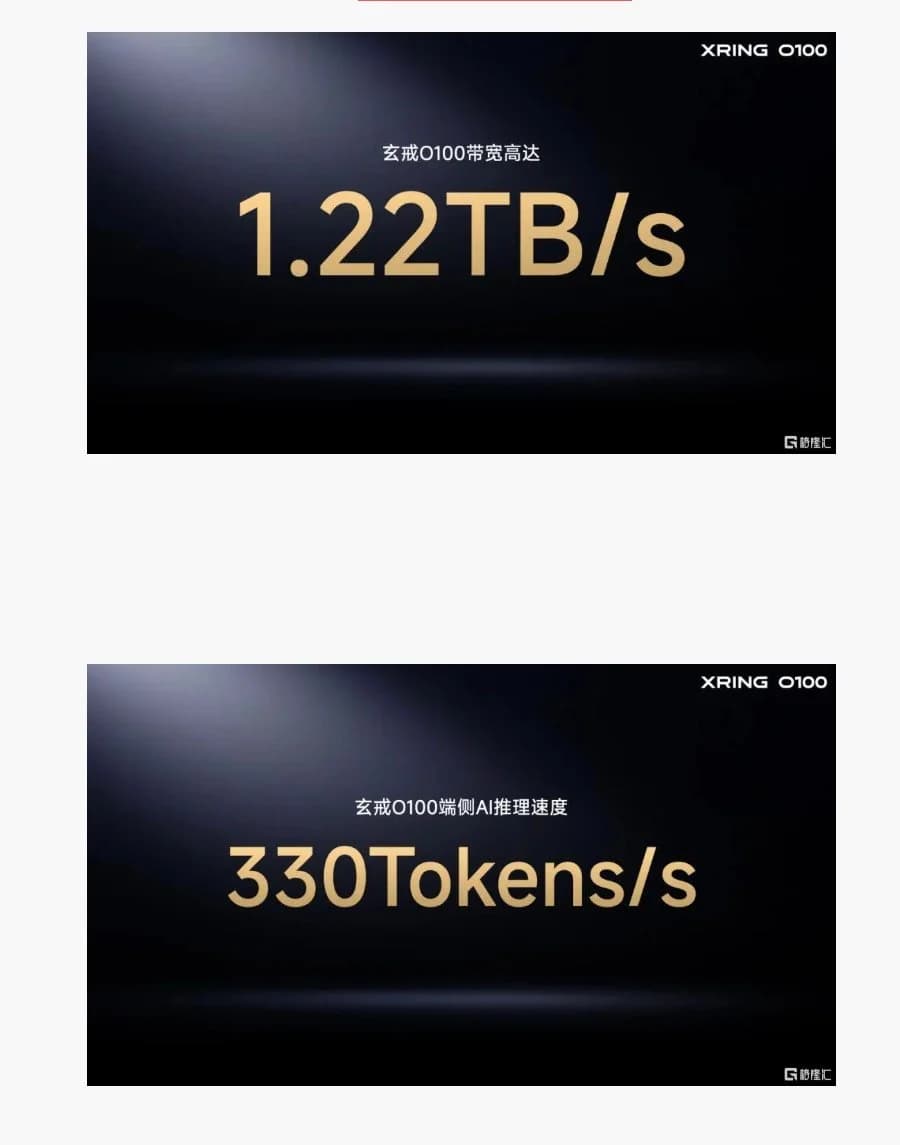
Xiaomi's two headline O100 slides: 1.22 TB/s of bandwidth, 330 tokens/s of on-device inference. Credit: Xiaomi, via AJ on X.
The O100 is the genuinely novel part. It is a 6nm accelerator with a 14-core NPU that stacks two DRAM layers directly onto the compute die using wafer-on-wafer packaging, with hybrid bonding at a 1.4 μm pitch, 0.7 μm through-silicon vias and 28,672 effective data connections. That is where 1.22 TB/s comes from — near-memory bandwidth, which Xiaomi says is roughly 16x mainstream smartphone memory. The D100 is a separate 3nm part with a 20-core CPU and 16-core NPU, and it is the one that owns the unified memory pool a 120B model actually lives in.
| Component | Memory | Bandwidth | Role |
|---|---|---|---|
| Xring O3 SoC | LPDDR6 system memory | 113.8 GB/s | 10-core CPU, 16-core G2-Ultra NX GPU, 200 TOPS NPU |
| Xring O100 | stacked near-memory DRAM | 1.22 TB/s | 14-core NPU; feeds hot data to the accelerator |
| Xring D100 | up to 160 GB unified (chip maximum) | not disclosed | 20-core CPU, 16-core NPU; holds the large model |
| AI Cube prototype | 80 GB unified | not disclosed | runs 120B + 3B together |
| Nvidia DGX Spark (GB10) | 128 GB unified LPDDR5X | 273 GB/s | the comparison everyone is making |
Memeburn's Marko Nguyen traced the confusion after a reply on the same thread asked why some posts quoted 113.8 GB/s instead — that figure, he argues, is the O3's LPDDR6 system memory, a third tier entirely. His conclusion: "three specs from three different contexts wearing one trench coat."
The other headline figure has the same shape. Xiaomi's claimed 330 tokens/s is the O100 running its own MiMo 3B model, not the 120B model in the Cube demo. A separate O100 prototype — a phone-form-factor demo terminal with the camera module removed, the motherboard rebuilt and a 10W active fan bolted on — measured 295 tokens/s with the on-device MiMo model.
Desk-side AI boxes are decided by unified-memory bandwidth, not TOPS. The DGX Spark's 128GB pool tops out at 273 GB/s, and that ceiling is why token generation on large models slows down; AMD's Ryzen AI Halo sits at 256 GB/s with the same behavior. Xiaomi did not publish the bandwidth of its unified pool, which is the single number that would settle the GB10 comparison. Hardware Corner adds a second unknown: nothing announced confirms llama.cpp, vLLM or open-kernel support, and an accelerator that only runs Xiaomi-approved models is worth little to people chasing each new open-weight release.
What is not in doubt is the direction. Xiaomi designs the Xring family (TSMC is reported to fabricate the O3, O100 and D100), cumulative shipments of the previous-generation O1 have passed one million, and Lei Jun has committed at least CNY 50 billion over a decade to the program. The O3 debuts in the Xiaomi 18 Fold; O100 and D100 are targeted for commercial use in 2027. There is no price and no retail AI Cube — the specs are a statement about China's on-device silicon roadmap, not a product you can buy.
VideoCardzIT之家 on the AI Cube announcementIT之家 on Lei Jun's prototype breakdownEqualOcean on the Xring O100NotebookcheckMemeburnHardware CornerAJ's original post


