Anthropic launched its IPO roadshow, offering 825 million Class A shares at $70–$78 each and seeking a Nasdaq listing under the ticker ANT.
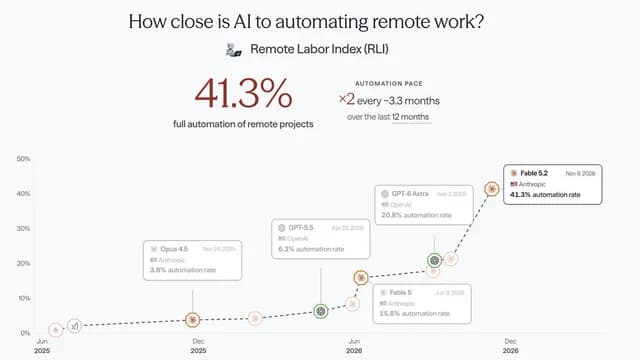
Independent tests put Claude Fable 5.2 first on Epoch's Capabilities Index and the Remote Labor Index, where it automates 41.3% of real freelance projects, while it trails on some games and legal tasks.
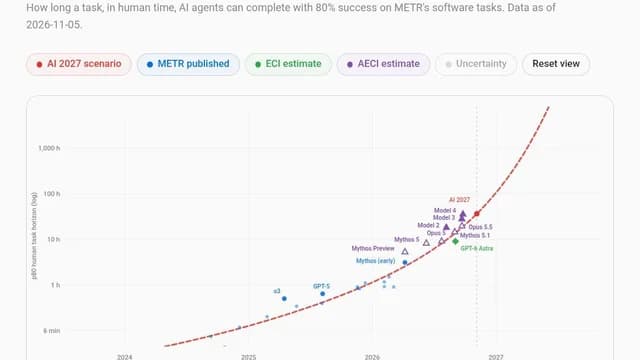
METR estimates AI has roughly doubled Anthropic’s pace of progress, and AI 2027’s authors now expect a superhuman AI researcher in 2027; skeptics point to the cost curve.
OpenAI built Control Room, a fail-closed system that can stop any research model workload within 35 seconds, as the enforcement layer behind its expanded misalignment monitoring.
Meta released Muse Ember, its smallest model, at $0.10/$0.50 per million tokens, claiming it beats Claude Haiku 5.5 and GPT-6 Luna on cost per point of intelligence.
Google made Gemini 4 Carbon, its strongest model, available to all paying developers and launched Gemini 4 Hydrogen, a faster, cheaper model that brings Gemini 4 to every tier.
Inkling 2 Small combines 17B active parameters, image understanding and a 1M-token context window for coding and research agents. It launched on Tinker, with Apache-licensed weights planned after safety testing.
Fable 5.2 cuts token prices by 20%, improves coding and reasoning, and adds an optional fast mode. Early X discussion focuses on cost and scientific applications.
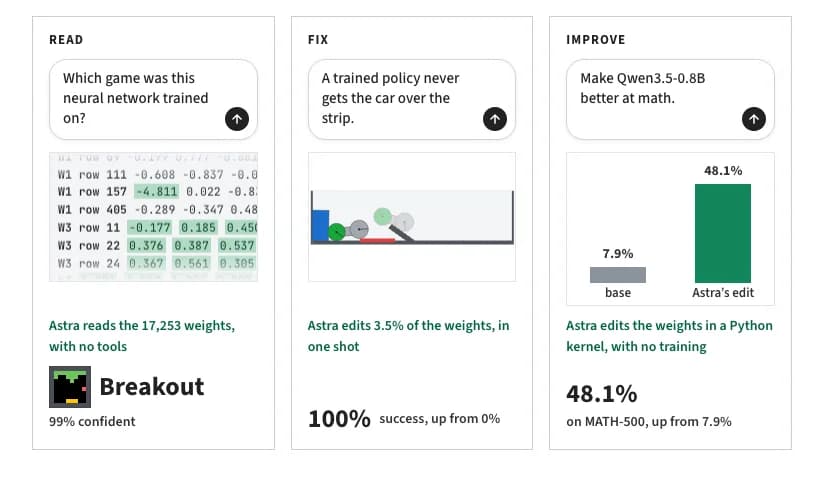
MIT researchers use GPT-6 Astra to read, repair and construct neural networks. Experiments, public reproductions and behavioral baselines show the promise and limits of programming model weights directly.
PHP patched two critical RCE flaws as attackers began exploiting them. A separate LiteLLM supply-chain attack shipped credential-stealing malware. Here is what to patch, rebuild, and investigate.
Anil Seth, Ned Block, and Giulio Tononi argue against AI consciousness in Nature. Chalmers and Sebo question what their arguments establish and how uncertainty should guide AI welfare.
Google DeepMind's Gemini 4 Argon is top or tied on 14 of 19 benchmarks in Google's table and scores 53 on the Artificial Analysis Intelligence Index. It is rolling out first to cyber defenders, at $2/$10 per million tokens.
Anthropic’s centralized source-control system supports over 30,000 daily merges, using server-side operations and sparse checkouts to reduce infrastructure costs.
Evo² trains one policy to edit and evaluate an agent’s harness, using execution outcomes to improve its model weights.
Exa launched Exa 3.0, claiming #1 on every benchmark it tested. Artificial Analysis shows Exa narrowly ahead on its Search Index, tied with Perplexity, while DeepSeek and Octen are far cheaper.
Alex Wang's new blog post derives the linear layer, MLP and self-attention as associative memory stores. It estimates how many key-value pairs each can hold before interference drowns the signal.
@skeptrune said an abliterated build of dsv4.1-flash-1017 left them sick to their stomach. Replies argued over regulation, defense, and who controls open weights.
DeepSeek released DeepInfer, the in-house inference framework that serves DeepSeek-V4.1-Flash in production, as open source. It says the stack delivers high throughput and low latency, and it hopes to help the community lower compute costs and energy use.
MATS researchers, with Anthropic's Alex Cloud among the authors, propose GRAFT. It routes gradients from monitor-flagged reward hacks into a sacrificial adapter that is removed before deployment. On Qwen3-8B, hacking of all types fell to nearly zero.
Noise provides an open speedrun for improving pretraining without backpropagation, following the team's Dust work on zeroth-order optimization.
OpenCode says a breach affected 1.4% of Console users. Follow-ups clarify the scope, Anthropic key revocations, continued attack attempts, and OpenAI refunds.
DeepSeek V4.1-Flash-1017 improves reasoning, coding, agents, and vision while reducing task runtime and output length. Token prices stay unchanged as task efficiency improves.
Odyssey demonstrates a fruit-fly brain flying autonomously through simulated worlds generated by Odyssey-3.
Claude Code compresses the conversation sent on each turn, while cloud sessions begin starting as users type.
Fine-tuned Qwen3-8B detects numerical traces left by activation capture. Sauers traces the effect through compiler changes and an attention head, with sharp limits across hardware and runtimes.
The AI adoption funnel describes a widening gap between casual chatbot use, professional agent workflows, and access to internal frontier systems.
REA gives AI agents an MCP interface for examining application behavior, native binaries, and runtime evidence without access to source code.
Persistent agent swarms can distribute working context across multiple models, reducing dependence on repeated summaries of a single context window.
Continuous Memory Machines give recurrent models separate short-term and persistent memory matrices, with a Transformer coordinating reads and updates.
Harness learning trains a model to revise an agent’s executable control program from execution feedback, adapting to unseen tasks without changing model weights.
The weekly AI digest — models, agents, open source, research — plus a monthly round-up. Unsubscribe anytime.