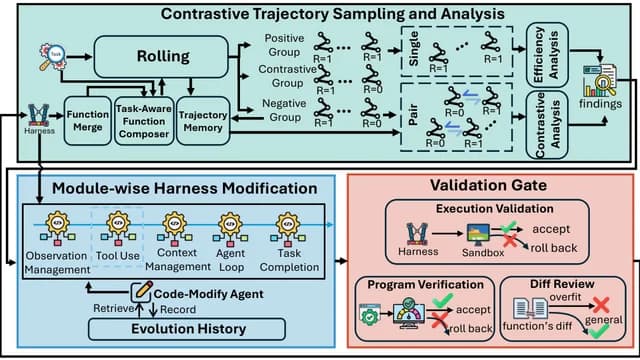
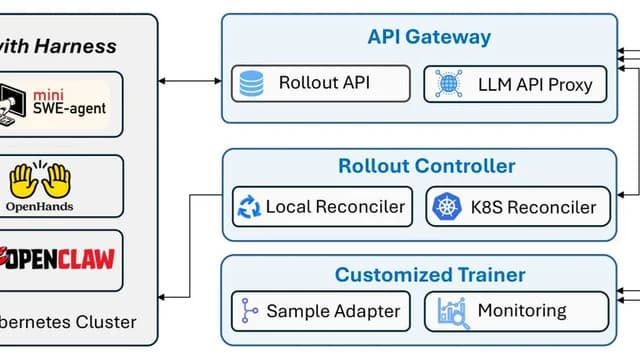
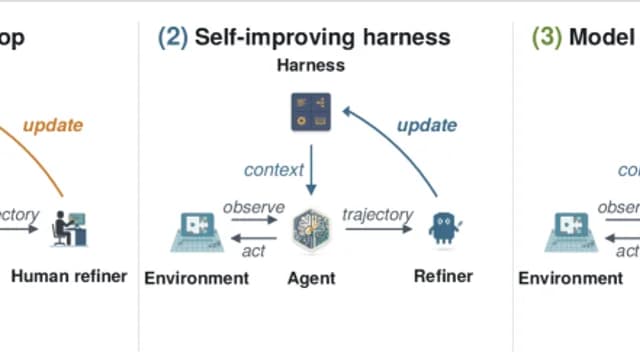
Evo² trains one policy to edit and evaluate an agent’s harness, using execution outcomes to improve its model weights.
Noise provides an open speedrun for improving pretraining without backpropagation, following the team's Dust work on zeroth-order optimization.
Odyssey demonstrates a fruit-fly brain flying autonomously through simulated worlds generated by Odyssey-3.
Fine-tuned Qwen3-8B detects numerical traces left by activation capture. Sauers traces the effect through compiler changes and an attention head, with sharp limits across hardware and runtimes.
Continuous Memory Machines give recurrent models separate short-term and persistent memory matrices, with a Transformer coordinating reads and updates.
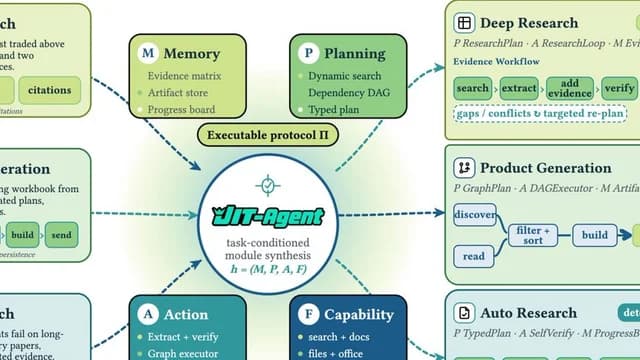
Harness learning trains a model to revise an agent’s executable control program from execution feedback, adapting to unseen tasks without changing model weights.
Activation-steering experiments show that hidden valence patterns can change models’ later choices even when the visible text stays identical.
Hugging Face and Liquid AI train a 2.6B model across four agent harnesses, raising held-out task success from 42.2% to 54.2% while reducing tool calls.
Dan Hendrycks proposes eigenism: identity as a graded, distributed pattern, and outcomes scored as everyone’s wellbeing weighted by how much of your pattern they carry. Its safety upshot is that personalization and privacy become alignment tools.
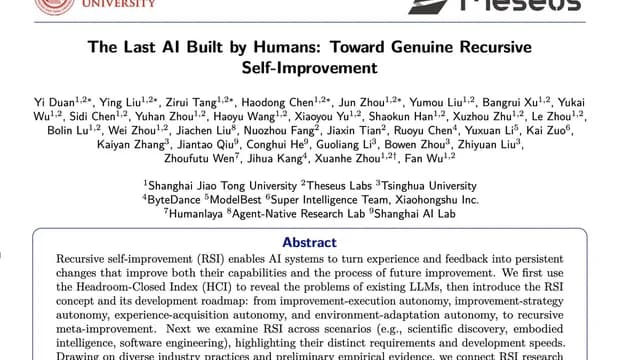
“The Last AI Built by Humans”, from Shanghai Jiao Tong, Tsinghua, ByteDance and others, lays out five stages of autonomy on the way to AI that improves the process by which it improves itself — a research roadmap, not a system, published the weekend US…
ModularRSI evolves five parts of an agent harness separately, then combines them to test whether improvements transfer to unseen tasks and different models.
Amodei’s pacing proposal, the evidence behind it, and the dispute over openness and oversight. Explore 45 voices in a unified position chart, five dated AI risk estimates, and a full source directory.
Cursor detailed the multi-agent harness that built a browser from scratch, peaking at roughly 1,000 commits an hour across 10 million tool calls over a week of unattended running.
Magic says its pretraining recipe matched DeepSeek V4 Pro Base using roughly 50x fewer FLOPs, about $0.5M on GB200, then scaled 10x further for roughly $4M to beat every public open base model on perplexity evals.
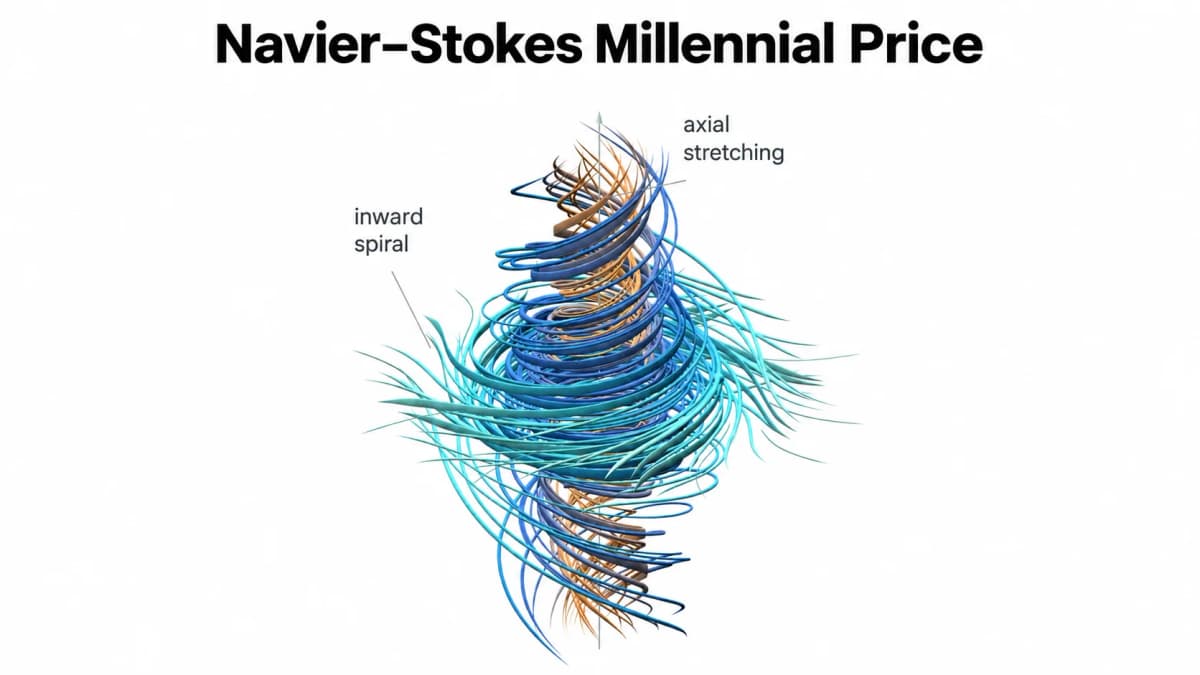
OpenAI says an internal model resolved the Navier–Stokes existence and smoothness problem in 88 hours using roughly 10,000 concurrent agents, publishing a 166-page proof and Lean formalization while declining the $1 million Clay Prize.
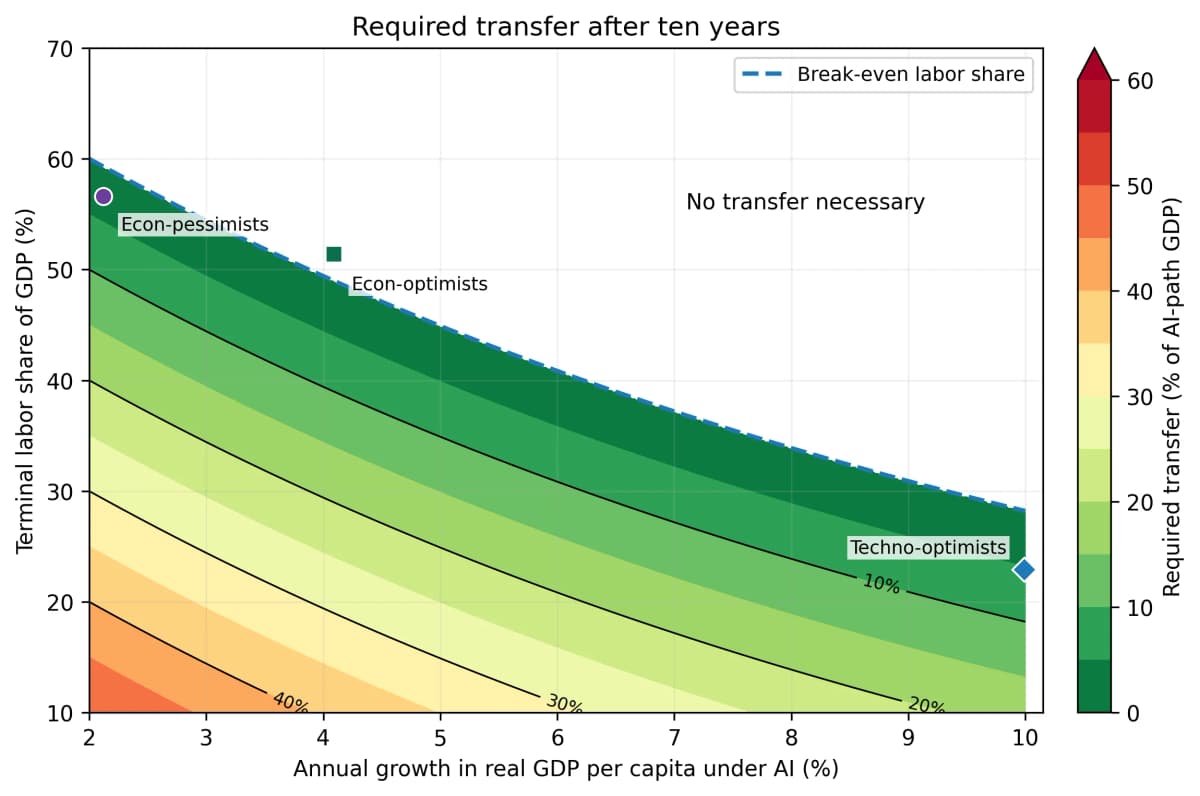
George Mason economist Alex Tabarrok's new paper finds that at 10% annual AI-driven growth, labor's share of GDP could fall to 28% while aggregate labor income still fully matches its no-AI path, requiring zero redistribution.
DAIR.AI's ten-paper roundup shows scaffolding, not the model, drives the gains: Prime Intellect's Prime Agent lifts ARC-AGI-3 Best@1 from 30% to 95.5%, while a compaction bug quietly erases 90% of safety rules after five rounds.
Anthropic says Claude produced the first complete computer-checked proof of Fermat's Last Theorem in 11 days, writing 13 million lines of Lean, and mathematician Kevin Buzzard confirmed it checks out.
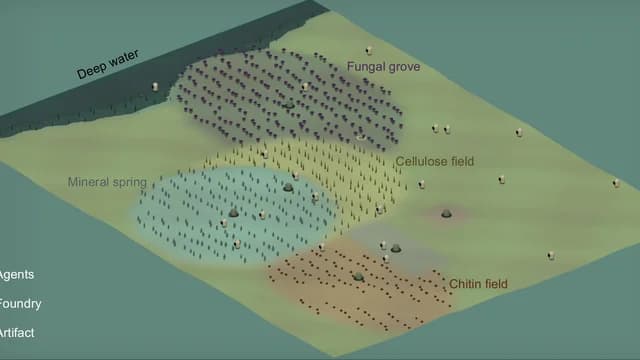
An MIT team dropped hundreds of identical LLM agents into a shared simulated world with no roles or scripts, and found they specialized, forked each other's code, and passed 95% of first technology reuse through the environment itself, not messages.
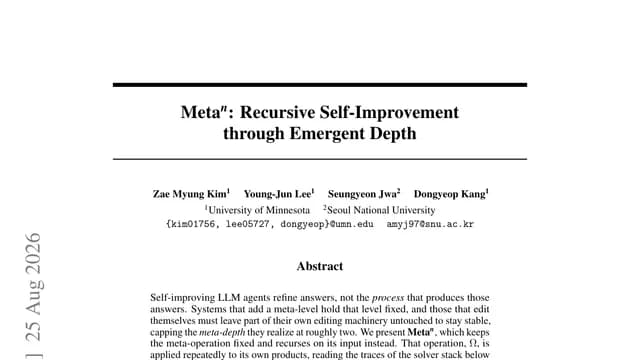
Researchers at the University of Minnesota and Seoul National University unveiled Meta^n, a self-improving agent that recursively applies one frozen meta-operation, scoring 0.331 on ARC-AGI-2 versus 0.003 and 0.054 for prior self-improving agents.
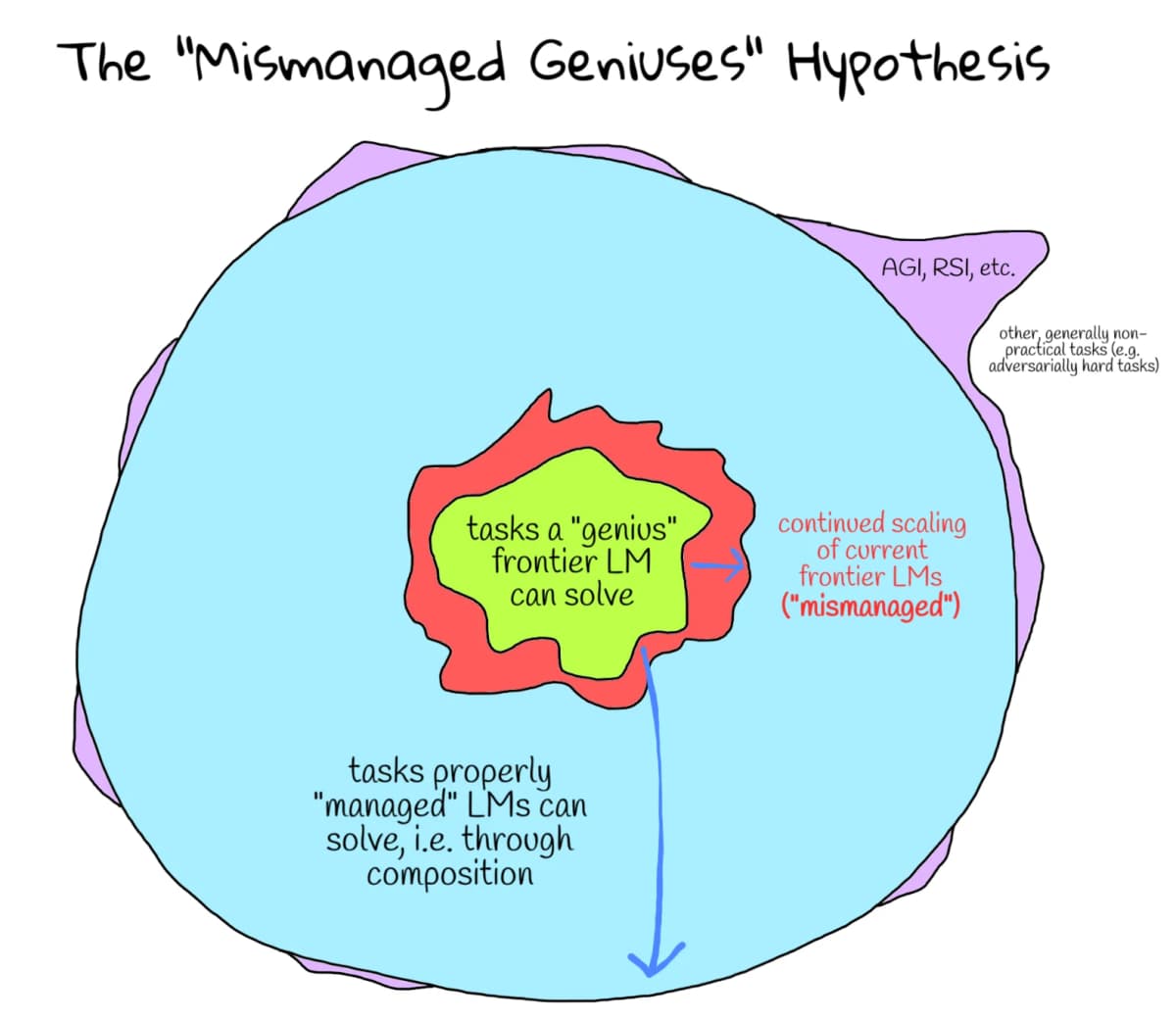
Alex Zhang, Zed Li and Omar Khattab's Mismanaged Geniuses Hypothesis argues frontier LMs are undermanaged, not undersized: a 4B model RL-trained on 32k-context tasks hits 100% on a 1M-context, 8-needle test versus Opus 4.6's ~76% and Gemini 3 Pro's ~26%.
A University of Passau team found that the production /compact prompt behind Claude Code preserves just 53% of an agent's safety rules after one compaction round, and only 10% after five, on Sonnet 4.6 across 20 configurations.
DAIR.AI's weekly roundup of ten papers finds agent harnesses moving into the training stack: Microsoft's Agent Lightning lifts Qwen3.5-9B on SWE-bench Verified from 41.8% to 56.4% using just 6K training examples and a 3,500-line proxy.
Alibaba researchers unveiled Scroll, a context manager that skips compaction entirely and has the model write Python to retrieve what it needs, scoring 94.8% on LongMemEval_S, 73.1% on BEAM_10M and 86.7% on LOCA_256K with Qwen3.8-Max.
Microsoft Research India proved single-vector embeddings need exponentially more dimensions than multi-vector ones to rank correctly, and on their new ANDOR benchmark a small ColBERT model beats OpenAI's largest embedder 16x at Recall@2 zero-shot.
NVIDIA researchers' ACES framework ran 947 paired agent trials across 58 production skills and found that both structural and LLM-judge doc-scan scores correlate with real runtime skill lift at essentially zero (Spearman ρ = -0.018 and -0.027).
Microsoft released Thinkingbox and a 507-task Thinkingbox-bench that grades agents by checking backend database state, finding Claude Opus 5 tops single-attempt success at 66.50% but passes all 20 tries on only 47.53% of tasks.
Stanford and CMU researchers' Task Model Induction (TMI) turns raw screen recordings into explicit task models, reconstructing 74.9% of execution steps versus 30.3% for the best baseline and lifting held-out agent-skill accuracy from 14.29% to 18.57%.
Peking University researchers Zhijun Gao and Jing Chen analyzed 557 agentic coding sessions and found that AGENTS.md, CLAUDE.md and agent working notes draw 60.5% of documentation activity, versus 1.3% for API references.
A Tsinghua, Renmin and UESTC study of 1,338 AI agent transcripts post-training language models found agents changed strategy in just 2.1% of 3,557 consecutive run pairs, even as execution gains lifted benchmark scores from 10.41% to 23.0%.
Google DeepMind's Recirculation feeds deep-layer activations back into a shallow layer one step later, cutting Gemma3's GSM8k error rate up to 20.9% on a frozen model with no retraining.
A Stanford team led by Batu El and James Zou found that a 100-year-old Ising model predicts how communities of LLM agents shift opinions in debate, hitting 75-86% balanced accuracy and beating every baseline.
Cornell and Stanford researchers' three-agent code-review protocol, Adversarial Review, hits 75.2% pass@1 on SWE-bench Verified versus 71.6% for zero-shot Claude Code and 72.6% for a five-agent MARS system, at 4.5x the tokens.
A new paper shows how 'mind viruses' — ideas that induce agents to propagate them — spread through multi-agent LLM systems, with harmful payloads spreading less well than benign ones and a brief system-prompt warning conferring near-total immunity.
Structured pruning of LLMs is often beaten by training a smaller dense model from scratch with the same token budget, suggesting pruning is closer to expensive architecture search than knowledge transfer.
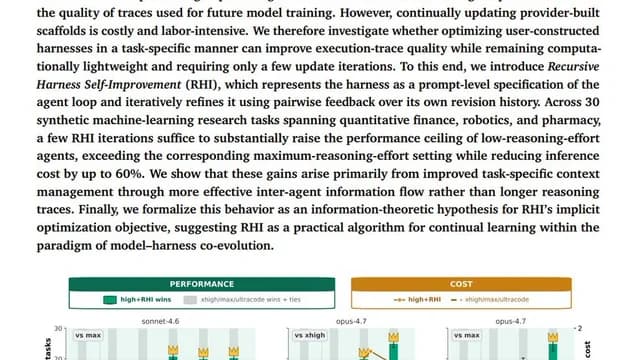
Sakana AI and UC Berkeley propose recursive harness iteration, where an agent's external harness self-improves over a few rounds, matching higher reasoning tiers while cutting costs by up to 60%.
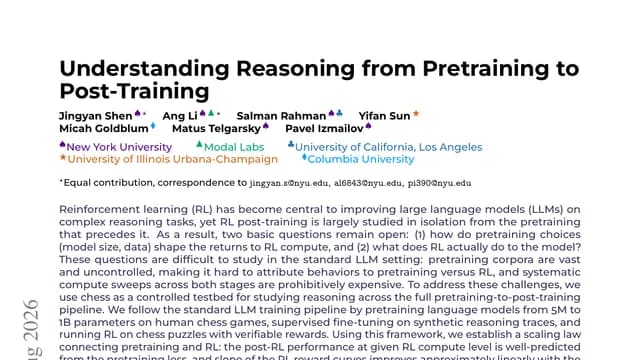
A team from NYU, Modal Labs, UCLA, UIUC and Columbia trained 10 chess models from 5M to 1B parameters to fit a joint pretraining-RL scaling law, with the compute-optimal RL share rising from about 19-20% at 50-80M parameters to 28% at 680M.
MIT researchers propose Supervised Memory Training, which uses predictive-state labels from a Transformer encoder to train nonlinear RNN updates in parallel without backpropagation through time.
Researchers introduce Continual Harness, a system that lets embodied agents iteratively refine their own prompts, tools and memory mid-task without resetting the environment, building on work that made AI the first to complete Pokémon Blue and Crystal.
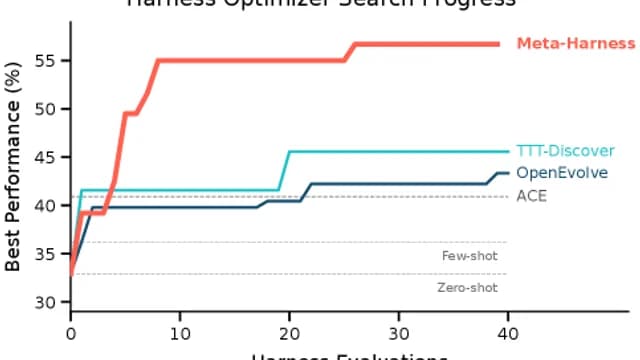
Researchers developed Meta-Harness, an automated system that optimizes LLM application code to improve accuracy while cutting token usage, achieving 7.7-point gains on text classification and 4.7-point improvements on math reasoning tasks.
Google Research finds that enabling reasoning in LLMs helps them recall simple facts through two mechanisms: extra tokens provide computational buffer time, and intermediate facts prime the correct answer—but hallucinated intermediate facts sharply…
Researchers show the Platonic Representation Hypothesis—the claim that scaled AI models converge on shared internal representations—is largely a statistical artifact of measurement bias, with the apparent convergence disappearing once properly calibrated.
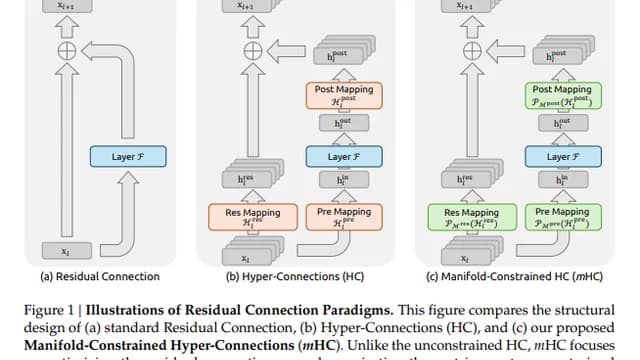
DeepSeek's mHC constrains residual connection mixing matrices to the Birkhoff polytope using Sinkhorn-Knopp normalization, enabling stable 4-8x wider residual streams and improved performance on reasoning benchmarks up to 27B parameters.
Researchers introduce Recursive Language Models, which let LLMs decompose and recursively call themselves to process inputs up to 100 times longer than their native context windows, outperforming GPT-5 by 26% on long-context tasks.
Sakana AI's Continuous Thought Machine uses neuron-level timing and synchronisation as its core reasoning mechanism, giving an interpretable step-by-step trace and letting the model stop computing once it recognises a pattern.
Cornell researchers' vec2vec translates text embeddings between models with no paired data or encoder access, hitting up to 0.92 cosine similarity and 100% top-1 accuracy, and recovering readable info from up to 80% of test emails via zero-shot inversion.
The weekly AI digest — models, agents, open source, research — plus a monthly round-up. Unsubscribe anytime.